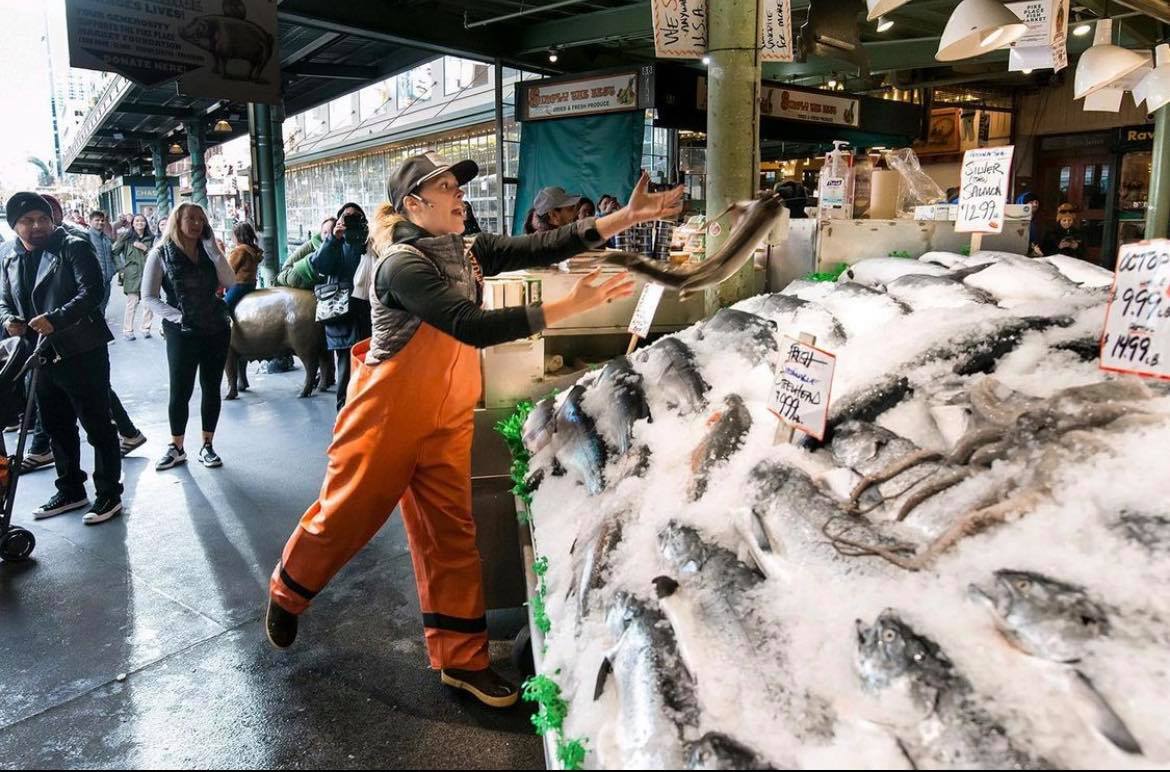
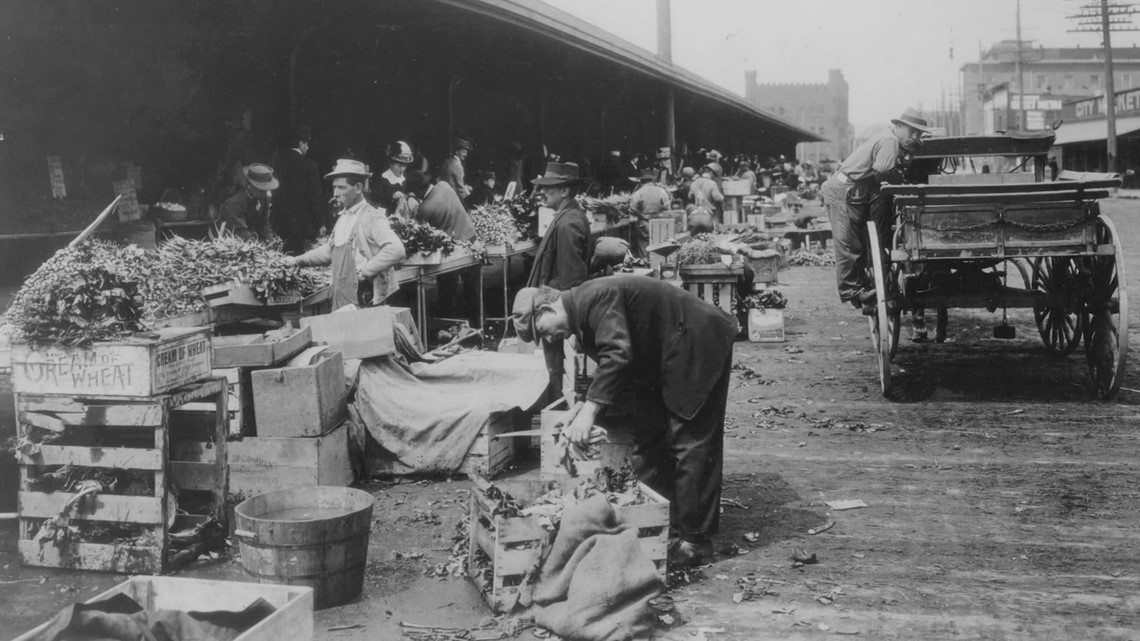
In one of Seattle’s most famous places — the Pike Place fish market — fish can fly. They’re tossed through the air, caught with bare hands, and tourists from around the world laugh all around. But that strange game wasn’t invented by magicians or marketers; it was created by ordinary immigrants and their children who were simply tired of freezing and staying silent behind the counter. This is the story of how hard work became a celebration — and what other cities can learn from that celebration.
The girl who was ashamed of her father’s job
Every morning Lena woke up before the sun. Not because she liked it — because her father would whisper:
“Lenka, get up, the market won’t start without us.”
They lived in a small apartment near the bay. Her father had come to Seattle many years ago with a different name and a strong accent. His native language tangled with English like nets in a boat. In old photographs he stood in a wool hat somewhere by a cold sea — maybe in Norway, maybe in Russia; Lena herself was already confused.
They came to Pike Place Market when the city’s windows were still dozing. The seagulls weren’t sleeping. They circled over the unfolding stalls and screamed as if competing to see who would wake Seattle first.
Fish lay in rows, gleaming silver and ice. It smelled of salt, seaweed and something else… raw. Lena wrinkled her nose and pulled on gloves that were too big for her hands.
“Dad, why are we wet all the time?” she asked for the hundredth time.
“Because our fish are fresh,” her father laughed. “They’re as close as the sea.”
He pronounced “sea” like “sée,” softly and oddly. Some customers asked him to repeat. Lena blushed: she felt as if everyone heard her dad’s accent louder than the cry of the gulls.
Work at the fish market was hard. Men and women carried crates like weightlifters, their hands shaking by evening. The cold ice bit their fingers, even through rubber. Sometimes her father came home so tired he fell asleep right in his chair.
Lena felt that her father did a “not-important job.” Not a doctor, not a teacher, not a programmer. Just a man who stood all day next to wet fish.
She didn’t yet know that soon his work would become famous around the world.
The first fish nobody was supposed to catch
That morning was especially damp and especially sad.
Rain pounded the awning like someone up above playing drums. People jostled, umbrellas poking into each other’s shoulders. Her father and his partners — Joe, Samir and Karl — darted from counter to ice and back.
They were all “someone’s from somewhere.” One had a mother from Japan, another a grandfather from Africa, a third’s family from Scandinavia. Their home languages sounded different, but at the market they spoke the same way: fast, loud and a little tired.
The market owner, Uncle John, walked around ticking things off in a notebook. Business had recently been poor: people were buying fish in supermarkets more often than at the old market.
“We can’t just be another boring stall,” he grumbled. “We need… something. Something that nobody will forget.”
But that morning nobody was in the mood for “something.” The line grew, feet ached, and a customer at the far end of the counter suddenly shouted:
“Two big fish! Those ones!”
Lena looked: the man who pointed was standing too far away. Her father would have to walk the long counter, squeeze through people, not drop the fish, not elbow anyone.
“How much more running…” Karl muttered in his accented English and then stopped. His eyes lit up like a child’s at recess. “Listen… what if I just throw it?”
The workers froze.
“You… what will you do?” Samir asked.
“I’ll throw it!” Karl grabbed a large silvery fish, measured the distance and shouted to the customer: “Hey buddy, catch this with your eyes!”
Everyone turned. Lena held her breath.
“Karl, don’t you dare…” her father began, but it was too late.
The fish took flight.
For a second it seemed alive again: it whistled through the air, flashed its side, traced an arc above the counter. People gasped: some in fear, some in delight. Someone covered their mouth with hands, someone lifted a phone.
Her father, by habit having caught thousands of slippery bodies that day, extended his arms. And — he caught it.
The fish softly slapped into his palm, ice spray scattering. For a second the market fell silent. Even the seagulls seemed to hush.
And then — an eruption of laughter.
The customer applauded.
“Again!” someone in the queue shouted.
“Throw one to me too!” added another.
Lena felt her cheeks flush hot. But it was not shame — it was something else. Hotter and joyful.
That day the fish were thrown many more times. First timidly, then bolder. By evening a whole crowd gathered at the counter just to watch fish fly.
“Well,” Uncle John said, scratching his head. “Looks like we found our ‘something.’”
So from a chance joke a tradition was born that would later make Pike Place Fish Market “world famous.”
When work becomes a game and an accent becomes a strength
A few weeks later the market seemed to have changed its skin.
Yes, it was still cold and wet. Yes, the crates were still heavy. But now between “take the order” and “give the fish” there was a little piece of playful magic.
“Two salmons!” Samir shouted.
“Two salmons—!” the whole crew replied in chorus, like football fans.
Karl tossed the fish, her father caught it. Sometimes Joe caught it, sometimes someone else. They made up chants, joked with kids, asked tourists to call out orders loudly so the “fish could hear.”
At first Lena was afraid to get close. But one day her father winked at her:
“Lenka, ready? Look me in the eyes. You’ll catch your first fish now.”
“Me?” she squeaked. “A real one?”
“Of course. Everything here is real.”
He put a small fish in her hands so she could feel the weight, the slipperiness, the cold. Then he stepped back a little and extended his palms.
“Throw. If I don’t catch it — I’ll do the whole display myself all day,” he joked.
Lena swallowed. The fish felt as heavy as a brick of shame in her hands: what if she failed, what if everyone laughed?
But her father looked at her as if he believed in her more than in ice and knives.
Lena inhaled — and threw.
The fish flew unevenly, tilting slightly to one side. Her father took a step and caught it like a ball.
The crowd around, which had first watched out of curiosity, applauded. Someone said:
“Look, a real local girl. The market’s daughter.”
In that moment Lena first thought: “Maybe it’s not shameful to be a fish seller’s daughter. Maybe it’s even… cool?”
The market workers were different: their words tangled, stress fell in the wrong places, sometimes they mixed up phrases in funny ways. But when the fish flew through the air their accents suddenly didn’t matter. People watched not how someone spoke, but how they caught, joked, and how they together made a hard day light.
This is what would later be called the “spirit of Pike Place Fish Market.” Films would be made and trainings held around the world teaching serious adults:
“Look: these fishmongers decided their work would be a celebration. And they pulled it off.”
But for Lena it was simpler. For her, her father’s work for the first time looked not like a sentence but like a game in which he was a champion.
What other cities can learn
A few years later Lena no longer felt ashamed to bring classmates to the market.
“See that guy who throws the biggest fish?” she said proudly. “That’s my dad.”
Friends hid behind her when fish flew nearly over their heads, equal parts terrified and delighted. Someone squealed, someone filmed on their phone. Some later wrote online: “There’s a place in Seattle where fish fly!”
Lena thought: “Funny. People come from all over the world to watch my dad just do his job… happily.”
One evening she asked him:
“Dad, why don’t they do this in other places? Why are supermarkets so serious?”
Her father thought, wiped his hands on his apron.
“You know, Lenka…” he said. “Every city has hard work. Someone mops floors, someone drives a bus, someone stands at a register. People get tired. Sometimes their labor feels invisible. But one day we decided: since it’s hard, let’s at least make it so that those around us feel better.”
He smiled his crooked smile.
“So our fish became our game. Our way of saying: ‘Hey, look at us. We’re here. We help build this city too.’”
Lena imagined: what if a bus driver joked with passengers the way her father joked with customers? What if the school cafeteria had a “flying day” (perhaps without pasta on the walls)? What if park cleaners left small chalk drawings on the pavement?
You don’t have to throw fish. The main thing is to invent your own little ritual that turns an ordinary place into something special.
And not wait for the mayor to proclaim it.
At Pike Place the idea came from the workers themselves — immigrants, people “with an accent,” those who are usually not asked to give speeches. And the idea proved so strong the whole world began to talk about it.
Here’s the lesson for other cities: sometimes the brightest traditions are born not in offices, but right above a wet counter, between tired hands and heavy fish.
The city that’s built by more than builders
Now, when tourists come to Seattle, many go first not to skyscrapers but to Pike Place. They film flying fish, laugh, try to catch an order with bare hands. Then they go home and tell people:
“There’s a market in Seattle where work feels like a celebration.”
Few think about how many immigrant stories are hidden behind those throws. How many people with different languages and destinies made this little corner of the city a place of joy.
Lena has grown up. Sometimes she helps at the market, sometimes she just drops by after classes. Every time a fish takes flight over the counter she remembers her first clumsy throw and the hot pounding of her heart.
And she understands: cities are made not only of roads, houses and bridges. They’re made of people who one day say:
“Yes, our work is hard. But we can make it so that it makes our eyes — and those of the people around us — shine.”
In Seattle that happened with flying fish.
And which “flying fish” will appear in your city — only you can invent it.