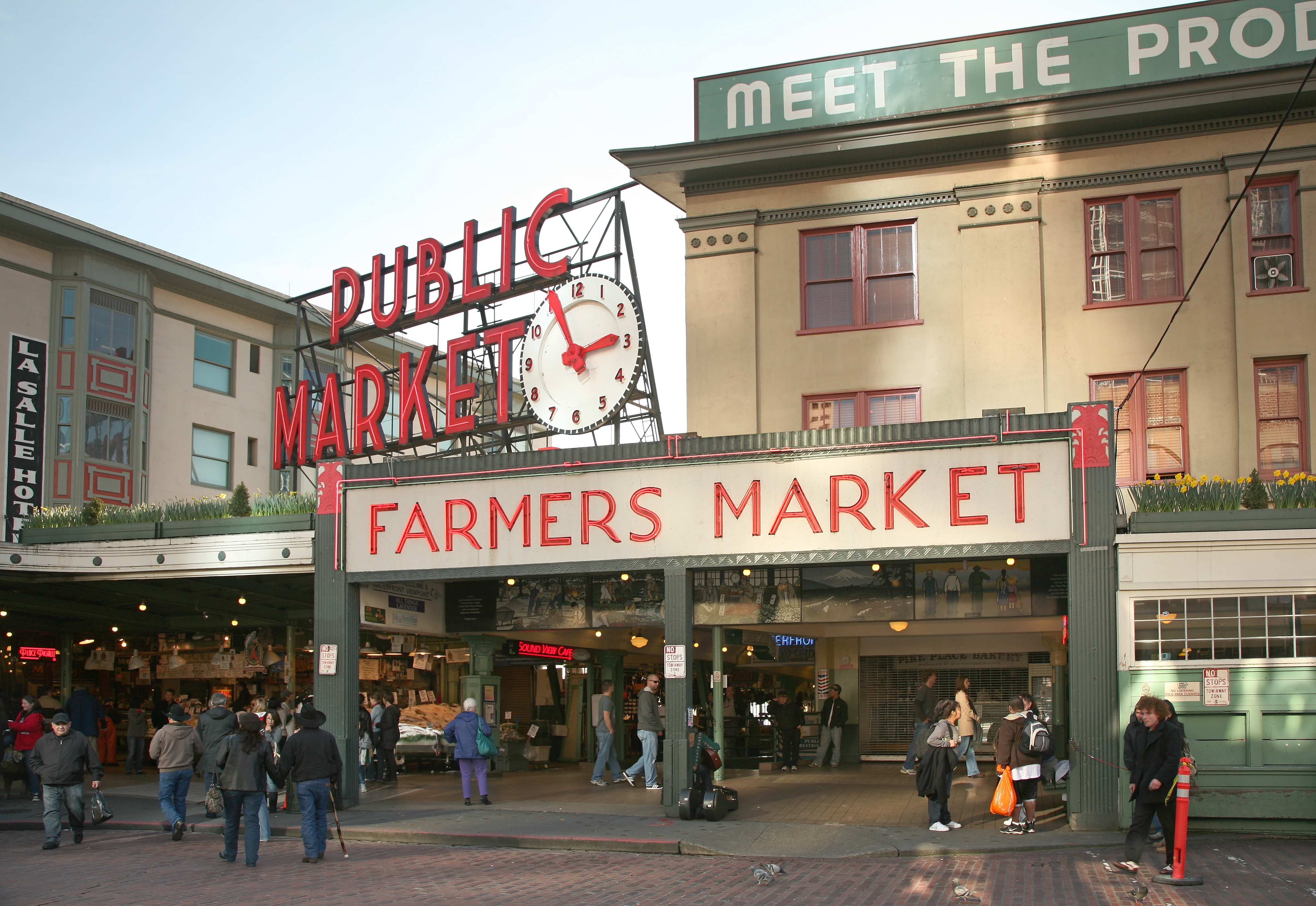
Imagine: a huge silvery fish sails through the air like a football, and a vendor catches it with bare hands and shouts, “One salmon for the lady!” Tourists clap, take photos, laugh. This is the famous Pike Place Fish Market in Seattle, where fish fly every day. But few know the real story: these flying fish are not just a funny show. They are a symbol of a great victory when ordinary people—fishmongers, farmers, grandmothers and grandfathers—stood up to powerful interests and saved their beloved market from destruction. And that story changed how cities are built across America.
When the city decided to erase the market
In the 1960s, big officials in Seattle decided the old Pike Place Market was ugly and outdated. They wanted to replace it with huge glass-and-steel skyscrapers, wide highways and massive parking lots. “Progress!” they said. The market was already more than 50 years old, and planners thought it was time to get rid of it like an old toy.
But for thousands of people the market was not just a place to buy vegetables and fish. It was their home, their work, their life. Italian grandmothers sold tomatoes they had grown with their own hands. Japanese farmers brought the freshest strawberries at dawn. Fishermen laid out their catch straight from the boats. And shoppers came not only for food—they came to chat with neighbors, hear the news, and feel like part of a big family.
An architect named Victor Steinbrueck walked the market and talked with vendors. He listened to their stories and realized: if this market disappeared, the city would lose its soul. Victor was neither rich nor famous, but he could draw beautiful pictures. He drew what the city would look like if the market were torn down: gray concrete boxes, empty streets where no one smiles. And then he drew what the market could become if preserved and repaired: bright stalls, laughing people, the living heart of the city.
The great fight: when neighbors became an army
Victor and the market vendors started a real war—but not with weapons, with petitions, posters and meetings. They knocked on doors across Seattle and told people: “They want to destroy our market! Help us!” Old women who had bought flowers here for 40 years, students who loved wandering between stalls, artists who painted the market—all united.
In 1971 Seattle residents voted: save the market or allow it to be torn down? It was like a fairy tale: little people versus big bosses with their money and plans. Developers said, “We’ll build something new and shiny!” And the market defenders replied, “New doesn’t mean better. Our market is alive, and we love it!”
And you know what? The little people won! More than 70% of the city’s voters chose to save the market. It was an incredible victory. For the first time in American history ordinary citizens were able to stop a large urban redevelopment project. They proved that people have a right to decide what their city should be.
How the fish learned to fly and why it matters
After the victory the market didn’t just survive—it blossomed. In the 1980s, the fish stalls were staffed by young guys who were bored with simply laying out fish. Their work was hard: getting up early, hauling heavy boxes, standing in the cold. So they invented a game: one vendor would call out an order and another would throw the fish across the counter!
At first it was just for fun, to make the day go faster. But then magic happened: customers began to stop and watch. They laughed, clapped, came back again. The flying fish turned ordinary work into a performance, and the vendors into entertainers. It became famous around the world.
But most importantly—these flying fish remind us of the main thing: work can be joyful, people can be creative even in the simplest tasks, and traditions are born where people aren’t afraid to be themselves. The Pike Place fishmongers showed that you don’t have to be serious and dull to do your job well. You can shout, laugh, toss fish—and still respect your work and your customers.
A lesson for the world: when the small beat the big
The story of Pike Place Market changed how people think about cities. It used to be believed that to make a city modern you had to tear down the old and build new. But the market’s defenders proved otherwise: old places make a city special, alive, human.
After Seattle’s victory, other cities across America began to preserve their historic markets, old neighborhoods, and small shops. A new idea in urban planning emerged: “Listen to the people who live here! They know their neighborhood best.” Architects and officials realized you cannot simply erase the past for the future. You must find a balance.
Today Pike Place Market is visited by 10 million people every year. But it hasn’t become a museum or a tourist trap. Real farmers, fishermen and artisans still work here. You can still buy the freshest produce, talk to a vendor who remembers your name, and feel part of a big urban family.
And the flying fish? They fly every day, reminding everyone: when people unite and fight for what they love, they can beat even the biggest bosses. Those fish are not just fish. They are a symbol that ordinary people can change their city, their lives, their world. You just need the courage to raise your voice and say, “This matters to us. And we will not let it be destroyed.”
So next time you see a photo of a flying fish from Seattle, remember: behind that joyful spectacle is a story of courage, friendship and faith that small people can have great power.