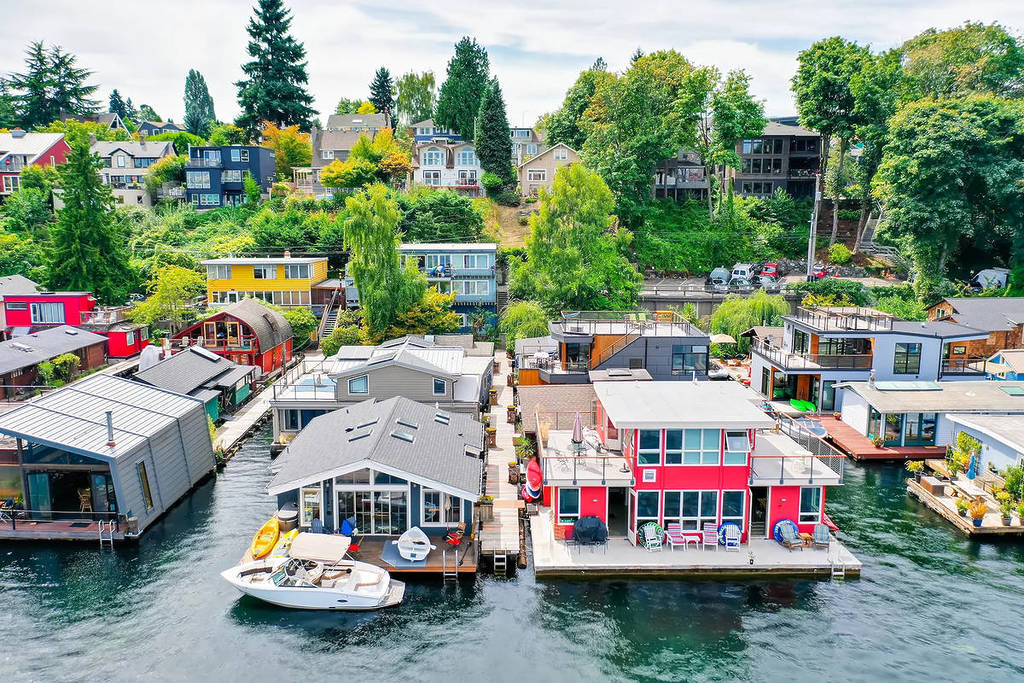
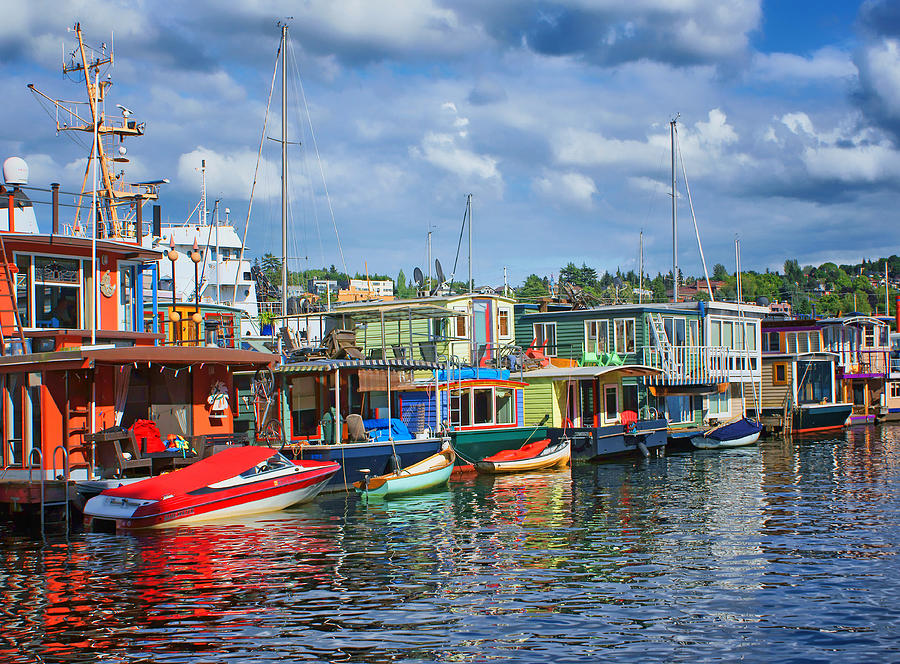
Imagine a street where, instead of asphalt, there is water, and instead of houses, there are colorful houseboats rocking on the waves. That’s what the South Lake Union neighborhood in Seattle looked like before one of the world’s biggest companies arrived. This is the story of how tiny floating houses managed to stay put even as glass towers as tall as clouds sprang up around them.
A Lake of Artists and Dreamers
In the early 2000s, special people lived on Lake Union in Seattle. They were artists, musicians, writers, and dreamers who couldn’t afford conventional housing in the city. They built small houses right on the water — floating homes that sat on pontoons (flat platforms that keep them afloat).
Each house was unique. One was painted bright blue and decorated with seashells. Another was made from old windows found in a landfill and sparkled in the sun with all the colors of the rainbow. A third was surrounded by flower pots that hung right over the water. Residents woke to the cries of seagulls, drank morning tea while watching ducks drift by, and in the evenings gathered on rafts to play guitars.
Life on the water wasn’t easy. In winter the houses rocked so much that dishes chimed in the cabinets. Water and electricity had to be run from shore through special pipes and wires. But people loved this life. They said the water taught them not to cling to unnecessary things and to value simplicity. In their small community everyone knew each other, helped repair leaking roofs, and celebrated holidays together.
When the Giant Arrived
In 2007 Amazon — which began as an online bookstore and then started selling everything under the sun — decided to build its new headquarters in the South Lake Union area. Founder Jeff Bezos chose the location because it was close to downtown, next to a lake, and seemed ideal for a modern tech hub.
Amazon began buying old warehouses, small shops, and vacant lots around the lake. Over a few years the company purchased more than 40 buildings. Construction of huge glass offices began, intended to house thousands of programmers, engineers, and managers. The neighborhood changed at an incredible speed. Where old wooden houses once stood, towers of 30–40 stories rose.
Floating-home residents grew worried. They saw everything around them becoming more expensive. Small cafés where they had breakfast closed because they couldn’t afford the new high rents. In their place upscale restaurants opened. Many of their friends who lived in ordinary houses on shore were forced to move — they could no longer afford to live in a neighborhood that was getting richer by the day.
Houses That Couldn’t Be Moved
But something surprising happened with the floating homes. It turned out the city of Seattle’s laws protected them! Back in the 1960s, when the city wanted to get rid of all the floating homes (they were then considered ugly and impoverished), residents fought for their right to live on the water. They proved that floating homes are part of Seattle’s history and a unique feature of the city.
As a result, the city adopted special rules: floating homes could be preserved, repaired, and sold, but new ones could not be built without special permission. That meant these homes became fewer and rarer, and therefore more valuable.
When Amazon began transforming the neighborhood, something nobody expected happened. Floating homes, once regarded as housing for poor artists, suddenly became worth huge sums! If in 2005 a small floating home could be bought for $150,000–$200,000, by 2015 similar houses were selling for $700,000–$900,000, and some even exceeded a million dollars.
Why did this happen? Because thousands of well-paid people began working in the area and dreamed of living in something unusual. They saw those colorful houses floating amid glass towers and thought, “This is real life! This is beauty!” Floating homes became a symbol that even in a modern city you can live differently.
When Towers Met Tiny Houses
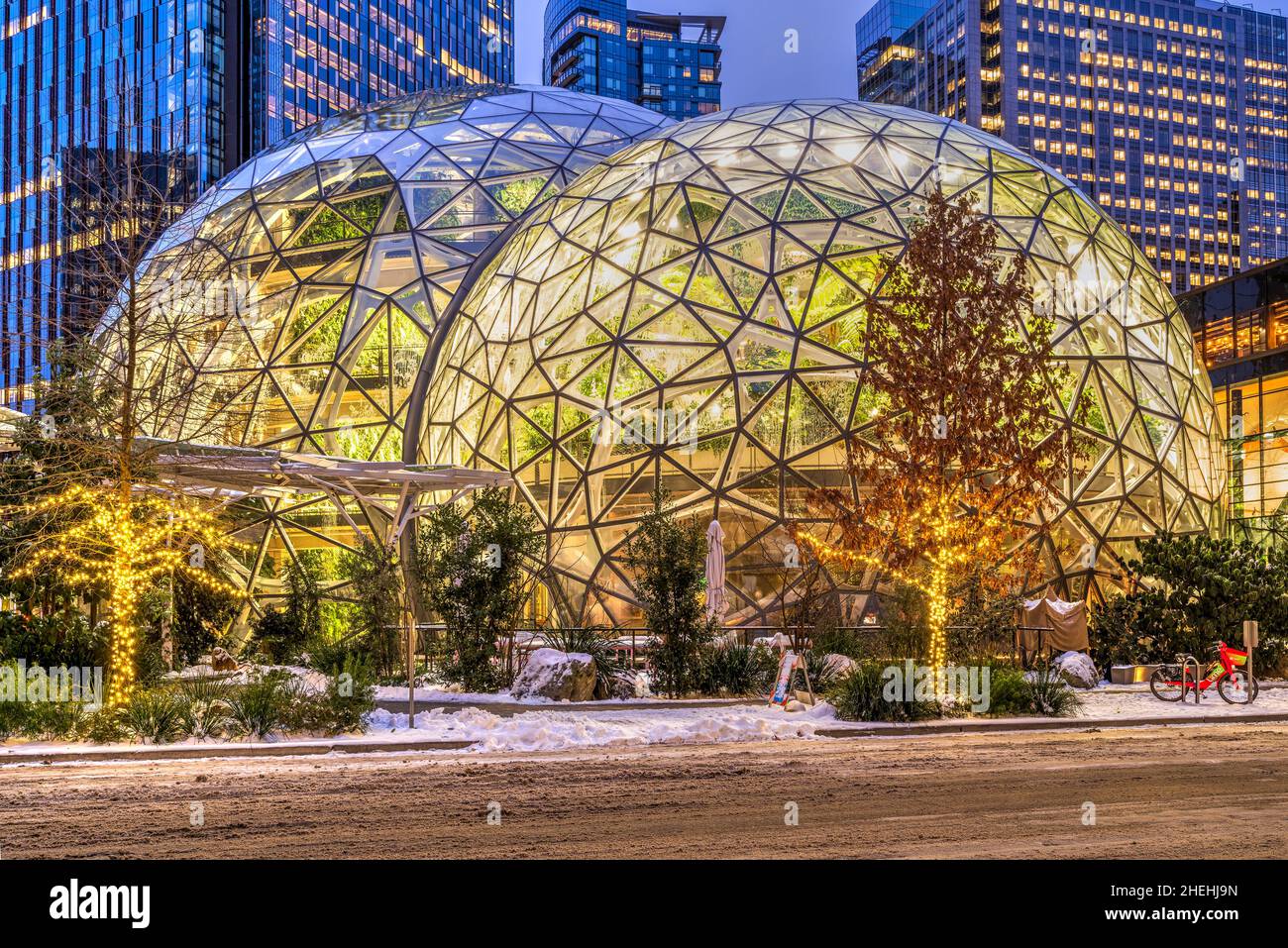
Today South Lake Union looks like a scene from a sci‑fi movie. On one side of the lake tower huge glass Amazon buildings with names like “Day One” and the famous “Spheres” — three giant glass orbs containing a real tropical forest with 40,000 plants. Amazon employees work there at computers while sitting among palms and vines.
And on the water, just meters from those futuristic buildings, colorful floating houses still rock. In the morning, as programmers hurry to their offices across modern glass footbridges, floating-home residents step out onto small decks with a cup of coffee and feed the ducks. In the evening, when artificial light pours from the tall towers, the windows of floating homes glow with cozy lamps, and you can see someone reading in a rocking chair or painting a picture.
Many of the artists and musicians who used to live there have indeed left — their houses became too expensive and they sold them. But some stayed. They say their mission is to remind programmers and managers that life isn’t only work and money; it’s also beauty, creativity, and a connection to nature.
Interestingly, Amazon itself has learned to respect these houses. The company even created viewing platforms where tourists and workers can admire the floating homes. They’ve become part of what makes the neighborhood special — its “charm.”
The Lesson Taught by Small Houses
The story of South Lake Union’s floating homes teaches an important lesson: big and small can coexist if we’re willing to value diversity. Amazon could have tried to remove these houses and make the whole neighborhood uniform and modern. Instead, the giant company learned to share the lake with tiny homes.
These floating houses proved that sometimes the most valuable things aren’t the biggest or newest. Sometimes they are old, slightly crooked houses that remember what life used to be and remind us that progress doesn’t mean erasing everything and starting from scratch.
Today, when someone comes to Seattle and sees these floating houses among glass towers, they understand: this city knows how to preserve its soul even as it becomes a center of modern technology. And perhaps that’s why people keep wanting to return — here the future doesn’t drive out the past; it learns to live beside it, like neighbors on the same lake.