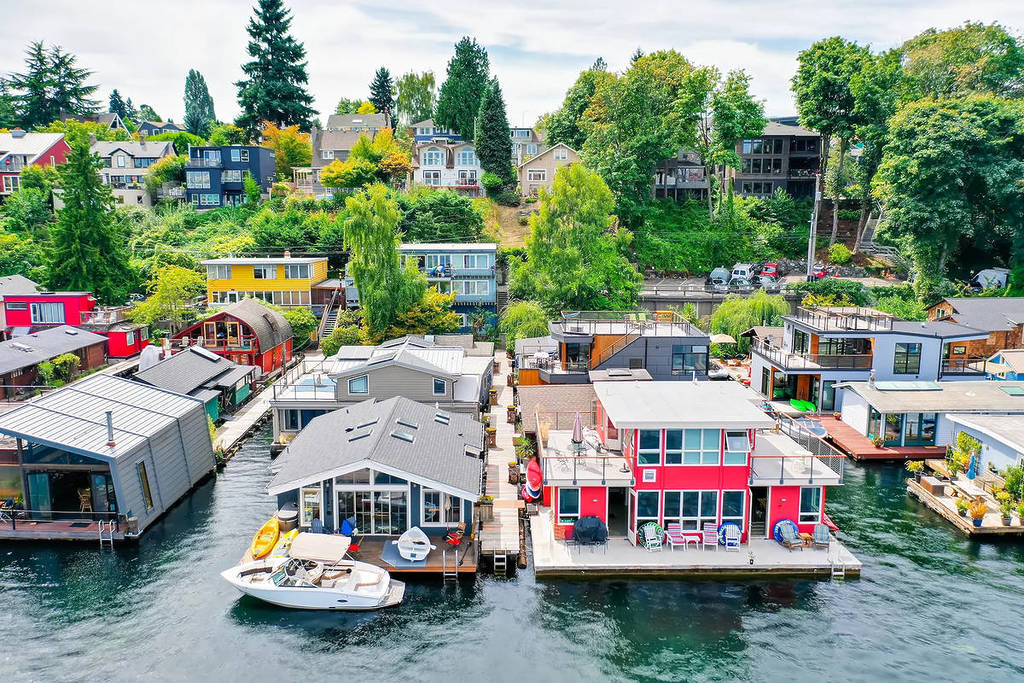
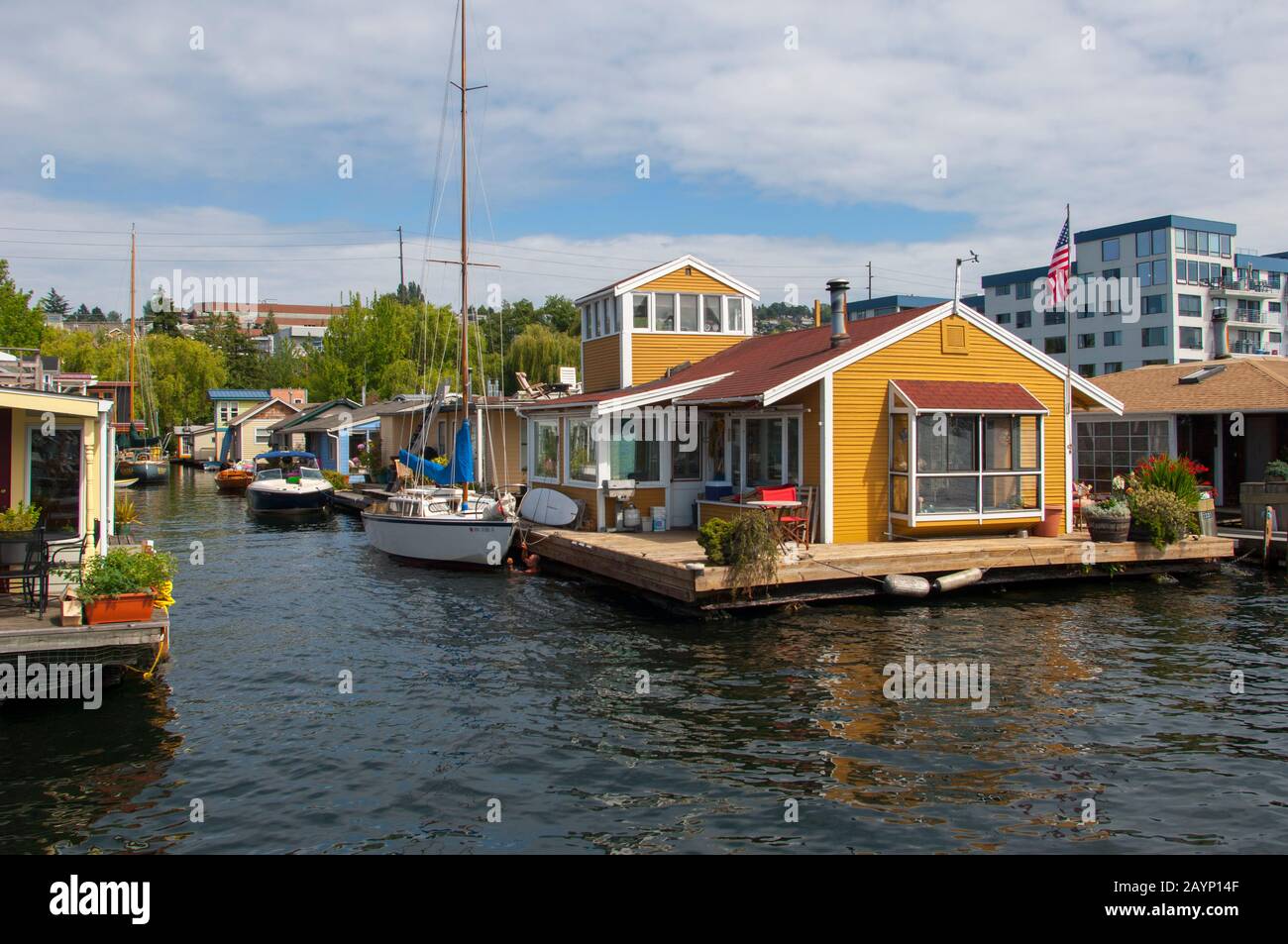
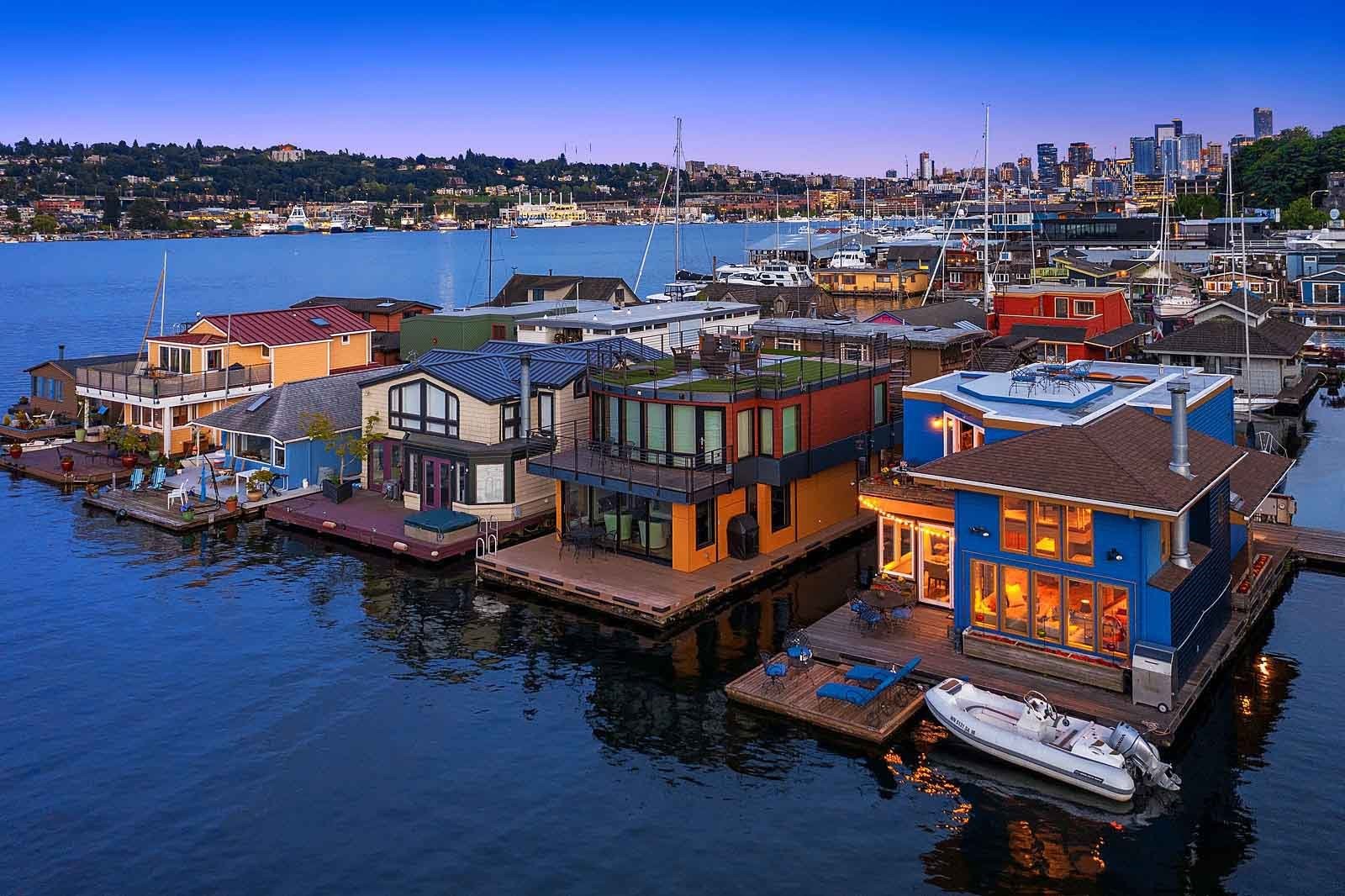
Imagine a street where, instead of asphalt, there is water, and houses rock on the waves like cradles. In Seattle there are such unusual neighborhoods where people have lived in houseboats for more than a hundred years. But once these remarkable floating homes nearly vanished forever — and they were saved by ordinary families with children who simply didn't want to lose their special world.
When Houses Learned to Float
In the early 1900s, people in Seattle wanted to own a home but didn't have enough money for a conventional house. They came up with a brilliant idea: what if they built a house right on the water? Lake Union in the center of the city became their new address. At first these were simple rafts with small shacks — nothing pretty. Fishermen, artists, writers and just poor families built these homes out of what they could find: old boards, tin sheets, even doors from dismantled buildings.
Over time these simple shacks turned into true works of art. People added windows with views of the water, built decks where you could sit right over the lake, planted flowers in pots. Each house was unique, unlike its neighbor. Architects call this "organic architecture" — when buildings grow naturally, like trees, adapting to people's lives and the surrounding nature.
When the City Decided That Different Was Bad
But in the 1960s something strange happened. Seattle began to grow rapidly, tall glass-and-concrete buildings were being erected, and everything was supposed to look modern and uniform. City officials looked at the floating homes and said, "This is ugly and wrong. These old boats spoil the view of the lake. They must go!"
Officials created strict rules: you could not repair the old houseboats, and you could not build new ones. They thought that in a few years all these "odd" houses would simply fall apart, and in their place they could build ordinary high-rises or parks for wealthy people.
For the families living on the water this was a disaster. Many had lived there for decades. Children grew up diving from the doorstep straight into the lake, doing homework to the sway of the waves, falling asleep to the sounds of water. Writers created books there, artists painted pictures. It wasn't just real estate — it was an entire special world.
How Children and Parents Became Defenders
Then something surprising happened. The houseboat families began to fight for their right to live the way they wanted. They formed an organization called the "Houseboat Association." Both adults and children attended the meetings. Schoolchildren drew posters, wrote letters to newspapers, and told classmates why their homes mattered.
One girl named Terry wrote to the local paper: "My house rocks when boats pass, and that's the best feeling in the world. Why do adults want all houses to be the same? Isn't that boring?" Her letter was read by thousands, and many people began to wonder: she was right, why indeed?
Houseboat residents invited journalists, showing how their lives were organized. It turned out these homes were very eco-friendly — they didn't take up land and didn't require cutting down trees. The water under the houses stayed clean because residents learned to care for it carefully. And the architecture itself was unique; nothing like it existed elsewhere in the world.
What Architects Learned from Ordinary People
Gradually architects and researchers began to study Seattle's floating homes and discovered many interesting things. It turned out untrained people had invented very clever solutions. For example, they devised ways to keep a house stable on the water even during storms, using special floats and flexible attachments. They learned to build so the house could "breathe" — moisture from the water wouldn't ruin the walls.
Architects realized that floating homes address a very modern problem: how to live in a city where land is expensive but still own a home rather than a tiny apartment in a high-rise. These simple families on their boats showed there is another way.
In the 1970s, after ten years of struggle, the city finally changed its rules. Floating homes were recognized as an important part of Seattle's culture. They were allowed to be preserved and even to build new ones — now with safety regulations in place.
How an Old Idea Became New Again
Today, almost fifty years later, the story of Seattle's floating homes sounds very contemporary. Around the world people are again looking for unusual ways to live: tiny houses on wheels, container homes, eco-friendly constructions. Why? Because conventional housing has become too expensive for many families, and cities are growing so fast there is not enough space.
Amsterdam, Copenhagen and other cities have begun building new floating neighborhoods, recalling Seattle's experience. Architects say: "Look how ordinary people a hundred years ago solved a problem that seems so difficult to us now!"
And in Seattle itself the floating homes have become so popular they now command high prices — sometimes more expensive than regular houses. That's a little sad, because originally they were a solution for people with limited means. But these wonderful rocking homes are now protected by law, and no one can tear them down.
The Lesson from Houses That Can Float
The story of Seattle's floating homes teaches an important lesson: sometimes the best solutions don't come from experts with degrees but from ordinary people simply trying to solve their own problem. It also teaches that "different" is not bad. When all houses are the same and all streets look alike, a city becomes boring.
The children who defended their floating homes in the 1960s showed adults: you cannot destroy something just because it is not like everything else. Sometimes the thing that is "not like the others" turns out to be the most valuable.
Today, when you walk along the shore of Lake Union in Seattle, you see those colorful homes swaying on the water. In some of them live the great-grandchildren of the people who built the first rafts. Children still jump from doorsteps into the water on hot summer days. And these homes remind us: a home is not necessarily four walls on solid ground. A home is a place where a family feels happy — even if that place can float.