Seattle has bridges that don’t rest on supports but float on the water like enormous rafts. And then there’s a road that was never built—because city residents stood up to protect their park. Here’s how it happened.
A Bridge That Isn’t Afraid of Deep Water
Lake Washington is very deep. In some places, the lakebed lies dozens of meters below the surface, covered in soft mud. Driving supports into a lakebed like that would be almost impossible: they would just sink deeper, like a spoon in thick jelly.
An engineer named Homer Hadley came up with an unusual solution. He proposed building a bridge from huge, hollow concrete boxes called pontoons. The boxes are filled with air, so they float, much like an empty plastic bottle in a bathtub. Line up enough of them in a long row and lay a road on top, and you have a floating bridge!
At first, many people laughed at the idea: concrete is heavy, and everyone knows it sinks. But the air inside the pontoons makes them buoyant, like a boat. In 1940, the first bridge of this kind—the Lacey V. Murrow Bridge—opened. It was the largest floating bridge in the world. Later, in 1963, another bridge, Evergreen Point, opened nearby. It was even longer—more than two kilometers. Cars drove across it, with the water gently rocking beneath their wheels.
The Bridge That Sank
Want to hear the strangest part? One of the floating bridges sank! It happened on November 25, 1990. The bridge was being repaired, and workers cut away part of the concrete. This allowed water to seep into the pontoons. A fierce storm hit, and too much water poured into the hollow “boxes.” They became too heavy, and the bridge slowly sank to the bottom of the lake.
Luckily, no one was driving across the bridge at the time, and no one was hurt. But imagine waking up one morning to find that a bridge used by half the city was lying at the bottom of the lake! Later, the bridge was raised and rebuilt, with a different design.
The Road That Was Never Built
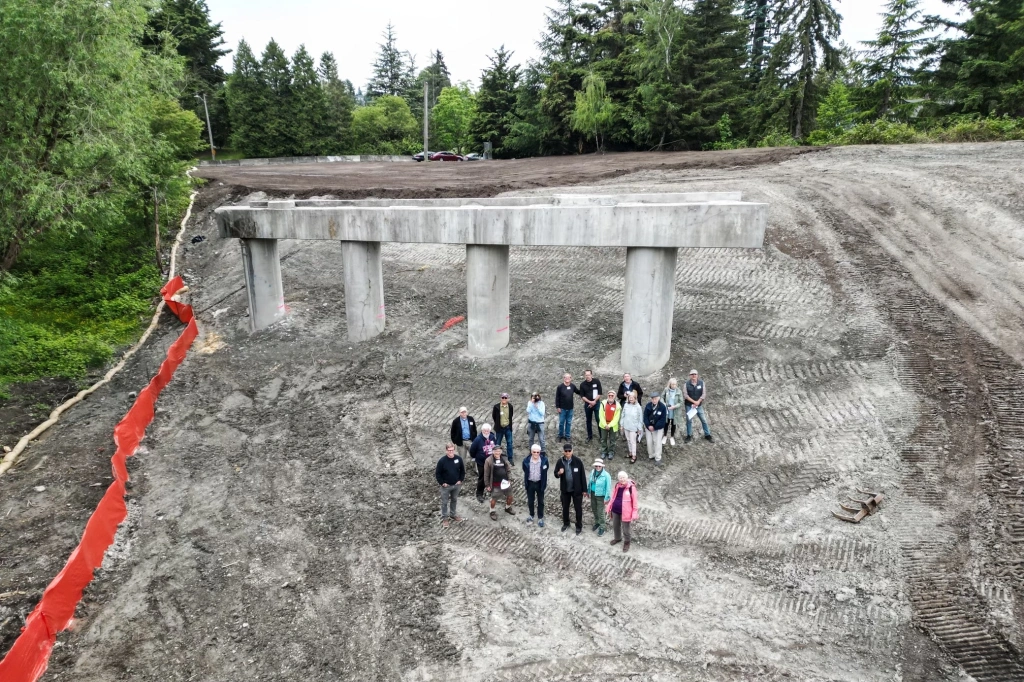
Now for the most important part. When Seattle was building its bridges, city officials also drew up plans for a huge network of wide roads—expressways. One of them, the R.H. Thomson Expressway, was supposed to cut right through the Arboretum, a large park with rare trees where families go for walks and children run along the trails in summer. The road would also have cut through residential neighborhoods where people had lived for years. Homes would have had to be demolished.
Residents were furious. They gathered, wrote letters, attended meetings, and told their neighbors that a city is about more than cars—it’s also about people, trees, and peace and quiet. At first, adults thought no one would listen: the plans had already been drawn up, and the money had been allocated. But the residents didn’t give up. In 1972, the city voted, and the project was stopped.
But some of it had already been built before work was halted. You can still see strange concrete ramps in the Arboretum that rise into the air and then end abruptly—they lead nowhere. These concrete structures are known as the “Ramps to Nowhere.” To me, they look like a monument: a reminder of what might have happened if people had stayed silent. Today, birds sometimes perch on them, and flowers grow all around.
What We Can Learn From This
The story of the floating bridges and the road that was never built teaches us several things.
First, even an idea that sounds silly at first—like concrete that floats—can turn out to be the right one. You just have to be willing to think differently.
Second, even the smartest adults sometimes make mistakes: the bridge sank because of a small mistake during repairs. The important thing is to admit the mistake and fix it.
Third, and most importantly, ordinary people can change decisions made by those in power. The people of Seattle weren’t mayors or engineers. They simply loved their park and their homes—and spoke up.
The next time you’re walking in a park and see an old tree or a trail, remember Seattle. The park near your home might need people to stand up for it someday, too. And anyone can be one of those people—even someone who’s only ten years old.