Imagine a road carrying cars with deep lake water instead of solid ground beneath it. Seattle has had roads like this for more than eighty years: floating bridges. It is not a trick or magic, but a clever engineering idea. Yet behind it lies another story too—about how city residents argued, wrote letters, attended meetings, and fought to ensure that roads served people, rather than the other way around. Let’s look at how a bridge floats and whose voices were long overlooked in these debates.
How a Bridge Floats
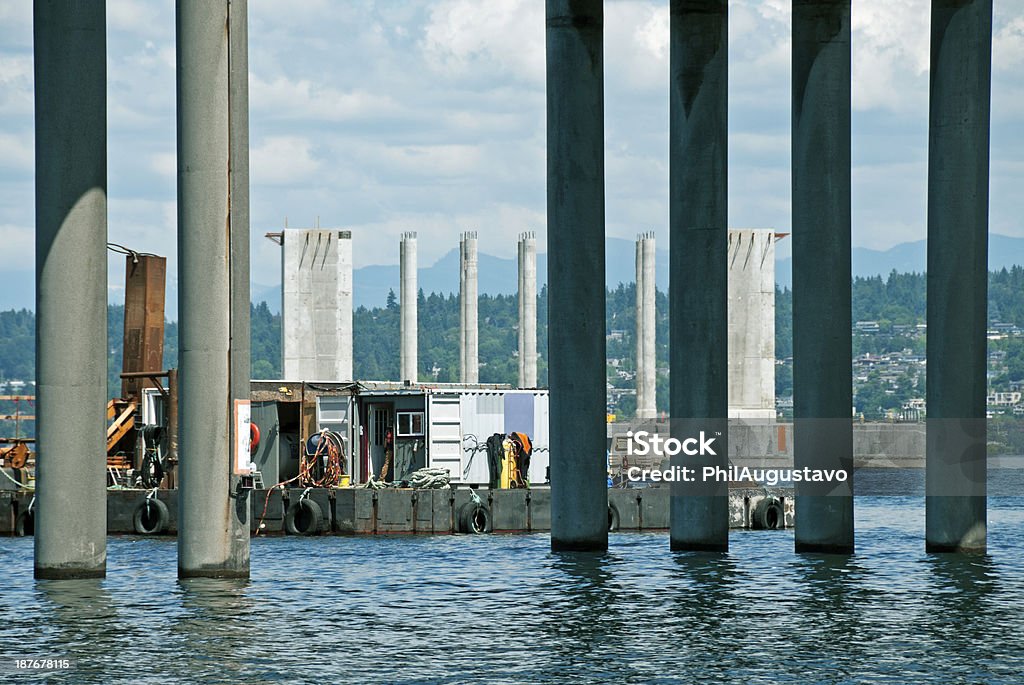
Take an empty pot with a lid and place it in a basin of water. It will not sink because there is air inside. The famous bridge across Lake Washington—the Lacey V. Murrow Memorial Bridge, opened on July 2, 1940—was built on the same principle. It does not stand on columns, but on enormous hollow concrete pontoons—like giant concrete boats joined into one long chain. At the time, it was the longest floating bridge in the world.
Why not build a conventional bridge on supports? Because the lakebed turned out to be very deep and covered with soft silt. The columns simply would not have found solid ground. Engineers decided not to fight the water, but to work with it: if the road itself floats, depth is no obstacle. Heavy anchor cables keep the pontoons in place, preventing the bridge from drifting away while allowing it to sway slightly with the waves and changes in water level.
This story is often told as a victory of clever people over challenging nature. But it seems to me that the main lesson is different: sometimes the best solution is not to “conquer” nature, but to adapt to it.
The Roads People Fought Over
As the bridges appeared, the number of cars in the city continued to grow, and officials wanted to build more and more roads. In the 1950s and 1960s, they planned huge freeways that would cut through entire neighborhoods. Building such roads meant demolishing homes, parks, and whole communities where people lived.
Seattle residents did not want to accept this silently. They collected signatures, held meetings, wrote letters, and took part in votes. Historians call this movement the “freeway revolt”—similar disputes were taking place in many American cities at the time. In Seattle, such protests helped stop several major projects, including plans for broad highways that were supposed to run through residential neighborhoods. Exactly what was stopped and when is best checked against city archives and books on Seattle’s history, since each project had its own long and complicated fate. But the general fact remains: the voices of ordinary people sometimes really did change the city’s map.
Whose Voices Went Unheard for Too Long
Here is the most interesting—and saddest—part. When textbooks discuss bridges and roads, they usually name engineers and officials. But people lived around the lake long before them. The Indigenous peoples of the area, including the Duwamish, had used the lake and rivers for centuries for daily life, fishing, and travel. When the city began changing the shorelines and waterways, their views were far from always taken into account. The same can be said of many workers, residents of smaller neighborhoods, and low-income families: their homes were more likely to lie in the path of planned roads, and their voices carried less weight.
That is why many historians and Seattle residents today try to tell these stories more fully. It means listening not only to those who built things, but also to those who lived nearby, and asking how each decision affected everyone. It seems to me that this is an important lesson for any city.
The Bridge That Sank—and the Lesson of Care
Floating bridges have their own vulnerability. The concrete “boats” must remain watertight. Seattle’s history includes cases in which sections of floating bridges were damaged by storms and repair work. In 1990, for example, an accident occurred during work on the Lacey V. Murrow Bridge, and part of the structure ended up underwater. After that, engineers became even more attentive to safety. So when you see work being done on a bridge today, remember: people are taking care to keep the concrete boat afloat.
Conclusion: A Road Is an Agreement
A floating bridge reminds us that cities can be built in different ways. We can impose our solution on nature and people, or we can look for an approach that works for everyone. The story of Seattle’s floating bridges is about smart engineering, but it is also about residents who taught the city to listen. And it is about the fact that every story includes people whose voices are heard less clearly—and they, too, need to be given a say.
The next time you drive across a bridge or see a picture of a road over water, ask yourself: Who came up with this road, whom did it help, and whose voices may have been left out of the story? Questions like these are what make us attentive members of our city.