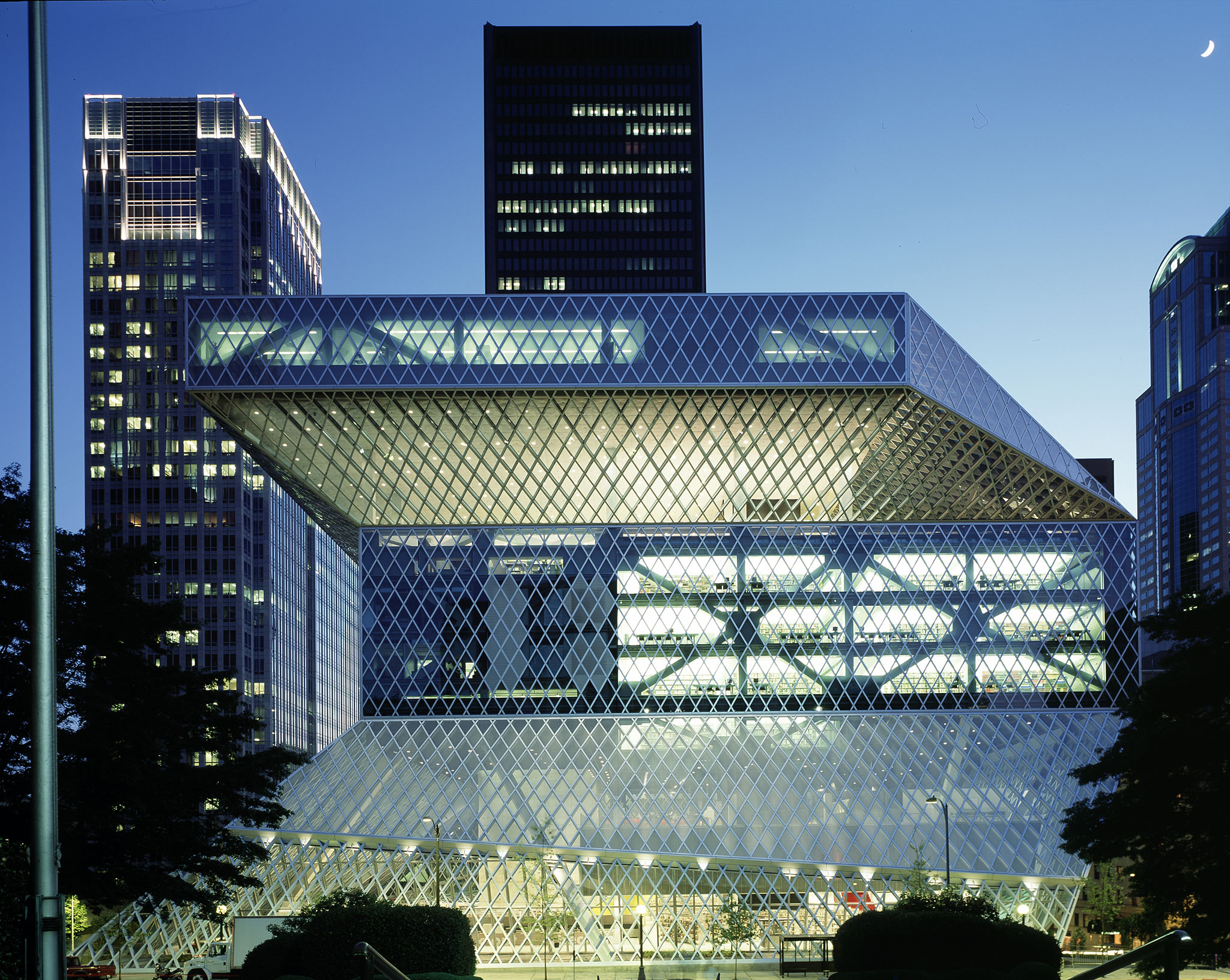
Picture this: you’re walking down a typical city street—around you there are shops, cafés, trees—and then you see this. A huge building covered in thousands of glass diamonds, as if a giant crystal fell from the sky and got stuck between the houses. Or as if someone stacked a skyscraper out of Lego pieces—but according to rules nobody had ever invented before. That’s exactly what the Seattle Central Library looks like, opened in 2004. And from that moment on, one very important thing in the world began to change.
The building everyone first hated
When architect Rem Koolhaas—Dutch, with very bold ideas—showed Seattle residents his design, many people rolled their eyes. “Is this a joke?” people asked. “A library is supposed to be beautiful, classic, with columns! And this is just a heap of glass and metal!”
Newspapers published critical articles. Residents argued at meetings. Some said the building looked like crumpled foil. Others said it resembled an alien spacecraft. But city officials still decided to build it. The project cost nearly $166 million and took several years to complete.
When the library finally opened, the line of people wanting to get inside stretched for an entire block. People who had been complaining about the building just the day before suddenly found themselves inside—and went quiet. Because what was there was something completely unbelievable.
A staircase you can walk through—all the world’s knowledge
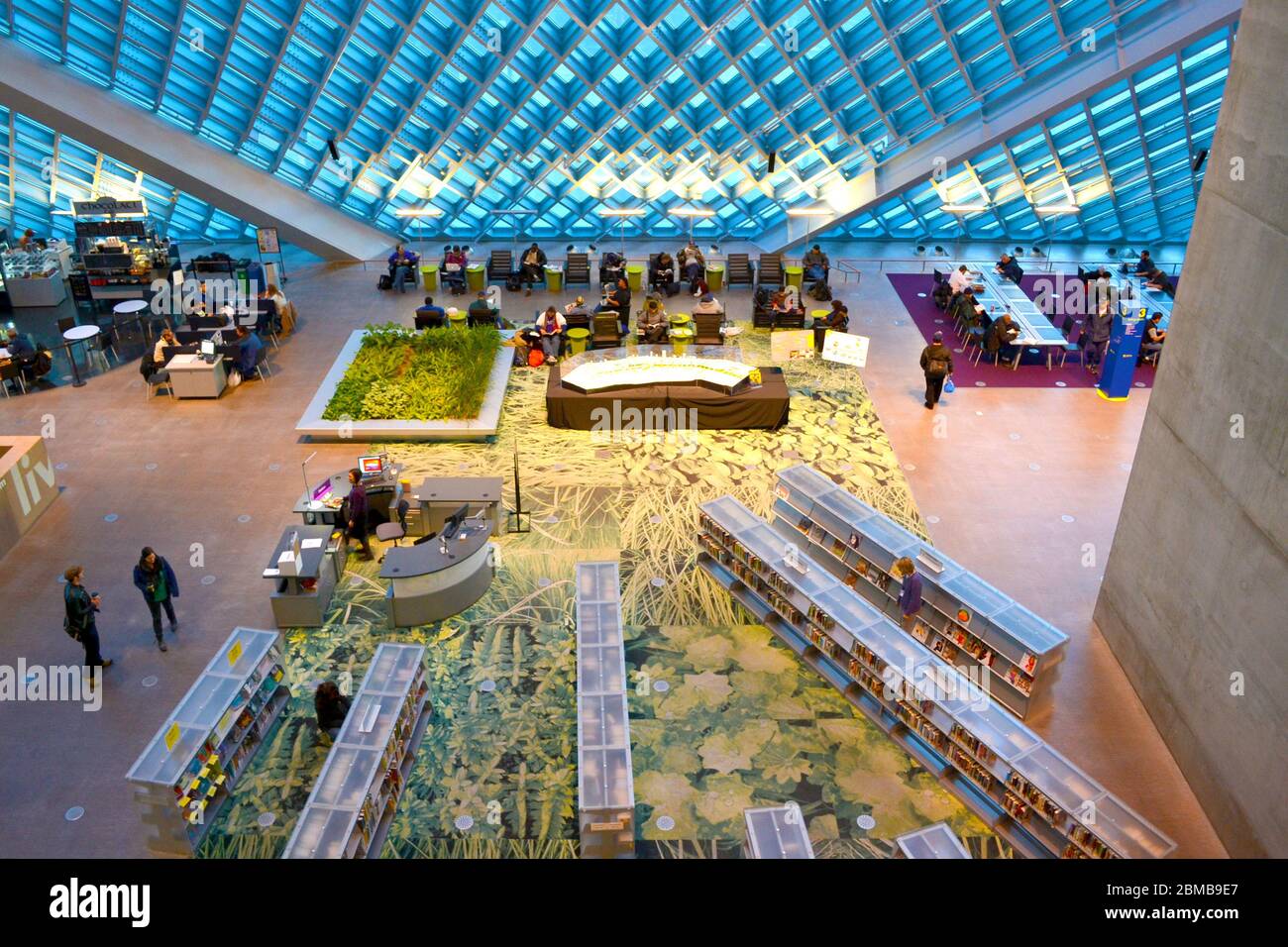
The most astonishing place in the library is called the “Book Spiral.” This isn’t just shelves of books—it’s a whole route that smoothly rises through four floors, like a gently sloping track going up in the opposite direction. And along that entire spiral, with no single step, the books are arranged in strict order—from the first topic to the last.
The system is called the “Dewey Decimal Classification”—a way of sorting all the world’s books by topic using numbers. Philosophy is in the 100s, history is in the 900s. In most libraries, these sections are scattered across different floors and halls, and to find a particular book you often end up wandering around for a long time.
But in Seattle, you can simply keep going. You start with books about math, pass by books about nature, then about art, then about languages, then about history—and eventually you reach the very end of human knowledge, packed into books. It’s as if someone took everything people have ever learned and laid it out into one long path you can walk along.
Children who came on tours often said the same thing: “I didn’t know you could walk through knowledge.”
A library as a living room for the whole city
But Rem Koolhaas came up with something even more important than the spiral. He decided that the library should be a place not only for people who love reading. It should be for everyone.
Before that, most libraries looked pretty much the same: quiet halls, strict signs that said “No loud noise!”, wooden tables, gray walls. Pleasant, but a bit boring. You went there for books—and left with books. You didn’t really feel like lingering.
In the Seattle library, everything was different. Inside, there’s a bright red-orange hall called the “Mixing Chamber” (as if different people and ideas are mixed here). Soft chairs, large windows, spaces where you can just sit and think. Computers—back in 2004, that wasn’t yet something you took for granted in libraries. Spaces for meetings, for conversations, for children’s events.
The architect said, “A library is the city’s living room. People should want to come here who don’t have a home where they can sit quietly. And people who are simply bored. And children who have nowhere to do their homework. And an older woman who wants to talk to someone smart.”
It sounded unusual. But it worked. In the very first year after opening, the number of visitors grew several times compared with the old library that previously stood on the site.
How one “strange” crystal changed libraries around the world
This is where the most interesting part of the story begins. After Seattle showed that a library could be bright, unusual, and welcoming—other cities started looking at their libraries differently.
In Birmingham (in England), a new library was built in the form of interlinked golden rings. In Helsinki, the “Oodi” library opened—with a wavy roof where you can not only read, but also sew, record music, and just lie down on soft cushions. In Amsterdam, they created a library with a café, a concert stage, and a view over the entire city.
All of this is an echo of the debate that began in Seattle in the early 2000s—the argument about what a library is. Should it be a quiet, slightly boring place for serious people? Or should it be alive, noisy, colorful—a place you want to drop by just like that, for no special reason?
Seattle answered that question loudly. With glass diamonds, with the Book Spiral, and with an orange hall where thousands of completely different people meet every day.
Sometimes the most important changes in the world begin with something that at first seems strange and ugly. The key is not to be afraid to ask: “What if it’s right after all?”