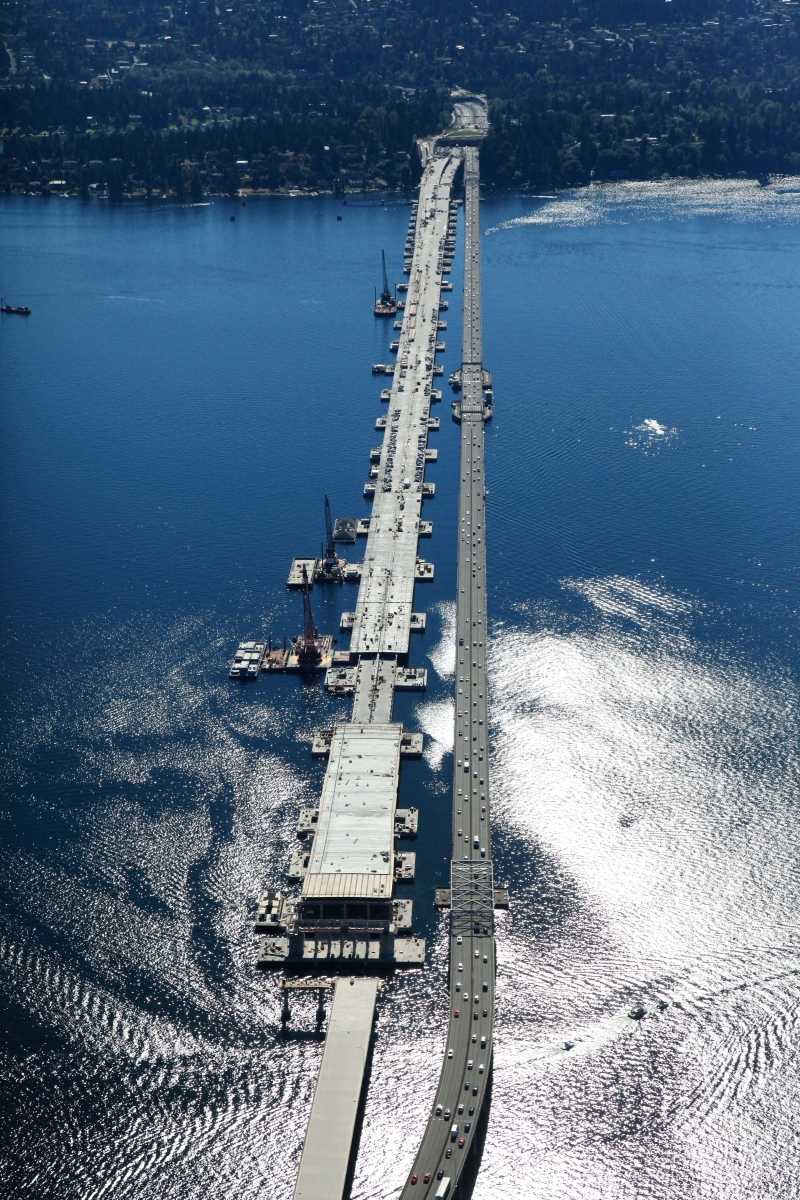
Imagine your city decided to throw away huge concrete boxes the size of a three-story house. Seems like junk, right? But in Seattle those boxes sparked a real dispute. Some said, “Sink them in the ocean!” Others shouted, “Don’t you dare! That’s someone’s home!” And you know what? Those “someones” turned out to be fish, crabs and starfish. The story of how old chunks of bridge became underwater cities taught people to see treasures where others see only trash.
Floating bridges (and why they’re even possible)
Seattle is a city surrounded by water. Lake Washington divides it into parts, like a river cutting a cake. To let people drive from one side of the city to the other, engineers in 1940 came up with something incredible: a bridge that doesn’t rest on piers but floats on the water, like a giant raft.
That bridge was named after engineer Lacey V. Murrow. It was built from huge concrete pontoons — hollow boxes that float because of the air inside (just like an empty plastic bottle doesn’t sink in a bathtub). The bridge served for 50 years! But in 1990 a disaster struck: during repairs water got into the pontoons and the whole bridge sank to the bottom of the lake. It was like watching the Titanic sink, only in the middle of the city.
Seattle built a new floating bridge in the same spot. And the old pontoons? They lay on the lakebed, and nobody knew what to do with them. Years passed. The city grew, there were more cars, and engineers realized: another new, wider bridge was needed. That was the SR 520 bridge, which is also floating. But what to do with the old pontoons from previous bridges that were in the way of construction?
The discovery that changed everything
In the early 2000s, when plans for the new SR 520 bridge were being discussed, marine biologists asked for permission to inspect the old pontoons. “We’ll just take a look down there,” they said. What they saw looked like the discovery of a lost city.
Over decades underwater, the concrete walls of the pontoons had been covered with algae, shells and sponges. Crabs had settled in the cracks. Schools of small fish swam between the structures, hiding from predators. Starfish crawled across the surfaces like they were rock faces. The old, dull concrete boxes had turned into artificial reefs — underwater jungles full of life!
Scientists explained: Lake Washington doesn’t have many places for fish to hide. The bottom is mostly mucky and flat. The hard surfaces of the pontoons became like multi-story apartment buildings for marine creatures. One biologist said, “Destroying these pontoons is the same as tearing down an entire neighborhood without warning the residents.”
The battle over concrete: people against people (with the fish in the middle)
A real battle began. On one side were builders and officials: “These pontoons are in the way! We want to build the new bridge faster and cheaper. Let’s sink them in the Pacific Ocean or dismantle them.” On the other side were environmentalists and local residents: “You can’t just destroy homes for thousands of living creatures! This is an ecosystem!”
The dispute lasted years. Studies were conducted, reports written. Both sides made arguments:
| Arguments “for disposal” | Arguments “for preservation” |
|---|---|
| Pontoons interfere with building the new bridge | Pontoons have become homes for a unique ecosystem |
| Moving them is expensive | Artificial reefs are rare in freshwater lakes |
| Concrete can be recycled | Creating new reefs would take decades |
| The ocean is a “natural” place to sink them | Local fish species depend on these structures |
In the end a compromise won. Some pontoons were removed because they truly obstructed construction. But several of the largest and most “populated” pontoons were left on the lakebed intentionally — as a gift to the fish. They were relocated to places where they wouldn’t interfere with boats and bridges but would continue to serve as underwater cities.
The lesson from old boxes: trash or treasure?
This story teaches us something important. Adults often think they know what is valuable and what is trash. Old bridge sank? Trash. Concrete boxes on the lakebed? Trash. But nature thinks differently. For fish and crabs those “boxes” are home, shelter, a place to raise young.
Today engineers and ecologists around the world talk about “blue infrastructure” — intentionally leaving old ships, platforms or bridges underwater to create new ecosystems. In Seattle this was discovered by accident, but now the experience is used in other cities. For example, in some countries old subway cars are sunk in the sea to create reefs for fish!
There’s something almost magical in that. We’re used to people destroying nature. But sometimes — even unintentionally — we create something good. The old bridge didn’t just break and disappear. It became something new, alive and important. It’s like outgrowing a favorite jacket and giving it to your little sister, and it becomes her favorite jacket. The thing didn’t die — it got a second life.
What it means for us today
The battle over Seattle’s pontoons ended more than ten years ago, but its lessons still live on. When cities now plan to tear down old buildings, build new roads or rework shorelines, the question increasingly asked is: “Who else lives here besides humans?”
Engineers are learning to design bridges and dams so they can immediately become homes for fish — with special ledges and crevices. This is called “ecological design.” In Seattle the new SR 520 bridge that replaced the old one was designed with the idea that its pontoons might also become reefs someday (many, many years from now).
And the story also reminds us: sometimes the most valuable things are those we almost threw away. No one built the old pontoons for fish. But the fish found a home in them. Maybe there’s something in your life that seems “old and useless” but is a treasure to someone else — an old toy you can give, a book to pass on to a friend, or just an idea that seems strange but could be brilliant.
The concrete boxes on the bottom of Lake Washington still stand there, covered with shells and algae. Every day fish swim past them, unaware that people once argued over their home. And that’s probably the best ending to the story: when the argument ends and life goes on.