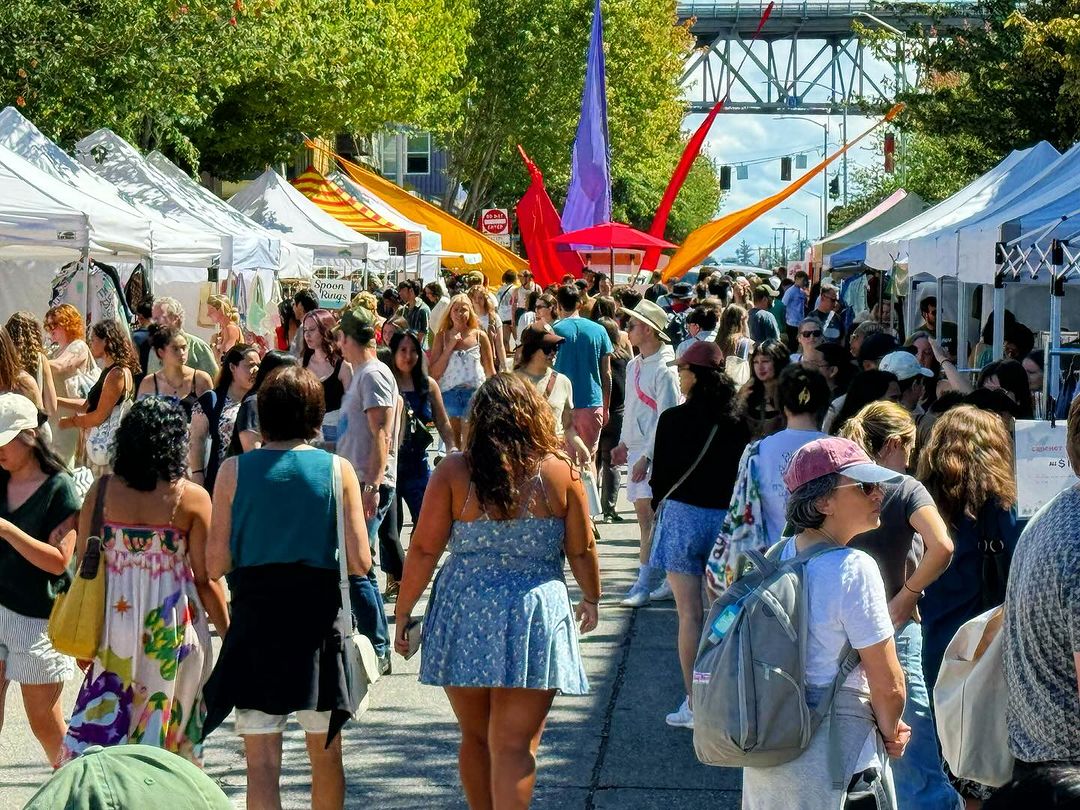
Imagine you come to a market with a painting you made yourself and leave with a basket of apples and fresh bread. No money — just an exchange. Sounds like a fairy tale? But that’s exactly how the Fremont Sunday Market in Seattle worked (and still works!), which began in 1990 and accidentally invented the rules that now govern half the internet.
This is the story of how a group of neighbors from the city’s quirkiest neighborhood created a place where people could trade not only goods, but time, talents, and kindness. And how their “crazy” idea, thirty years later, saved thousands of people around the world when regular money suddenly stopped being enough.
A market where artists trade with farmers
When residents of Fremont decided to start a Sunday market in 1990, they did something unusual. Of course, you could buy things there with ordinary dollars — vegetables, old books, handmade jewelry. But the organizers added a special rule: “Barter is welcome here.”
Barter is an ancient word that means “exchange without money.” You give me what you have, I give you what I have, and we’re both satisfied. It sounds simple, but in the 1990s, when everyone had grown used to credit cards and ATMs, it felt like a return to the Stone Age.
However, surprising things started happening at the Fremont Market. A musician could play the violin for half an hour — and be rewarded with fresh flowers and homemade cookies. A woman who knew how to fix bikes traded her services for knitted hats. An artist brought small watercolors and walked away with bags of organic vegetables. One baker even hung a sign: “I accept poems in exchange for bread” — and every Sunday he received dozens of homemade poems from customers.
The most interesting thing: people began to value things differently. When you trade your painting for someone’s bread, you don’t think “how much is this worth in dollars,” but “how much work and heart did this person put into it.” The artist knew the farmer woke at five a.m. to harvest lettuce. The farmer saw how many hours she spent on the watercolor. That created a special bond between people.
Strange money and the “time bank”
But the market organizers went even further. In the mid-1990s they began accepting “alternative currencies” — homemade money that worked only within the Fremont community. There were “Fremont hours” (each hour of work was worth one “hour,” regardless of what you did), “local dollars,” and even special tokens.
The idea was this: if you helped a neighbor repair a fence (two hours of work), you received two “Fremont hours.” You could then exchange those “hours” at the market for anything — a massage, guitar lessons, a homemade pie. It meant an hour of a programmer’s work and an hour of a gardener’s work were valued the same. That seemed insane! In the regular world, programmers earned much more.
But Fremont residents believed: any honest work has value. If you spent an hour of your life helping others, that matters, no matter who you are. That idea was called the “time bank,” and it worked! People with little conventional money could live full lives by swapping their skills.
At the time many laughed at Fremont. “They’re playing Indians,” said skeptics. “It’s not serious, it can’t work in a real economy.” The market was labeled a “hippie fantasy” and a “communist experiment.” But the experiment continued every Sunday, and each year more people came to the market.
How Fremont predicted the future
Now for the most surprising part. Remember those “strange rules” of the Fremont market — swapping goods, alternative currencies, valuing time instead of money? It turns out they predicted how the world would be arranged twenty to thirty years later!
Think of modern apps and websites. There are platforms where people swap housing (you stay in my Seattle apartment, I stay in your house in Paris — no money exchanged). There are sites where neighbors share tools, clothes, toys. There are even apps where you can “trade” your skills — teach someone to paint in exchange for Spanish lessons. This is called the “sharing economy,” and it’s discussed in economics textbooks. But Fremont was doing it back in the 1990s, before the internet!
Or take cryptocurrencies — digital money like Bitcoin that isn’t controlled by any bank. Many think this is ultra-modern. But the idea of an “alternative currency created by the community” is exactly what Fremont did with its “hours” and tokens. The only difference is the technology.
Today, Seattle runs an official “Time Bank” program (Community Exchange) that grew out of Fremont’s experiments. Thousands of people trade services using “hours” instead of dollars. Similar programs appeared in Portland, San Francisco, even New York. What once seemed the “eccentricity of a small neighborhood” became a movement changing cities across America.
When the whole world started playing by Fremont’s rules
The real test of Fremont’s ideas came in 2020–2023, when the pandemic and economic troubles left many people unemployed or short on cash. Then something striking happened: cities worldwide began copying Fremont Sunday Market’s model.
In Detroit a “Skill Exchange Market” appeared where unemployed auto workers taught kids to fix things in exchange for fresh produce from local farmers. In London a “Neighborhood Help Bank” was created where elderly people received help with shopping by “paying” with stories and advice to young volunteers. In Barcelona a market opened where artists traded works for studio rent.
Even in Russia, in St. Petersburg and Moscow, small “swap fairs” inspired by the Fremont model started to appear. People brought unwanted items, books, toys and exchanged them without money. This helped families save and find what they needed when cash was scarce.
Journalists wrote about the “return of barter” and the “new economy,” but Fremont residents just smiled. For them it wasn’t “new” — they had been doing it for thirty years! It turned out the “strange rules” of a small Seattle market were not foolishness but wisdom. They showed how people can help one another and live with dignity even when the usual economy falters.
What you can do with your friends
The story of the Fremont market teaches an important lesson: you don’t have to be an adult, rich, or famous to change the world. A group of ordinary neighbors simply started doing things differently — and thirty years later their idea helped millions.
You can create a “mini-Fremont” with your friends or classmates. For example, organize a “skill swap”: someone teaches drawing, another helps with math, someone else shows cool dance moves. No money — just exchange skills. Or host a “book swap” where everyone brings books they’ve read and trades them.
The main thing Fremont residents understood: everyone has something valuable to share. Maybe you don’t have money for expensive gifts, but you can tell funny stories, bake cookies, or draw greeting cards. That’s wealth too! When people start swapping such “riches,” they build a community where everyone matters and everyone is needed.
The Fremont Sunday Market still runs every week. You can still buy vegetables for a song, swap a painting for bread, or just come and feel part of something special. A small strange market in a small strange neighborhood accidentally showed the world what the future could look like — if we learn to value not only money, but people, their time, their labor, and their kindness.
And who knows? Maybe in twenty years economists will study an idea you and your friends came up with during a school break. That’s how real change starts — with one person deciding to do something differently.