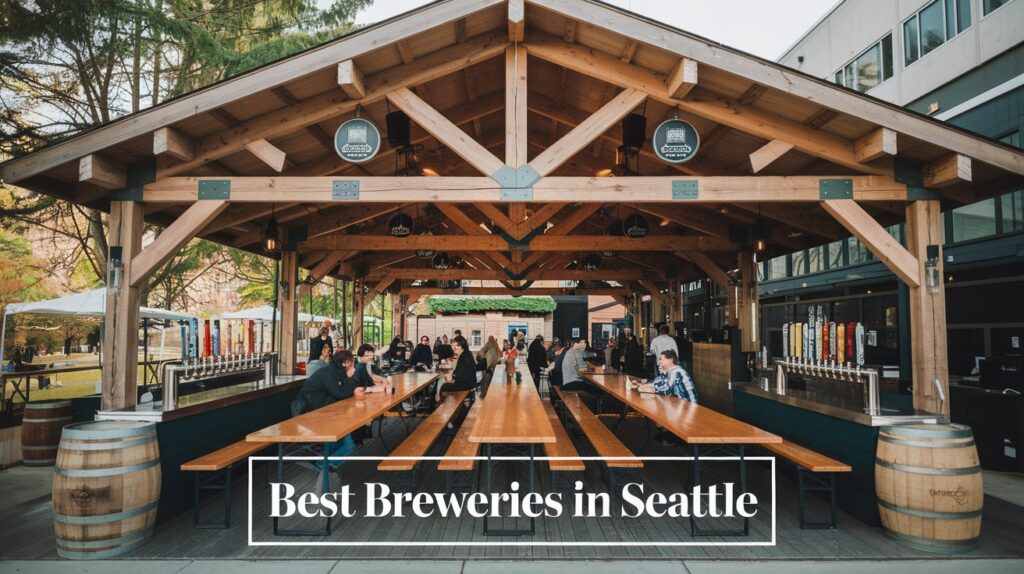
Imagine you set up a lemonade stand in your yard. Now imagine your lemonade became so popular that people started caring about the cleanliness of the river you use for water. Sounds like a fairy tale? But that's exactly how one of Seattle's most important stories began — the story of how small breweries changed not only what adults drink, but how an entire city relates to nature.
When water became more important than money
In the early 1980s, there were people in Seattle who were unhappy that almost all beer in America was made by huge factories far away. Paul Shipman and Gordon Bower were ordinary guys who loved two things: brewing beer and hiking the mountains around Seattle. One day they noticed something important: the streams were getting dirtier, and there were fewer salmon.
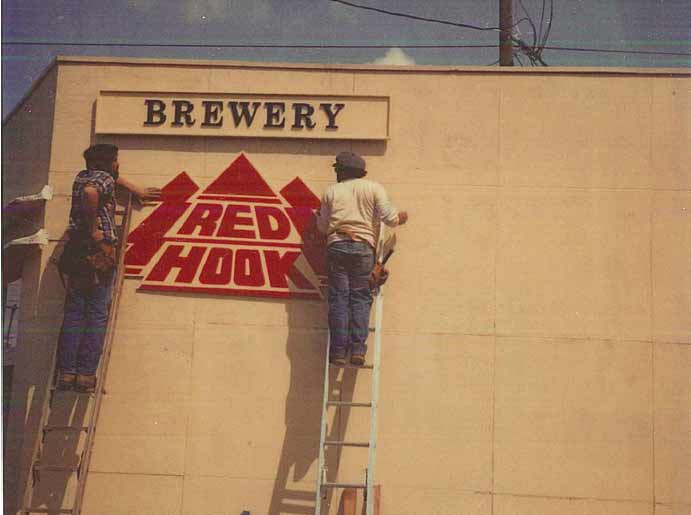
“If we want to brew good beer, we need clean water,” Paul told his friend. So they founded the Redhook Brewery right in an old trolley depot building in the Fremont neighborhood. It was a tiny place — about the size of your school gym. But they had a big idea: to make beer the way your grandmother bakes pies at home — with care, attention, and good ingredients.
What was unusual was that they began telling everyone where the water for their beer came from. They explained that clean mountain streams are home to salmon, and salmon are part of the history of the Indigenous peoples who have lived here for thousands of years. It turned out that everyone who bought their beer was, in a way, voting for clean water and healthy rivers.
Small kitchens versus big factories
To understand what these people did, imagine the difference between homemade cookies and supermarket cookies. Grandma bakes at her kitchen table; she knows where the flour, butter, and chocolate come from. She can add the nuts you like or make them less sweet if you ask.
Supermarket cookies are made in a huge factory where machines run day and night. Everything is uniform, fast, and cheap. But nobody knows the baker. Nobody can ask for more raisins.
Until the 1980s, almost all beer in America was like those supermarket cookies. A few giant companies made the same beer for the whole country. People like Paul and Gordon decided to open “home kitchens” for beer — small breweries where each batch was special.
And you know what happened next? People started coming to these small breweries not just to buy beer, but to talk to the brewers, hear their stories, and sit with neighbors. The brewery became like a library or a park — a place where people meet and build community.
Barley, hops, and salmon — unexpected friends
Now the most interesting part. Brewing beer requires three main ingredients: water, barley (a type of grain), and hops (a plant that gives beer its distinctive flavor). All three rely heavily on nature.
The first creators of Seattle’s small breweries quickly realized: if farmers irrigate barley and hops with dirty water or use too many chemicals, the beer will taste bad. And runoff from fields flows into rivers. And salmon live in the rivers.
So the chain looked like this: healthy salmon = clean rivers = good water for fields = tasty beer. One brewer named Mike Hale even started a program: for every keg sold, his brewery Hale’s Ales donated money to restore salmon spawning habitats.
Imagine drinking juice and part of the money going to plant an apple orchard for future children. That’s roughly how it worked.
How brewers became teachers
By the mid-1990s, more than thirty small breweries were operating in and around Seattle. Many of them began offering tours — not only for adults but for schoolchildren (of course, the kids didn’t taste the beer, but they watched how it was made).
Brewers taught children about the water cycle, how barley grows, and why it’s important to buy from local farmers instead of hauling food thousands of miles on trucks that pollute the air. The brewery became a place where people learned to care for the planet.
One girl wrote in a school essay after such a tour: “I thought factories were always bad for nature. But it turns out you can do things in a way that helps nature instead of harming it.” That thought is the most important gift Seattle’s small-brewery movement gave the city.
What changed in the city
Today, if you walk around Seattle, you’ll see the results of the revolution a few dreamers started in the 1980s. More than fifty breweries now operate in the city, and many are hubs for their neighborhoods. They host concerts, neighbor meetups, fundraisers for homeless pets, or park cleanups.
But most importantly — people’s attitudes changed. Seattle residents began thinking more about where the things they buy come from. This applies not only to beer, but to coffee (remember, Seattle is a city of coffee shops?), produce at the markets, and clothing. People started asking more often: “Who made this? How did it affect nature? Do my dollars help my city?”
And — this is very important — there are more salmon in Seattle’s rivers. Of course, not only thanks to brewers, but they were part of a larger movement of people who decided: our city should be a place where nature and people live together, not fight one another.
The brewers’ lesson
The story of Seattle’s small breweries teaches an important thing: even a small enterprise done with love and care can change a whole city. A few people who just wanted to brew good beer and care for nature set off a chain reaction of positive change.
Today, when you see a product labeled “locally made” or “eco-friendly,” know that real people stand behind those words — people who chose to do things right, even if it’s harder and costlier. They remember the lesson of those first Seattle brewers: what’s good for nature is ultimately good for people.
And who knows? Maybe one day you’ll open your lemonade stand, and it will help make the world a little better too. The main thing is to start by caring for what’s around you: the water, the land, and the people nearby. That’s exactly how this remarkable story in Seattle began.