Imagine your grandmother baking bread. Ordinary, fragrant loaves she takes to sell at the market. The police see her every day, greet her, sometimes even buy a roll. But they don't know the important thing: inside some loaves are hidden glass bottles filled with a liquid that at that time was strictly illegal to sell. Your grandmother is not a criminal. She's just trying to feed her children in very hard times. This is the true story of immigrant women who lived in Seattle almost a hundred years ago.
When water became more valuable than gold
In 1920 something strange happened in America. The government decided alcohol was bad and banned its production, sale, and transport. This period was called Prohibition. The idea sounded good: people thought fewer problems would follow if alcohol vanished. But the opposite happened.
Many people still wanted to drink wine or beer occasionally. Especially immigrants—people who had come to America from other countries. For Italians, wine was part of the family dinner. For Scandinavians, beer was a holiday tradition. Suddenly their customs became illegal. Worse, many families earned their living making or selling these drinks. Now they could be left without money, without food, without a roof over their heads.
So the women in those families made a decision. They couldn't let their children go hungry. They knew the law was unjust. And they used the only weapon they had: no one suspected that mothers and grandmothers could break the rules.
The secret skills of ordinary women
Maria Rossini came from Italy and could bake bread better than anyone in her neighborhood. Her ciabatta was so good people lined up for it. But in 1922 Maria began baking special loaves. She made loaves with a hollow inside—big enough to hide a bottle of homemade wine. She sealed the hole with a piece of dough on top, and nobody noticed. Maria walked around town with a basket of “ordinary” bread, sold it to certain houses, and the police didn’t even look her way. Who would suspect an elderly Italian mother with a bread basket?
Ingrid Larsen from Norway used a different method. She lived by the sea and ostensibly sold fresh fish. Ingrid made special baskets with false bottoms. On top lay real fish—shiny, fresh, smelling of the sea. But under a wooden panel that was hard to notice, bottles of smuggled whiskey brought in by boats from Canada were hidden. When the police stopped her, they saw only the fish and grimaced at the smell. “Move along, move along,” they said, pinching their noses. Ingrid smiled and went on her way.
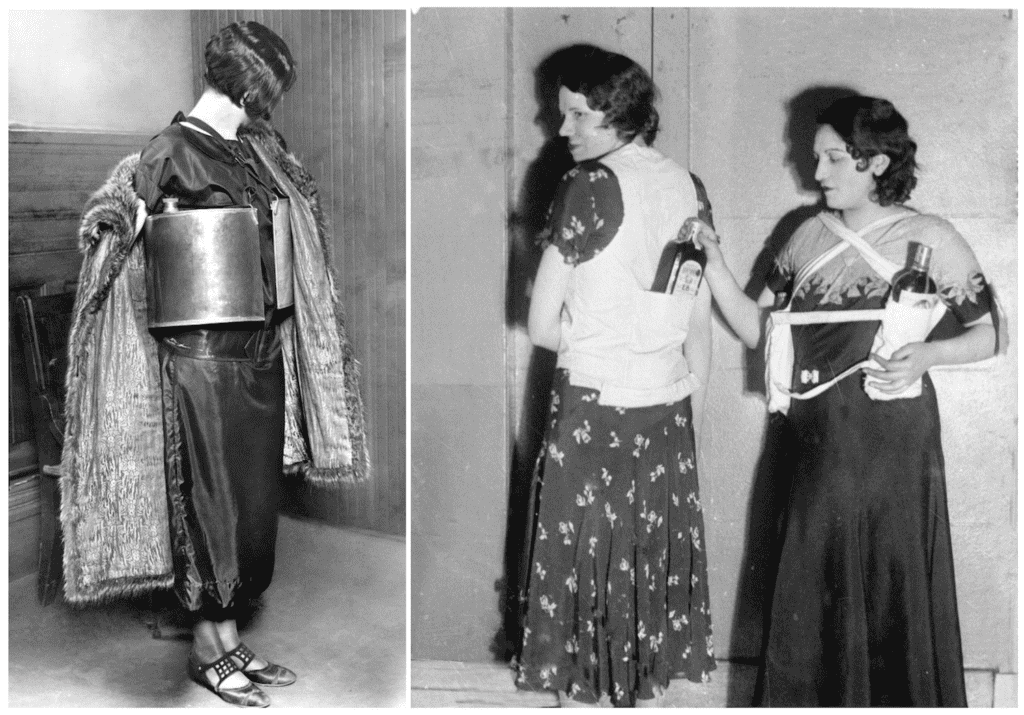
There were other tricks too. Women hid bottles in jam jars, in laundry baskets, even in baby carriages under infants. One Polish immigrant sewed special skirts with pockets that held up to six small bottles. She simply looked plump, and no one suspected her secret.
Why they weren’t caught
Police of that time were looking for gangsters—men in suits with guns who transported alcohol in trucks and fast cars. They imagined criminals as dangerous, loud men. So a quiet woman with a basket of bread or fish was invisible to them.
But there was another reason. Society back then believed women, especially mothers, were incapable of “serious” crimes. Women were supposed to stay home, cook, clean, and raise children. The idea that a gray-haired grandmother could be part of a complex smuggling network seemed laughable. These prejudices—unfair assumptions about what people can or cannot do—became protection for immigrant women.
Also, these women helped each other. They created an entire system. One baked the bread, another delivered it, a third knew who to sell to. They spoke in their own languages—Italian, Norwegian, Polish—which the police didn’t understand. They warned each other of danger with special signals: a red ribbon on a door meant “don’t come today,” a white tablecloth in a window meant “safe.”
Stories that nearly disappeared
For a long time no one talked about these women. When Prohibition ended in 1933, everyone rushed to forget those years. Women who risked their freedom for their families didn’t want to tell their stories—they feared judgment. Their daughters and granddaughters often didn’t even know what their grandmothers had done.
Only in recent years have historians begun to piece these stories together. They found old diaries, letters, photographs. They talked to very elderly people who as children remembered the strange “hide-and-seek” games their mothers and grandmothers played. One historian found a special loaf with a hollow inside in an old house scheduled for demolition—it had lain there almost 90 years!
It turned out that immigrant women played a huge role in alcohol smuggling. While men brought alcohol in large boats from Canada (a dangerous job that got many caught), it was women who distributed it through the city. They were the final, most important link in the chain. Without them the whole system would not have worked.
Why this story matters
This story teaches us several things. First, it shows that people who are underestimated can be the strongest and smartest. Society thought immigrant women were just mothers who didn’t understand American laws. In reality these women were brave, inventive, and organized.
Second, the story reminds us that immigrants have always been an essential part of America. These women came from other countries, brought their skills—baking bread, curing fish, sewing clothes—and used them to survive hard times. They didn’t ask for help; they found solutions themselves.
Third, this story shows how easily entire groups of people can be forgotten. When we read about Prohibition, we usually hear about famous male gangsters like Al Capone. But thousands of women who risked just as much remained unnamed. Their voices nearly vanished. Fortunately, now we are beginning to hear them.
The next time you see an elderly woman with a shopping bag or a basket at the market, remember: everyone may have an amazing story. Sometimes the most ordinary people do the most extraordinary things. And sometimes real heroes hide in the most unexpected places—like inside a loaf of bread.