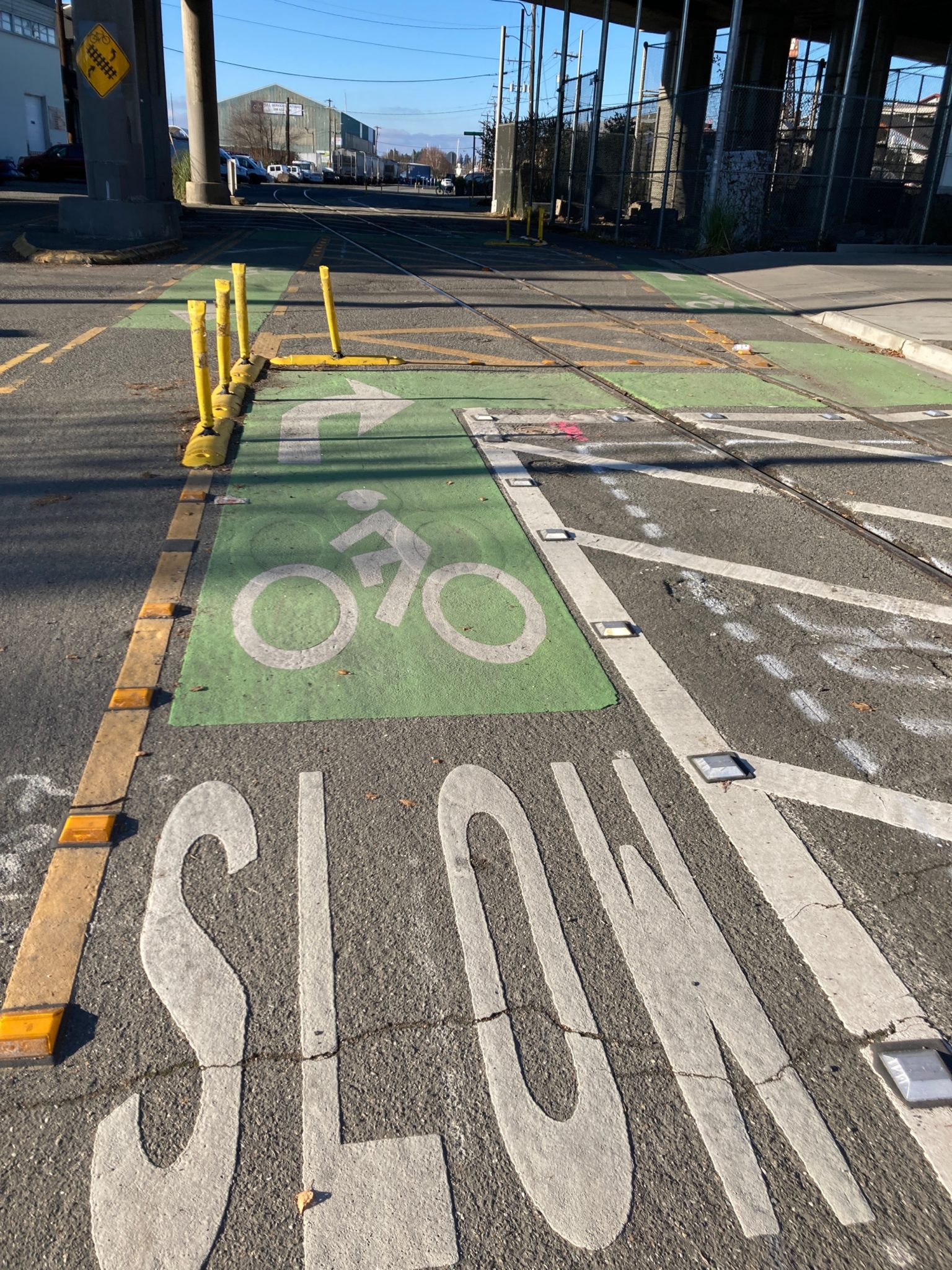
Imagine you’ve drawn a beautiful picture, and someone simply covers it with gray paint. Disappointing, right? But here’s what’s surprising: if the paint ever starts to peel, your drawing will show up again. That’s exactly what happened in the American city of Seattle. Only instead of a picture, there were bike lanes—and instead of paint, it was real asphalt.
How Seattle Fell in Love With Biking — and Then Forgot
Long ago, in the 1970s—about the time your grandparents were young—people in Seattle were very into riding bicycles. The city decided to help them and painted special markings on the roads: only for cyclists, so that big cars wouldn’t get in the way. It was bold and unusual—in those days, few cities even thought about cyclists.
Residents were happy. Kids rode to school. Adults headed to work. It seemed like everything was going well.
But then something went wrong.
There were more and more cars in the city. Drivers complained: bike lanes take up space that could be used for automobiles! City officials listened, and the bike lanes began disappearing one after another. Roads were resurfaced, asphalt was refreshed, and the old markings were simply… covered with a new layer. As if they’d never existed.
A Surprise Under the Asphalt
Years passed. In the 2000s, Seattle started thinking about cyclists again—because there were so many cars that the city was basically suffocating in traffic. They decided to build new bike lanes.
And then something unexpected happened.
When workers removed old asphalt on some streets, they found underneath it… the old markings! Those same bike lanes from the 1970s that had once been paved over with new asphalt. The city had buried its own good ideas—now it was digging them back up.
One of the city’s engineers said something along the lines of: “We spent thirty years coming back to where we left.” That’s a little sad, isn’t it? But also a little funny—like if you spend ages searching the whole house for your favorite toy, and it’s been under your bed the entire time.
A City That Learned Twice
After that discovery, Seattle really went to work. The city adopted a special plan—called the “Bicycle Master Plan”—and began building hundreds of kilometers of new lanes. And now they were designed more intelligently: cyclists weren’t just separated from cars by paint lines, but by real curbs and barriers, so riders could feel safe.
By the 2010s, Seattle had become one of the most bike-friendly cities in America. There were special bike signals, convenient bike parking outside shops and schools, and even bike “highways”—wide roads where you can ride fast without stopping.
But the most interesting part is that other cities began coming to Seattle to learn. Experts traveled from Europe, from Asia, and from other American cities, asking: “How did you do it?” And Seattle residents, a little awkwardly, would answer: “Well, we forgot everything at first, then remembered it— and here we are…”
A Lesson Worth Remembering
Seattle’s story of bike lanes isn’t just about asphalt and paint. It’s about how cities (and people!) sometimes make the wrong decisions and then regret them. And it’s about the fact that good ideas don’t disappear forever—they just wait for their moment.
So if today you ride your bike along a city lane, know this: at some point, someone fought to make it happen. Then someone else destroyed it. And then a third person fought for it again. Every stripe on the asphalt is a small victory for those who believed cyclists deserve their place on the road.
And Seattle now knows that for sure. Twice.