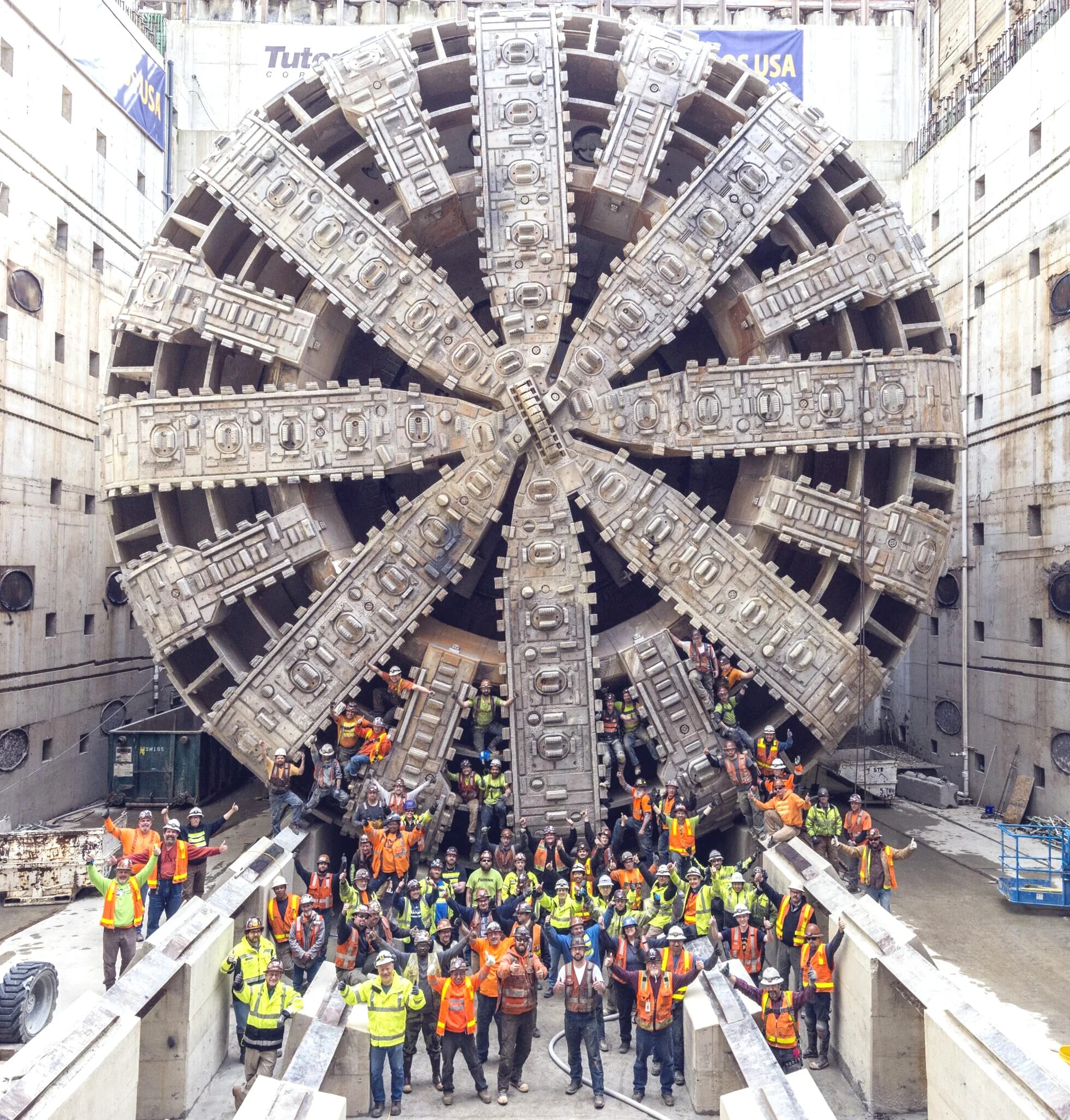
Imagine a road standing on tall concrete “legs” right by the sea and stretching for three kilometers. Cars drive along the top, while seagulls fly beneath it. That was Seattle’s Alaskan Way Viaduct. To get rid of it, the city needed a giant machine—a “mole” named Bertha—built far away in Japan and shipped across an entire ocean.
A Road on Legs
The viaduct was built in the early 1950s and opened in 1953. It had two levels, with one road above the other. At the time, it seemed very modern. But as the years passed, the concrete grew old. In 2001, an earthquake struck Seattle and damaged the viaduct. Engineers grew concerned: what if the next tremor was stronger? So they decided to remove the road from the waterfront and send cars underground, through a tunnel. The tunnel, about 3.2 kilometers long, was built beneath the city center.
Bertha, Who Came from Japan
You can’t dig a tunnel like that with an ordinary shovel, so a special machine came in handy. It was about 17.5 meters in diameter—taller than a five-story building! It weighed thousands of tons. It was built in Osaka, Japan, then taken apart into 41 pieces, loaded onto a ship, and sent across the Pacific Ocean.
The machine was named Bertha. Tunnel builders traditionally give their machines women’s names. In Seattle, they chose the name in honor of Bertha Knight Landes. In 1926, she became the first woman to serve as mayor of a major American city. I like that the giant “mole” bears the name of a brave woman who once did something no one had done before.
Bertha was reassembled in Seattle. People from different countries worked on the project: Japanese engineers, American workers, and construction companies from the United States and Spain. They spoke different languages but were working toward the same goal.
Bertha Gets Stuck
Bertha began digging in July 2013, but by December she had stopped and remained motionless for almost two years. Something had gone wrong with the main part that turns the machine. Among the possible causes people discussed was an old steel pipe underground, but the main problem turned out to be damaged seals in the machine’s “heart.”
Engineers came up with a daring plan. They dug a rescue shaft about 37 meters deep in front of Bertha, used a huge crane to lift the front section of the machine to the surface, and repaired it. Then they lowered Bertha back down, and at the end of 2015 she started moving again. Imagine how much patience it took not to give up halfway through! In April 2017, Bertha emerged on the other side of the city. The tunnel was complete.
The Tunnel Opens, the Viaduct Disappears
In January 2019, the old viaduct was closed to traffic, and the new tunnel opened in February. Before that, people were allowed to walk through it and see the place where cars would soon drive. Then the viaduct was taken down piece by piece, and the waterfront was gradually freed from its heavy gray “roof.” Today, a new waterfront promenade in Seattle offers a place to stroll, watch the waves, and enjoy the view without the roar of cars overhead.
People from far away have helped this waterfront before. A hundred years ago, Scandinavians, Japanese, and Chinese people lived and worked here. They built piers, fished, and opened shops. Now new “visitors” from other countries took part in the project, and together they, too, built something that will help the city.
What This Story Teaches Us
I think Bertha’s story teaches us two simple things. First, big things are accomplished together, and help can come from far away. Second, if something breaks, that’s not the end. Bertha got stuck, but they repaired her and saw the job through. When something isn’t going your way, remember the giant “mole” from Japan that eventually made it back into the light.