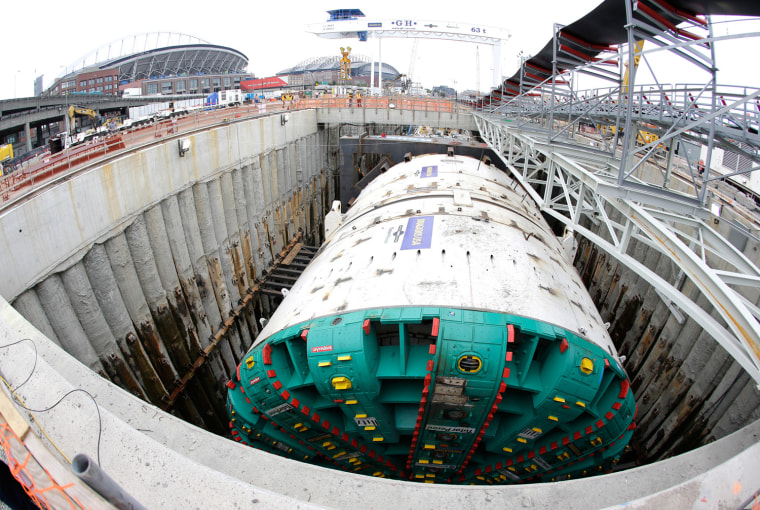
Imagine a machine the size of a five-story building that can chew its way through roads underground. Sounds like something from a sci-fi movie, right? But in Seattle such a machine really existed, and its name was Berta. It was the largest tunnel-boring machine in the world, and city residents loved it so much they wrote songs about it, painted pictures, and even celebrated its birthdays. Berta’s story shows how a massive engineering project can turn into an adventure that brings a whole city together — from adult engineers to schoolchildren.
A skyscraper-sized machine that ate rock for breakfast
Berta was a tunnel-boring machine — a specialized mechanism that digs tunnels underground. But she wasn’t just a machine; she was a true giant. Her diameter was 17.4 meters — about like stacking four giraffes on top of each other! She weighed around 7,000 tonnes, roughly the weight of about 1,000 elephants. As Berta moved underground, she rotated a huge circular cutting head with teeth that crushed rock and soil. A long trailing tail of machinery followed behind, immediately lining the tunnel walls with special concrete rings.
Berta was built in Japan specifically for Seattle. Her task was to bore a nearly 3-kilometer tunnel beneath the city center to replace the old elevated road — the Alaskan Way Viaduct. That roadway was built in the 1950s and had become dangerous over time, especially in earthquakes. The city decided that instead of repairing the old road, it was better to build a modern underground tunnel. This would free up space for parks and attractive waterfronts, while traffic would move safely below ground.
How schoolchildren named the giant machine, and she became famous
When the enormous machine arrived in Seattle in 2013, she didn’t yet have a name — only a dull model number. Project organizers decided to do something unusual: they held a contest for city residents to choose the machine’s name. Thousands of people, including many children, sent in suggestions. Some proposed naming the machine after famous people; others came up with funny names.
The winning name was "Berta" — in honor of Bertha Knight Landes, Seattle’s first female mayor, who led the city in the early 1900s. It was symbolic: just as Bertha Landes paved the way for women in politics, the machine Berta was paving a new path for the city. Schoolchildren drew portraits of Berta and wrote her letters wishing her luck. T-shirts appeared around town featuring the machine and the slogan “Go, Berta!”
When Berta began her underground journey in July 2013, the whole city followed her progress. Engineers created a special website where people could see exactly where Berta was each day. Children marked her route on maps at school. It seemed everything was going according to plan — until something unexpected happened.
When Berta got stuck, the city didn’t abandon her
In December 2013, after just 300 meters, Berta stopped. Something had gone wrong. Engineers discovered the machine had hit a steel pipe left over from earlier work and had overheated. She needed serious repairs, and to fix her they had to retrieve her from underground. This was a huge problem: Berta was stuck 20 meters below the busy city center.
Engineers had to dig a massive pit — 37 meters deep and 24 meters wide — to reach Berta and extract her front section for repairs. It took almost two years! The project, which was supposed to finish in 2015, stalled. Many adults criticized the situation, calling it a failure. But city residents, especially children, kept supporting Berta.
Artists painted graffiti of brave Berta. Musicians composed songs about her adventures. One local band even wrote a ballad called “Berta, Please Come Back.” A social media account appeared in Berta’s name, where she “shared” her underground experiences and gained thousands of followers. Schoolchildren sent her get-well cards. It was remarkable: instead of getting angry about the delay, many people treated the machine like a living being that needed encouragement.
Berta’s triumph and what she left behind
After repairs, Berta returned underground in December 2015. This time she worked without major issues. Slowly but surely, day by day, she carved her way beneath the city. Finally, on April 4, 2017, Berta broke through to the other end of the tunnel. It was a real celebration! Hundreds of people came to see the machine emerge, children waved signs, and an orchestra played festive music.
The tunnel opened to traffic in February 2019, and the old viaduct was demolished at the same time. Parks, bike paths, and promenades with ocean views now occupy the space where the ugly concrete road once stood. The city truly changed. What happened to Berta? Her cutting head — that enormous round part with the teeth — was left underground because removing it would have been too difficult and expensive. It remains there as a monument to its feat.
But Berta’s memory lives on above ground as well. Sculptures dedicated to her have been installed around the city. Stories about the giant machine are told in schools as an example of how large projects can encounter setbacks but that it’s important not to give up. Many children who followed Berta’s adventures became interested in engineering and science. Some even say they want to become engineers to create such amazing machines themselves.
When technology becomes part of a city’s story
Berta’s story shows something important: even the most complex technological projects are not just about machines and calculations, they’re about people too. When Seattle residents gave the giant machine a name, they turned a cold engineering project into a shared story that anyone could join. Children drew pictures, adults wrote songs, and everyone together experienced disappointments and rejoiced in successes.
Berta taught the city a valuable lesson: big changes are always an adventure, full of both difficulties and victories. The tunnel she bored changed not only Seattle’s roads but also how people think about their city. Where there once was an ugly concrete road blocking the ocean view, there are now places to walk, play, and meet. And the children who once rooted for Berta grew up understanding that technology is not something boring and distant, but a tool that can make life better if treated with care and imagination.