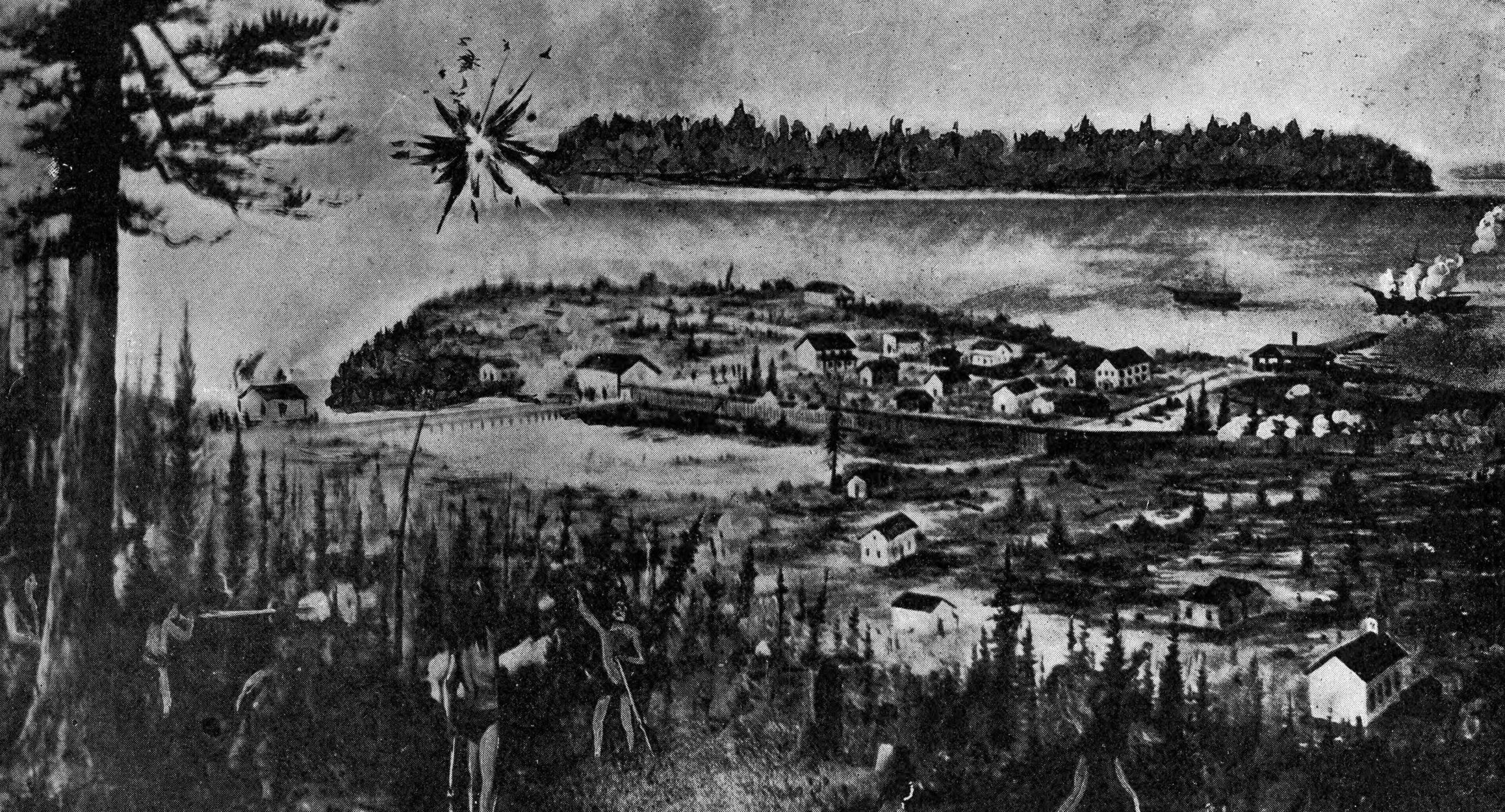
Imagine you moved to a new town where you know no one, you speak a different language, and suddenly you urgently need to ask your neighbors for help. That’s what happened in Seattle in 1856, and what the immigrants came up with then changed the city forever.
A town where nobody understood anyone
In 1856 Seattle was a tiny settlement — only a few hundred people. But these people had come from everywhere: Germany, Ireland, Scandinavia, China. The Maynard family spoke English, the Plummers spoke German, the Scandinavian loggers spoke Swedish and Norwegian. The children played together, but their parents often couldn’t talk to each other without translators.
When a conflict with local tribes began in January 1856, settlers faced a problem: how to warn everyone of danger if people didn’t understand each other? Shouting “Danger!” was useless if your neighbor only knew the word “Gefahr.” Sending messengers from house to house was too slow.
So the women and children of that multilingual community invented a system that didn’t need words.
A language without words
Mary Ann Boyer, the wife of one settler, suggested using the church bell. One strike — everyone stays calm. Three quick strikes — danger, run to the blockhouse (fortified house). Five strikes — fire, bring water.
But there was only one bell, and the settlement stretched along the shore nearly a mile. So the children came up with a flag system. A red flag on a blockhouse roof — danger from the north. Blue — from the south. White — all clear, you can return home.
Katrina Schwartz, a girl from a German family, recalled later: “We children became living telephones. I would stand on our roof and watch the Thompsons’ flag. As soon as it changed, I’d run to the bell and ring. Then my brother would run on to the next house. We could pass the signal across the whole settlement in three minutes.”
Adult men defended the blockhouses with rifles, but it was precisely this children’s communication system that saved lives. No one was left without warning, because bells and flags didn’t require translation.
When enemies became neighbors
The most surprising thing happened afterward. The conflict ended after a few months, but the system stayed. People realized: if the bell can warn of danger, it can also call for help.
Three bell strikes now meant: “The Schmidts have a fire, bring buckets!” Five strikes: “The mail ship has arrived!” Seven strikes: “Someone’s lost in the woods, searchers needed!”
Immigrants who a month earlier couldn’t talk to each other now came to help at the sound of the bell. Irish helped Germans build barns. Scandinavians taught Chinese fishermen better ways to catch salmon. German women showed Irish women how to pickle cabbage for winter.
Historian Muriel Williams wrote: “The 1856 warning system accidentally created what we now call the ‘Seattle neighborhood spirit.’ People got used to responding to a call for help, even without knowing exactly whom they were helping.”
From bells to smartphones
That tradition never disappeared. In the 1910s Seattle saw the first neighborhood councils — local groups where residents of different districts solved common problems. By the 1970s there were 13 such councils covering the city.
Today Seattle has a system that looks surprisingly like what the children invented in 1856. It’s called “Seattle Neighbors” — an app where residents warn each other of danger, ask for help, and organize joint projects. Only instead of bells there are phone notifications.
| Year | Communication system | What was conveyed |
|---|---|---|
| 1856 | Bells and flags | Danger signals |
| 1910s | Neighborhood councils | Solutions to common problems |
| 1970s | Telephone chains | Neighborhood news |
| 2020s | Apps and chats | All kinds of neighborly help |
There’s still an old bell hanging in the Fremont neighborhood — not the original, but a similar one. Once a year, on January 26, the anniversary of the start of the 1856 conflict, it is rung three times. It’s a reminder: once, different people who didn’t understand each other’s languages learned to hear what mattered most — a call for help.
A lesson that lasts 168 years
The story of the 1856 immigrants teaches an important lesson: sometimes crisis forces people to invent ways to understand each other without words. And those ways prove stronger than any language.
Mary Ann Boyer, the woman who suggested using the bell, wrote in her diary: “We came from different countries, speak different languages, pray to different gods. But the sound of the bell is the same for everyone. And when it rings, we all simply become neighbors.”
Today Seattle is one of the most diverse cities in America. People here speak 170 languages. But the tradition born in 1856 lives on: Seattleites are known for quickly organizing to help each other. Whether it’s a flood, an earthquake, or just a neighbor who broke a leg and can’t walk their dog.
The bells have long since fallen silent, but their echo still sounds in every neighborhood. Only now that echo comes as a message: “Someone needs help. Who will respond?”
And someone always does. Because 168 years ago immigrant children standing on their roofs taught the city a fundamental truth: help needs no translation.