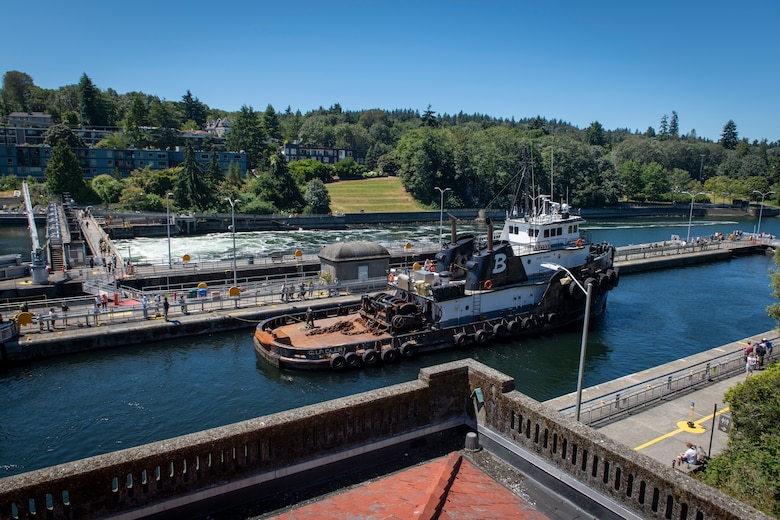
Imagine building the biggest ships, only to find that they can leave port through a high threshold. That was roughly the situation in Seattle a little over a hundred years ago. During World War I, the city’s shipyards were working at full capacity, and ships needed a reliable route between the sea and the lakes. To create one, engineers built a “ship elevator”—and radically changed the surrounding landscape in the process. At first, many people weren’t happy about it. Today, though, both locals and tourists love the place.
Why ships needed an elevator
In those days, Seattle was a bustling port city. Its shipyards launched dozens of large vessels, while hundreds of workshops and docks operated nearby. But the city’s geography posed a puzzle. On one side was the saltwater of Puget Sound. On the other were the freshwater lakes Union and Washington, with hills and a narrow strip of land between them. The lakes sit higher than the water in the sound, which also rises and falls with the tides.
The solution was to dig a canal and build locks. The project was conceived and championed by Hiram Chittenden, an engineer serving in the U.S. Army. That’s why the locks still bear his name. The canal officially opened on July 4, 1917—U.S. Independence Day. Boats and launches paraded along the water as crowds gathered on the banks to celebrate.
How the “elevator” works
A lock is simple in principle. It’s a large stone “bathtub” with gates at both ends. A ship enters, and the gates close behind it. Then water is either let in or drained out, and the ship slowly rises or falls, like an elevator. The difference in water level between the sea and the lake ranges from about 6 to 26 feet, depending on the tide.
Seattle’s large lock is very long—almost as long as two and a half football fields. It can hold many boats at once, or one enormous ship. There’s also a small lock for smaller boats, so water isn’t wasted.
There’s another advantage, too. Freshwater is harmful to marine snails, algae, and shipworms, which damage ship hulls and wooden pilings. So vessels entering the lake get a kind of “freshwater rinse.” This was convenient for fishermen and shipowners, too.
What went wrong
But the engineers changed more than the route ships took. After the canal was built, Lake Washington dropped by almost ten feet. The Black River, which used to flow out of the lake, simply dried up. For people living nearby—and especially for the Duwamish people, who had lived along these shores for generations—these were difficult changes. The shorelines shifted, and familiar places disappeared.
Salmon suffered, too. They used to swim up the rivers to the lake to spawn. Now the locks’ dam stood in their way. Without intervention, the fish would have been unable to get through. So a fish ladder was built next to the locks. It isn’t an ordinary staircase with steps, but a series of small pools, one above another. The salmon leap from one pool to the next, like climbing stairs, until they reach the lake.
In the early years, the ladder drew criticism: it wasn’t very easy to navigate, and many fish struggled to get through. It became a source of debate. Some said the city needed ships; others asked why fish should have to pay for our success.
From controversy to a beloved attraction
As time passed, people began looking for ways to correct the damage. In 1976, the fish ladder was rebuilt and underwater viewing windows were added. Now you can stand in a small room and watch silvery salmon swim past the glass. The best time to visit is in summer and fall, when the fish return home.
There’s a lovely garden next to the locks where you can take a walk. Children and adults gather by the railing, waiting for the gates to open and yachts, boats, and fishing vessels to pass through one by one. Usually, someone waves from the deck, and the people on shore wave back. I think it’s a lovely thing: you can watch engineering at work and, at the same time, see wildlife finding its way.
What we can learn from this
This story shows that good inventions aren’t always harmless. The locks helped Seattle grow and trade, but nature and the people living nearby paid the price. Still, the city didn’t stop there. It acknowledged its mistakes and gradually worked to fix them: it rebuilt the fish ladder and gave the salmon a better chance. That’s why Seattle’s “water elevator” is notable today not only as an engineering feat, but also as an example of how it’s never too late to correct your mistakes.