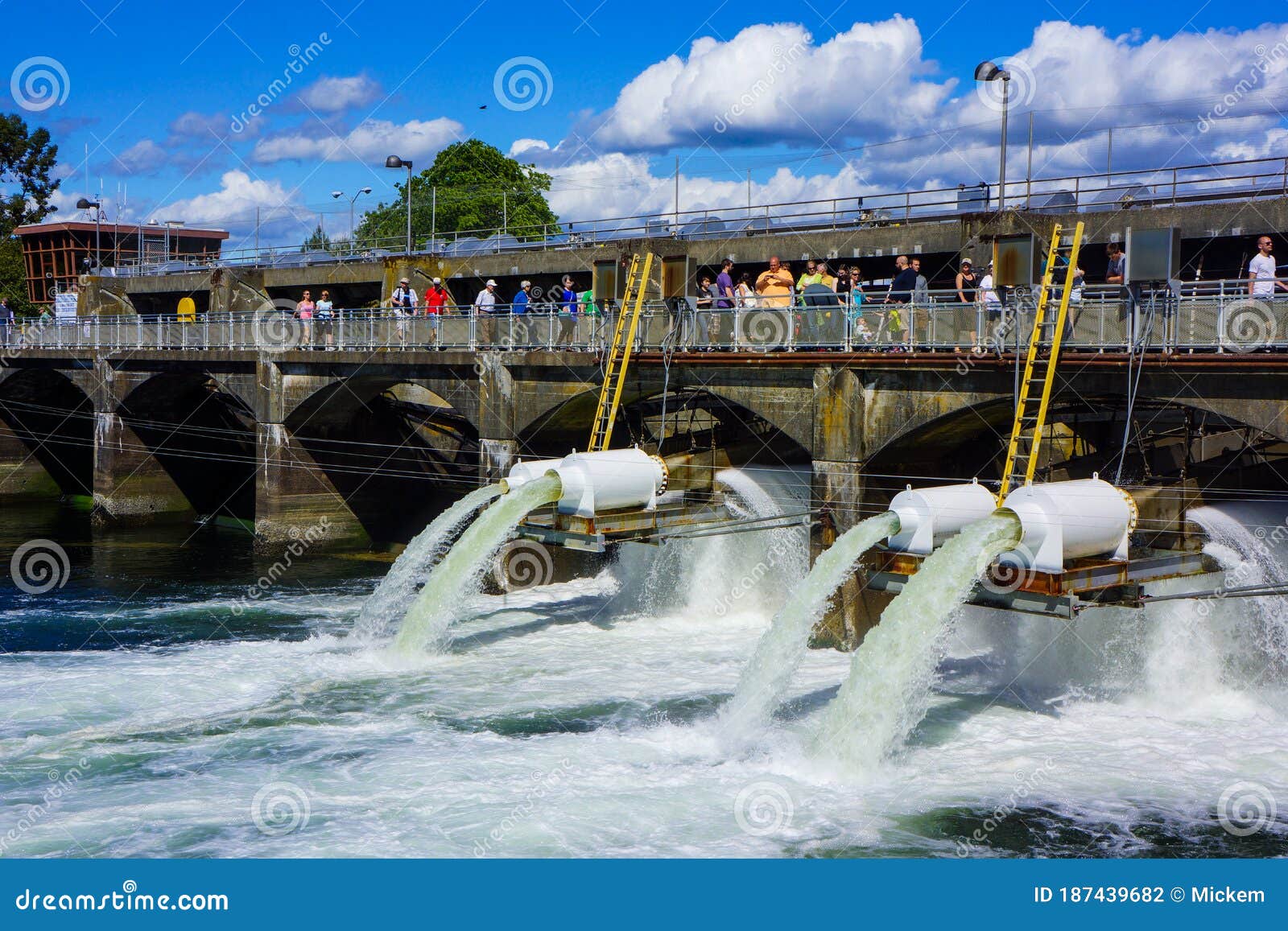
Imagine that every year you have to walk home the same way—through the forest, across the river, past old trees. You know the route by heart, the way your mother, your grandmother, and your great-grandmother do. And then one day, right in the middle of the road, someone builds a huge concrete wall. And says, “Don’t worry—we built a small stairway on the side.” That’s roughly what happened to Seattle’s salmon more than a hundred years ago, in 1917.
What are locks, and why were they built
In Seattle there is a special place—the Ballard Locks, or, officially, the Hiram Chittenden Locks. These are large gates in the water that connect Puget Sound’s saltwater bay with Lake Washington, which is freshwater. Sounds kind of boring, doesn’t it? But in reality, it’s a real engineering trick.
Saltwater and freshwater are at different elevations—the lake sits about three meters higher than the bay. The locks work like an elevator for ships: a boat enters, the gates close, the water rises or falls, and the vessel ends up at the right level. When Seattle was growing rapidly in the early twentieth century and becoming an important trading city, this “elevator” was absolutely necessary: logging boats, fishing vessels, and warships could freely move between the lake and the sea.
Construction took several years, and in 1917 the locks opened. City residents were delighted. Newspapers wrote about a great achievement of engineering. Nobody really thought about the fish.
Salmon and its ancient route
But the salmon was thinking—more precisely, feeling. This remarkable fish is born in freshwater—in rivers and streams—then heads out to the salty ocean, lives there for several years, grows, and finally returns back to the very same river where it was born. Scientists still can’t fully explain how salmon find their way home—maybe they sense the Earth’s magnetic field, maybe they remember the smell of the water. But they do return. Always.
For the Indigenous peoples of these places—the Suquamish and Duwamish tribes—salmon were more than food. They were part of life, part of stories, part of who they considered themselves to be. For thousands of years, people and fish lived side by side, and each fall the rivers would literally turn red with returning salmon. There were so many fish that, according to elders’ accounts, you could cross the river by walking right along the fish’s backs.
When the locks were built, the salmon suddenly found itself facing that same concrete wall in the middle of the road.
A staircase that helps, but not quite enough
Engineers, of course, thought about the fish. They built a fish ladder—a special channel with steps through which salmon could swim up from the bay into the lake. Today, it’s even become a tourist attraction: the ladder walls have glass windows, and every summer children and adults stand and watch as large silver fish move up the steps. It’s true—it’s beautiful and a bit magical.
But here’s the secret that isn’t printed on the tourist signs: the ladder helps fish get upstream, but it doesn’t solve all the problems. First, many salmon simply can’t find the entrance to the ladder—they circle around the concrete walls, exhausting themselves. Second, there’s an even sadder story involving young fish. When small salmon—called “smolts”—grow up in the lake and want to head out to the ocean, they need to pass through the locks in the opposite direction. And that’s where pumps, turbines, and lock machinery await them. Many don’t make it.
Imagine that someone helped you get into the house through the front door—but forgot to mention that the back exit leads straight to danger.
“We built a ladder and thought we’d done a good deed,” say biologists who have studied this issue for decades. “But nature is more complicated than one ladder.”
A hundred years later: what we see now
More than a hundred years have passed. The locks still operate—every day boats pass through them, and tourists photograph the fish ladder. But the salmon population in this area has never returned to what it used to be. Scientists, fishermen, and representatives of Indigenous communities have been talking about it for a long time, but solving the problem is extremely difficult: the locks are too important to the city to simply remove them.
This story teaches us something important: when people make a big decision—to build a dam, a lock, a road—they think about what people need right now. But nature follows a different schedule. Salmon didn’t read the 1917 newspapers and didn’t know that its route had been changed forever.
If you ever find yourself at the Ballard Locks and see a salmon through the glass window—give it a wave. It has traveled an incredibly long way. And it did so despite everything people put on its road.