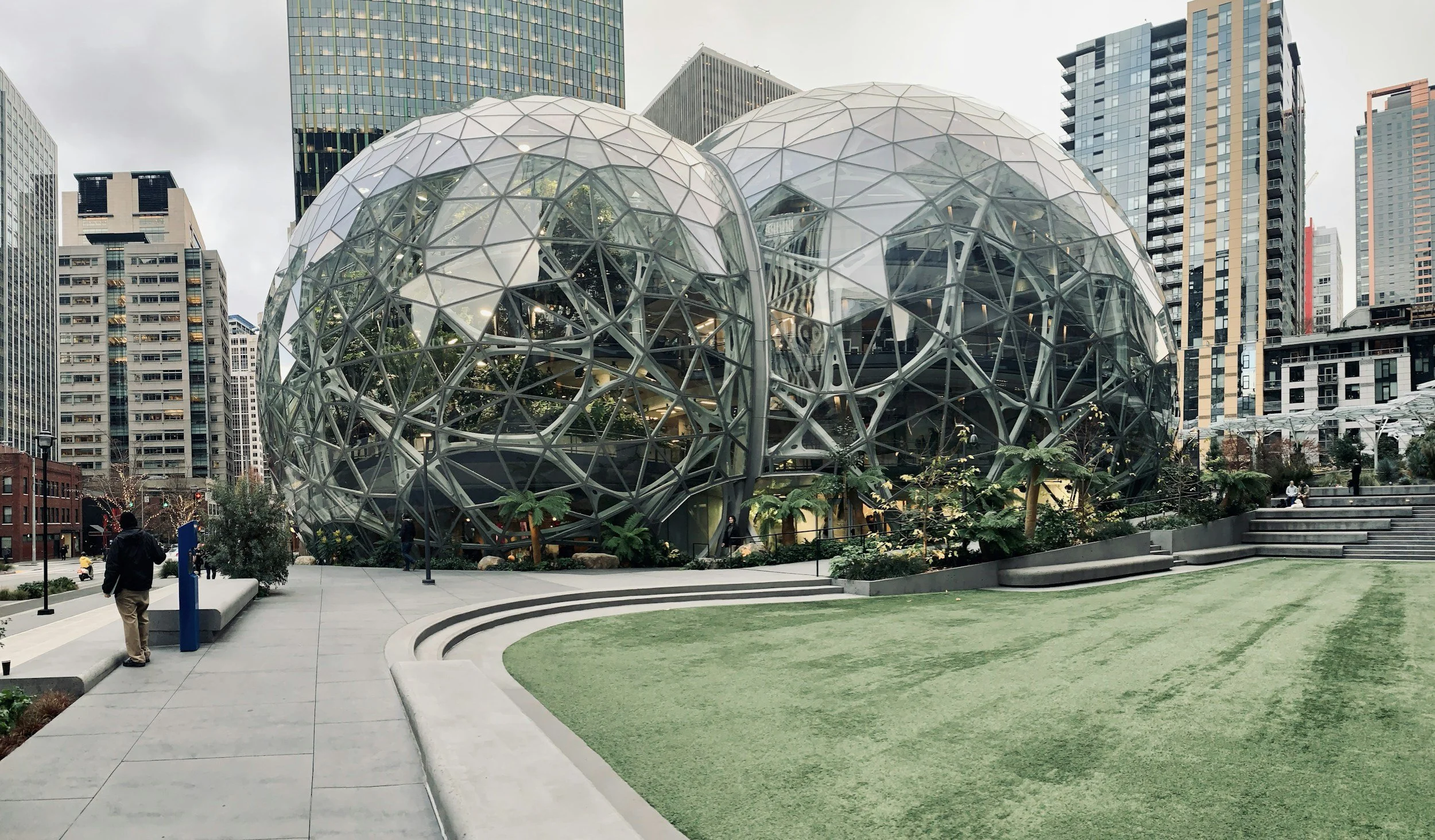
Imagine walking through an ordinary city, surrounded by glass offices, cars, and traffic lights, when you spot three enormous glass domes between the buildings. You look inside—and there’s a jungle! Tall trees, vines, flowers, a waterfall, and walkways among the leaves. This isn’t a fairy tale: it’s The Spheres in Seattle, a U.S. city. The most surprising thing about them is that some of the heat for this forest comes from computers.
How the South Lake Union Neighborhood Came to Be
The neighborhood where The Spheres stand is near Lake Union in Seattle. Many years ago, there were no beautiful glass buildings here. The area was full of warehouses, workshops, laundries, car dealerships, and small factories. It was considered an ordinary, slightly dull neighborhood.
But it had already been the site of bold experiments once before. In 1916, near Lake Union, William Boeing, then a young entrepreneur, tested his first airplanes. They landed directly on the water because they were seaplanes. Boeing later founded one of the world’s best-known aircraft companies.
More than a hundred years passed, and something unusual appeared nearby once again. This time, though, it wasn’t an airplane but a glass forest.
A Forest Designed for People
About 40,000 plants live inside The Spheres, and they come from more than thirty countries. Many thrive in misty mountain forests, where it’s always damp and cool.
The most interesting thing is that the plants weren’t chosen simply because “they’d like it here.” Company employees need to work and relax there, so the temperature was set to be comfortable for people: about 22 degrees Celsius during the day, like a warm room. That meant they had to find plants that liked that kind of weather, too. It’s like choosing clothes that suit both you and your cat, so you can both be comfortable on the same sofa.
Botanists look after the garden. They monitor humidity, light, and watering, and decide what to do with each tree that grows a little too enthusiastically.
How Computers Keep Plants Warm
Now for the most unusual part. If you play on a laptop or tablet for a long time, it gets warm. That’s no accident: the harder a computer works, the hotter it gets. Now imagine not one laptop, but an entire building packed with powerful computers. That’s a data center, a place where information from the internet is stored: photos, videos, messages, and games. A building like this produces a lot of heat, which is usually just removed and released outside.
In downtown Seattle, they came up with a different approach. According to the company, some of its buildings in this neighborhood get heat from a nearby data center. Warm water flows through pipes, like radiators in your home, except the heat comes from an unusual source: not a boiler, but computers at work. That way, one benefit comes from another: the computers are cooled, and nearby buildings are warmed.
What I like about this story is that nobody invented a magical new machine. Someone simply looked at something usually considered waste and realized: this is heat, and heat can always be put to use.
Why This Matters Right Now
Today, people are using AI more and more, watching videos online, and playing games. All of this runs on enormous data centers, which require a lot of electricity and generate a great deal of heat. Scientists and engineers around the world are thinking about how to make these buildings less harmful to nature. One solution is the very one used in Seattle: send excess heat to places that need it.
So the story of a small neighborhood where the first seaplanes took off a hundred years ago turns out to echo today’s conversations about the future. Back then, the bold idea was to land a plane on water. Today, it’s to grow a jungle among skyscrapers and warm it with heat from computers.
What I Think About It
When I read about The Spheres, I imagined a little girl going inside for the first time on a rainy Seattle day. Outside, the sky is gray and the pavement is wet; inside, there are green leaves as big as umbrellas and warm, humid air. And that warmth may have come from the very computers calculating someone’s messages and photos.
Smart ideas don’t always look huge and complicated. Sometimes they start with a simple question: Can we put what we already have to use?