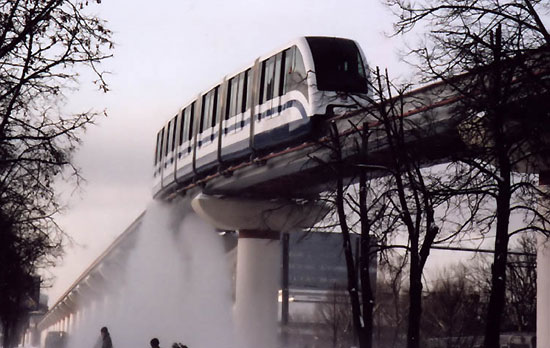
Imagine a train racing over the city on a thin rail—like it’s straight out of a science-fiction movie. Sounds magical, right? Exactly such a train appeared in Moscow in 2004. It was called a “transport of the future,” and people were very proud of it. But the future had one big problem—it wasn’t at all ready for a real Russian winter.
Where the idea of a magical train came from
Long ago, back in the middle of the last century, huge celebrations and exhibitions were held in different countries—so-called World’s Fairs. People came from all over the world to see the most astonishing inventions. There you could find TVs, space rockets—and… monorails.
A monorail is a train that runs not on two rails like a conventional one, but on a single rail. It hangs above the ground, as if floating in the air. At exhibitions, such trains looked incredibly beautiful: shiny, silent, and gliding smoothly over the heads of awestruck spectators. Everyone thought: “That’s what cities will look like in twenty years!”
And many cities really did want such a train. Not because it was more convenient than the regular metro, but because it was a beautiful symbol of the future. Sort of like buying very pretty high-heeled shoes because they look like something a princess would wear—but trying to walk in them through the forest would be completely impossible.
How a dream met Moscow’s reality
When Moscow decided to build a monorail, it chose a route in the north of the city—from the Timiryazevskaya metro station to Sergei Eisenstein Street. It took several years to build, swallowed huge sums of money, and in 2004 it was ceremonially opened.
At first everything looked exactly as people had imagined. The train drifted above rooftops; passengers watched from the windows as the streets and trees passed below. It was beautiful and unusual.
But very soon, something important became clear. The monorail technology used in Moscow had been developed for a mild climate—for exhibition pavilions and warm cities. And Moscow is not an exhibition pavilion. Here temperatures can drop to minus twenty-five, and there are blizzards and icy patches. And the future train began to break down. Often. Very often.
In winter, the wheels and mechanisms froze. The train moved so slowly—about 15–25 kilometers per hour—that pedestrians on the sidewalk below sometimes walked faster. One journalist once joked that the monorail was the only form of transport in Moscow that you could outrun on foot. People who had to hurry to work quickly stopped using it.
Why this matters for our planet
This is where the most important part of the story begins—the one people rarely talk about.
Maintaining the monorail was very expensive. Every year, millions of rubles were spent on its repair and maintenance. At the same time, the number of passengers kept dropping: people preferred the regular metro, which is reliable and fast. So for a very small number of trips, an enormous amount of resources was being burned—electricity, the metal for spare parts, and the labor of repair crews.
It’s like lighting a huge stove every day just to warm one small finger. There’s heat—yes, but at what cost?
Environmentalists and city planners say the story of Moscow’s monorail is an important lesson. When we choose a technology, we need to think not only about how good it looks in a picture, but also about whether: - it fits the local climate and conditions, - it consumes how much energy and resources, - it will truly be needed by people every day.
“Green” technology isn’t necessarily the one that looks like the future. Sometimes it’s simply the one that works well, lasts a long time, and doesn’t waste extra.
The end of one dream and the start of new questions
In 2023, Moscow’s monorail was shut down. Completely. For almost twenty years it had been running over the city’s northern districts—breaking down, getting fixed, breaking down again—and in the end city authorities decided that continuing made no sense.
Many Muscovites were sad. After all, the monorail was special—somewhat fairy-tale-like, somewhat funny, but also its own. Kids loved watching it. Some people even made a point of coming just to ride it at least once—to feel like they were in the future.
And here’s the interesting thing: the idea of the monorail itself didn’t die. In warm countries—such as Japan or the UAE—monorails work brilliantly. There are no such freezes, and the technology feels right at home. That means the issue wasn’t the train itself, but that it was brought to the wrong place.
The story of Moscow’s monorail teaches us something very important: dreaming about the future is wonderful. But before turning a dream into reality, it’s worth looking closely around—what the weather is like outside, who it’s for, and whether there will be the strength and resources to care for it. Sometimes the smartest decision isn’t the most beautiful one, but the most suitable. Like warm felt boots instead of crystal slippers—not as romantic, but your feet won’t freeze.