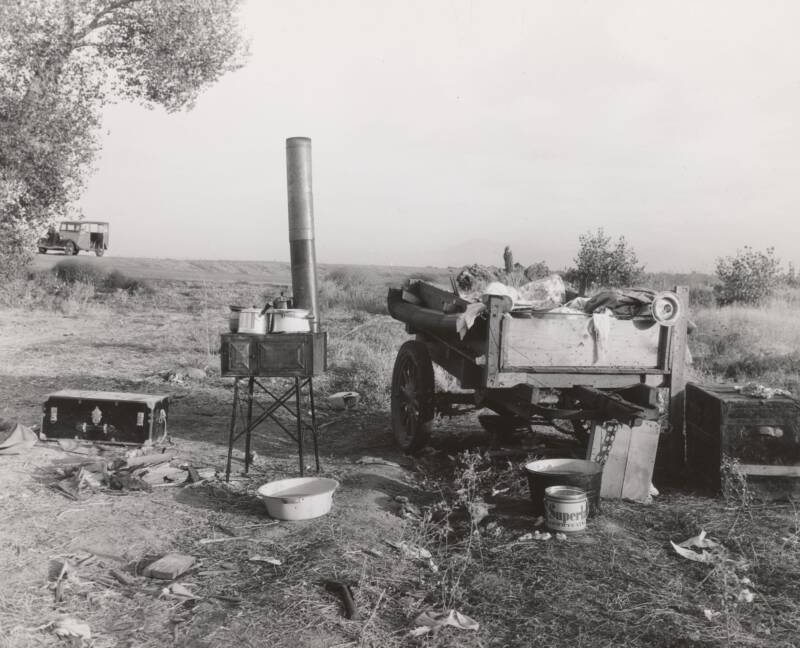
Imagine building a town out of what others threw away: old boards, rusty pipes, cardboard boxes. Now imagine that town had clean water flowing through pipes to every little house. Sounds like magic? But it really happened in Seattle nearly a century ago, when people who had lost everything built not just shelter but a genuine laboratory of resourcefulness.
In the 1930s, when the Great Depression hit America (a time when many people lost jobs and money), a special settlement sprang up in Seattle. It was called Hooverville — named after President Hoover, whom many blamed for the economic troubles. It was a town of homemade shacks built from whatever could be scrounged from dumps and the waterfront. But the residents of Hooverville didn’t merely survive — they invented. And one of their inventions still shapes how Seattle thinks about solving urban problems.
A Water System Built from Trash and Ingenuity
When hundreds began building shacks on a vacant lot near Elliott Bay in 1931, the first big problem was water. Drinking water from the bay was unsafe, and carrying buckets from far away was difficult, especially for the elderly and children. There were no engineers or funds to build a municipal water system. But there was Jesse Jackson.
Jesse had worked as a plumber before losing his job. He knew how pipes worked and understood one important fact: water flows downhill. That’s gravity, and it works for free, without electricity or pumps. Jesse proposed a plan: find a water source on the hill above Hooverville, collect old pipes from closed factories and abandoned construction sites, and build a system where water would run by gravity down to the houses.
Hooverville residents began gathering pipes. They found them at the docks, in dumps, and begged leftover sections from construction companies. The pipes came in different sizes and materials — some metal, others rubber. Jesse and his helpers devised ways to join incompatible pieces: they used rubber from old tires as gaskets, wrapped joints with wire and cloth soaked in resin. Each connection was tested repeatedly, because leaks meant loss of precious water.
By 1932 Hooverville had a water system more than a kilometer long (over 0.6 miles). Water ran from a hilltop source through homemade filters (sand and gravel in wooden boxes) to a central distribution point, and from there through small pipes to different parts of the settlement. It wasn’t perfect, but it worked. And it was built by people who had nothing but know-how and a desire to help one another.
A University of Survival and Invention
The water system wasn’t Hooverville’s only invention. The shantytown became a real school for those who could think differently. Residents created recycling systems that would seem very modern today.
For example, tin cans from food weren’t thrown away. They were flattened and used as roofing or wall material. One resident named Tom Mallony figured out how to make reflectors from cans for homemade stoves — they directed heat where it was needed and saved firewood. Old car tires were turned into shoe soles, wall insulation, even water containers (cut and sealed in particular ways).
Hooverville had a library of books people brought and exchanged. There was also an “invention workshop” — a place where residents gathered to solve common problems. How to build a stove that smoked less? How to insulate a shack without expensive materials? How to fix a tool without spare parts? People of various trades — former carpenters, mechanics, tailors, teachers — shared knowledge and searched for solutions together.
One of the most moving stories involves Hooverville’s children. Teacher Mary Farrell, who herself lived in a small wooden shack, organized a school right inside the settlement. She had no desks, textbooks, or boards. Children wrote on pieces of cardboard with coal from the stoves. Mary taught them not only to read and do math, but to think like inventors: “If you don’t have what you need, think about what you can make it from.” Some of those children later became engineers and teachers, and they always remembered Hooverville’s lessons.
How Ideas from a Shantytown Changed the Real City
Hooverville lasted until 1941, when the economy began to recover and city authorities cleared the site. But the ideas born there didn’t disappear. They took root in modern Seattle in several surprising ways.
Culture of makerspaces: Today Seattle hosts dozens of makerspaces — workshops where people gather to create things, share tools, and exchange knowledge. The best-known is called Metrix, located in Capitol Hill. There you’ll find 3D printers, machine tools, sewing machines, and, importantly, people willing to teach others. The philosophy of these places — “use what you have, share what you know, create together” — is a direct echo of Hooverville’s spirit.
Neighborhood resilience programs: After the 2001 earthquake, Seattle developed the Neighborhood Resilience Maps program. The idea is simple: in each neighborhood residents identify the resources they have (people with medical skills, tools, water sources) and how they will help one another in an emergency. This is a direct legacy of Hooverville, where survival depended on knowing who could do what and where resources were located.
Reuse movement: Seattle is known for strict recycling programs and “reuse stores” where building materials, furniture, and tools are sold cheaply. Habitat for Humanity ReStore in Seattle annually diverts tons of materials from the landfill. Staff often tell visitors how, during the Depression, people built entire homes from “trash,” and how that legacy inspires today’s builders to think creatively.
| Hooverville invention | Modern Seattle equivalent | How it works today |
|---|---|---|
| Gravity-fed water system built from scavenged pipes | Rainwater harvesting systems in urban gardens | More than 200 community gardens use gravity-fed irrigation systems |
| Knowledge-sharing workshop | Makerspaces and tool libraries | 15 branch libraries offer “libraries of things” with tools |
| Repurposing tin cans into building materials | Building material reuse centers | ReStore redirects 2+ million pounds of materials annually |
Why It Matters Today
Hooverville’s story teaches something important: the most interesting solutions often come not from people with big budgets and expensive equipment, but from those forced to think creatively because they have no other choice. When you don’t have ready-made answers, you start to see possibilities where others see only problems.
Today, as we confront climate change, resource shortages, and the need to live more sustainably, Hooverville’s experience feels relevant again. The settlement’s residents proved you could build functioning infrastructure from almost nothing, and that a community working together can solve problems that seem impossible for one person.
The Museum of History & Industry (MOHAI) in Seattle has a small exhibit dedicated to Hooverville. There you can see photos of the homemade water system, the tools residents used, and hear recorded stories from people who lived there. Many visitors are surprised to learn that this “town of trash” was in some ways more innovative than the city around it.
One of the most touching items in the exhibit is the diary of a girl named Ruth, who was 11 when her family moved to Hooverville. She wrote: “Dad says we’re poor, but I don’t think so. Yesterday Mr. Jackson taught me how pipes work, and now I know why water flows down. And we have neighbors who help each other. Is that poverty?”
Maybe true wealth isn’t money or things, but the ability to make something useful from what you have and to share that skill with others. Hooverville’s residents understood that. And Seattle is still learning from them, nearly a century after the last little tin-and-wood shack was taken down.