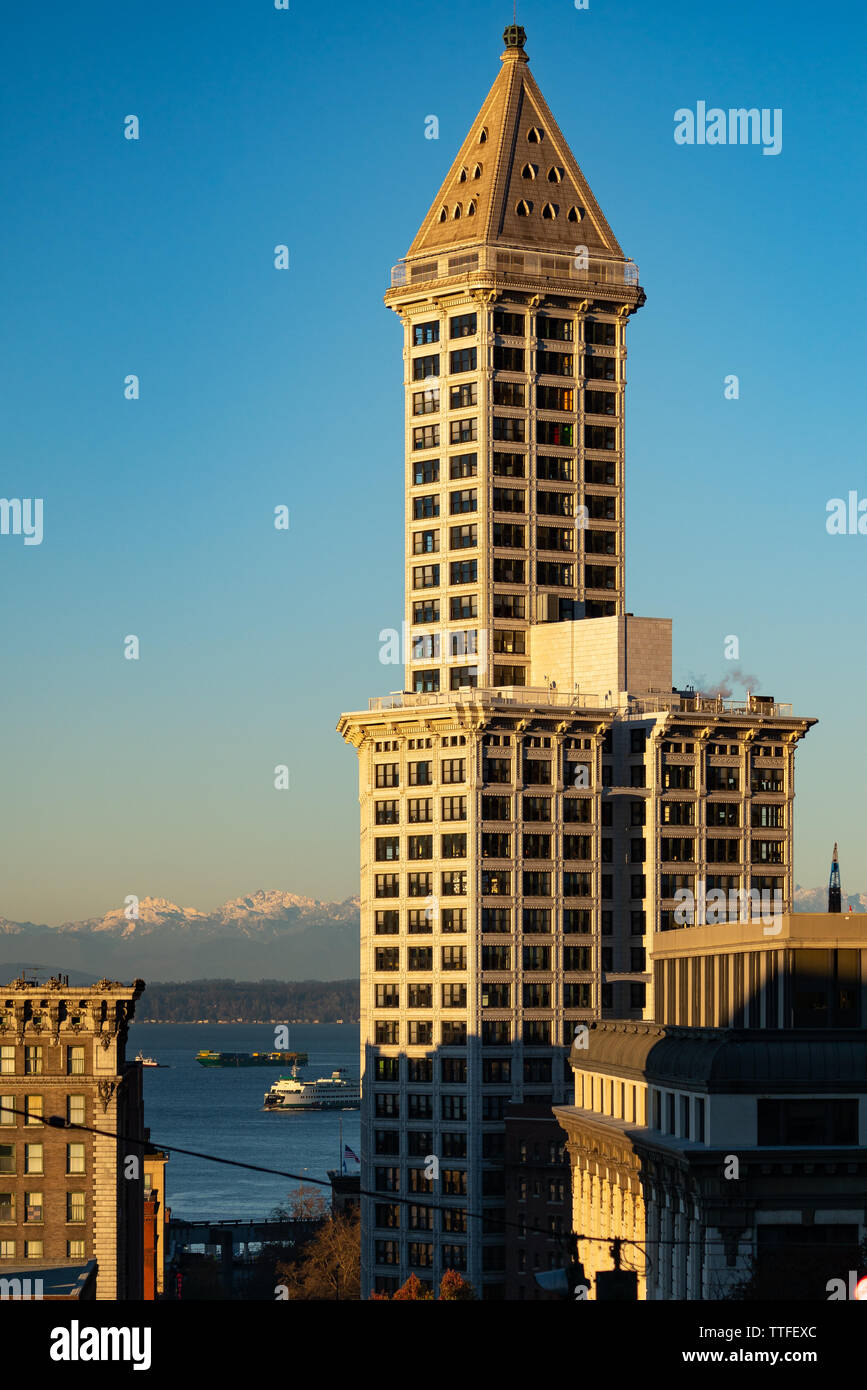
Imagine the tallest building on the entire West Coast of America. White, elegant, like a huge candle on a birthday cake. This is the Smith Tower in Seattle—it was built in 1914, and for years people looked up at it, both literally and figuratively. At the very top was the “Chinese Room”—a luxurious banquet hall with carved wooden panels imported from China, and an observation deck from which the whole city lay in plain view. That’s where, in the 1920s, dressed-up guests swirled in dances, glasses chimed, and fashionable new music played—the jazz. But this beautiful story has a darker side, one people long preferred not to talk about.
What jazz is—and where it came from
Jazz is a special kind of music. It isn’t played strictly according to sheet music: musicians improvise—that is, they invent the melody on the spot, listening to one another and responding with sounds like in a conversation. Jazz was born in the early 20th century in American cities—above all thanks to African American musicians, who took African rhythms, blues, and European harmony and fused them into something entirely new.
By the 1920s, jazz had become all the rage. Everyone loved it—rich and poor, young and old. It played in restaurants, clubs, and parties. It was alive, unpredictable, joyful. And it was the sound that filled the “Chinese Room” of the Smith Tower while, below, the lights of night-time Seattle shimmered.
But here’s the thing: the people who created this music were not invited to the tower party.
A street just a few blocks from the tower
While dances happened upstairs to jazz in the tower, quite a different life unfolded just a few blocks away. The area known as Jackson Street was the part of Seattle where African American families lived. It was packed with small clubs, cafés, and dance halls. White audiences weren’t allowed in—not because the owners didn’t want guests, but because that’s how unfair rules of the time worked. The city was divided into sections: some places were “for some,” others were “for others.”
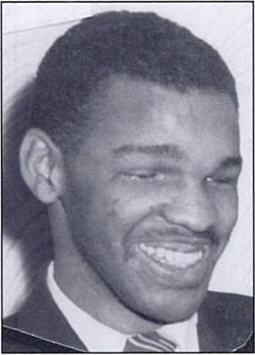
And it was in these small Jackson Street clubs that the real, living, bold music was heard. Musicians experimented, learned from one another, and played until dawn. Among them, at the end of the 1940s, was a very young man named Ray Charles—a blind pianist who came to Seattle with almost no money and no connections. He rented a room nearby and played in Jackson Street clubs, honing his craft. Later he would become one of the greatest musicians in history, known worldwide. But back then—he was simply playing for those who came to listen, in a modest room without chandeliers or gold trim.
The Smith Tower and its “Chinese Room” didn’t know about that. Or pretended not to.
An injustice that has a name
What was happening in Seattle in the 1920s–1940s is called segregation. It’s when people are separated by skin color: some get the grand entrance and the beautiful hall, others get the back door—or simply “not for you.” It was unjust. It hurt. And it was completely illogical: how could you love music and yet not let the people who made it into your celebration?
It seems to me that this is one of the strangest and saddest things in history: when people take something that isn’t theirs—an idea, a song, a dance—dress it up in gold and say “this is ours,” while asking the ones it was taken from to leave. The Smith Tower was beautiful. But beauty on the outside doesn’t always mean fairness on the inside.
The good news is that music proved stronger than any bans. Jazz from Jackson Street didn’t stay in small clubs forever—it spread across the entire world. Ray Charles became a legend. And segregation in America was officially outlawed by law in 1964.
The tower today—and voices worth hearing
The Smith Tower still stands in Seattle today. Now anyone can visit: take the elevator up, step onto the observation deck, and see the city from a bird’s-eye view. It’s beautiful and breathtaking.
But if you ever find yourself there, looking down at the streets of Seattle, try to picture it: somewhere down there, a few blocks away, a young Ray Charles once played. Laughter filled the air, people danced, and music was created by people whose names were never written into those elegant guest books. They weren’t allowed into the celebration—but they were the real celebration.
The story of the Smith Tower isn’t only about a skyscraper and jazz parties. It’s the story of how voices don’t disappear, even if people try not to notice them. And that sometimes the most important things happen not at the top, but on an ordinary street down below.