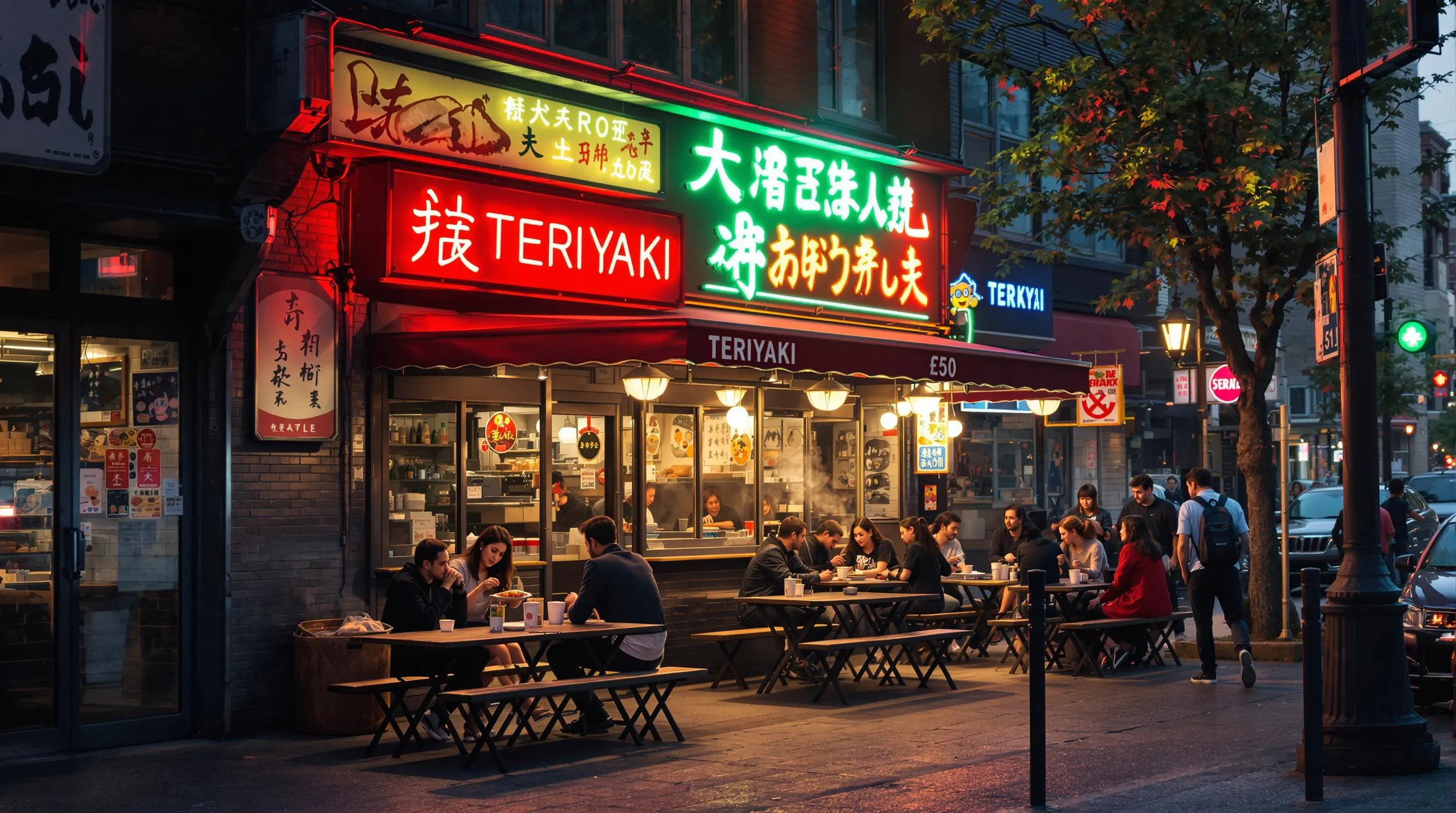
Imagine you arrived at a new school where nobody speaks your language, and the only thing in your backpack is what you do best. That's how Japanese families who came to Seattle in the 1970s felt. Many of them couldn't find work — their degrees weren't recognized, English was difficult, and good jobs went to others. But they had something special: they knew how to cook. And so these moms and dads did something that changed the whole city — they invented a food that hadn't existed anywhere in the world before.
A teriyaki that would surprise a Japanese grandmother
If you asked a grandmother in Tokyo about "teriyaki chicken with rice in a box," she would be very surprised. In real Japan, teriyaki is a cooking method (grilling with a shiny sweet sauce), not a standalone dish. There, teriyaki is most often made with fish, served in small pieces on a pretty plate, and the sauce is not nearly as sweet.
But Japanese cooks in Seattle quickly realized: Americans prefer chicken to fish. They like large portions. They like sweet food. And they're in a hurry — they need to eat in 15 minutes and go. So the cooks began to experiment. They made the sauce much sweeter, adding more sugar and using less traditional mirin (rice wine). They started using chicken thighs instead of expensive fish — it was cheaper and juicier. They invented serving everything in one box: rice, meat, and salad together.
The result was a dish that never existed in Japan. It was "Seattle teriyaki" — an entirely new invention born from the meeting of two cultures.
A kitchen that works like a factory assembly line
But the most important invention wasn't the recipe; it was how these small restaurants operated. Japanese owners devised a system that resembled an assembly line at a factory — only instead of machines, delicious lunches were assembled.
Imagine: a cook stands at a large hot grill. In front of them — chicken already cut, prepared in the morning. Nearby — a huge pot of rice cooked in a special way to stay ready all day. A little further — shredded salad in big containers. When an order comes in, the cook needs only 3–4 minutes: throw the meat on the grill, pour on the sauce (which is also pre-made according to the family's secret recipe), put everything in the box with rice — done!
This system allowed a single family — often a mom, dad, and teenage children — to serve dozens of hungry people each day. No expensive waitstaff, no big dining room with fancy tables, no large kitchen staff were needed. A small restaurant the size of your classroom could feed a whole family and even send the kids to college.
How a chicken box helped hundreds of families
In 1976 one of the first of these restaurants opened in Seattle — "Toshi's Teriyaki." Owner Toshi Kasahara worked there with his wife and children. They got up at five in the morning to cook rice and chop vegetables, worked late into the evening, but gradually business improved. A meal cost only $2–3 (about the price of two ice creams), and you could eat your fill.
People in Seattle loved it. Teriyaki was cheaper than a burger at McDonald's, faster than Chinese food, and seemed healthier (after all, it came with rice and salad!). Soon Toshi had competitors — other Japanese families saw his success and opened their own shops. By the late 1980s there were more than 60 teriyaki restaurants in Seattle. By the late 1990s — over 200.
It was a quiet revolution. Families who arrived with little money and few connections could start a business because a teriyaki restaurant didn't require huge investment. Many began by taking loans from friends or relatives. Children worked after school helping their parents. Later, when they grew up, they opened their own restaurants — with their own secret sauce variations.
Food that became part of the city
Today Seattle residents joke that there are more teriyaki joints in their city than Starbucks (though Starbucks was born in Seattle too!). Teriyaki became part of the city's identity — like pizza for New York or tacos for Los Angeles.
But it's more than just food. The story of Seattle teriyaki shows how people facing hardship didn't give up. They couldn't change the fact that their degrees weren't recognized or that finding work was hard. But they could use what they knew (how to cook), add creativity (adapt recipes for a new country), and hard work (working 12-hour days) — and create something entirely new.
Japanese immigrants didn't just invent a new dish. They invented a new business model — fast, efficient, family-run — that helped hundreds of families get back on their feet. They showed that sometimes the most important innovations don't happen in big companies with clever engineers, but in small kitchens where moms and dads are simply trying to feed their children and pursue a dream.
And every time a Seattle resident buys a box of teriyaki for a few dollars, they take part in that story — a story about how ordinary people with courage and imagination can change a whole city, one portion at a time.