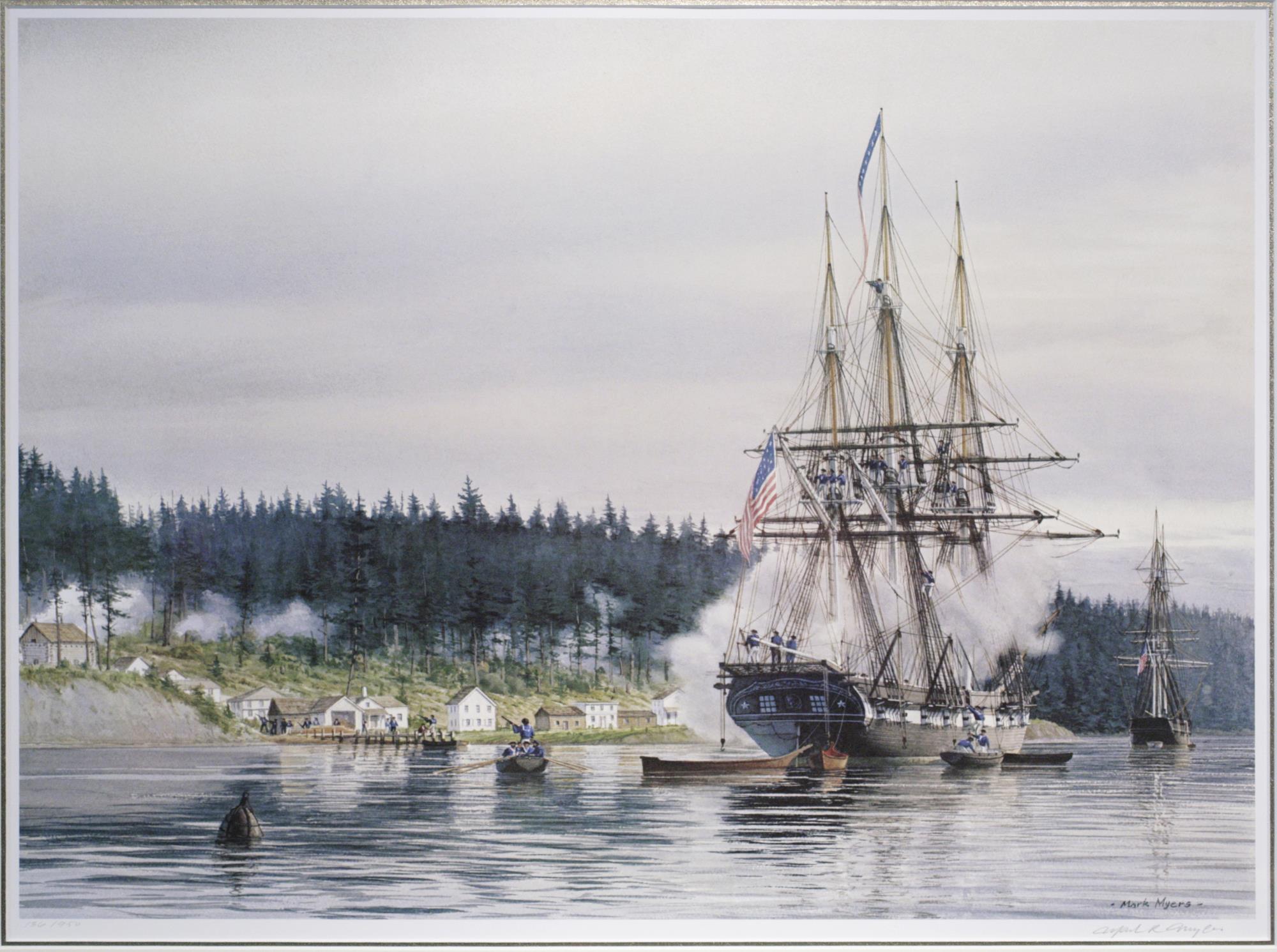
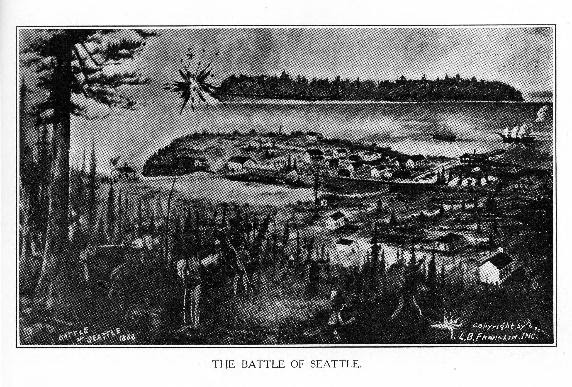
Imagine a small town on the shore of a bay, where almost everything is made of wood: the houses, the dock, even the sidewalks. A dense, dark forest looms behind it. In January 1856, Seattle found itself at the center of a battle. Log fortresses and a gunboat helped its residents survive the day, but the story of why it happened is much more complicated and interesting.
A City That Grew Out of the Forest
In the 1850s, Seattle looked nothing like today’s metropolis. About 200 people lived there. The town’s main business, a sawmill, turned trees into lumber, which was used to build houses. There were plenty of trees around: enormous Douglas firs stood almost right up against the first streets.
For builders, this was both a gift and a problem. Wood was close at hand, but the forest came so near that someone could approach the houses unseen. So the city’s early planners thought less about beauty and more about being able to see. Some trees were cut down to leave open ground between the forest and the houses. It was like a game of hide-and-seek: with nowhere to take cover, it’s harder to hide.
The Blockhouse: A House in a Shell
In the fall of 1855, as things grew tense in the area, Seattle residents built blockhouses. These were small fortifications made of thick logs. They were built in the center of the town as it then stood, near the dock and Yesler’s mill.
Think of a snail. It doesn’t attack; it simply retreats into its shell. A blockhouse worked in much the same way. Its heavy log walls were hard to break through. Narrow slits, or loopholes, let people look outside while staying protected. Families could gather inside—including children, older people, and women—while the alarm was raised.
The fort-houses were built from whatever was at hand, which almost sounds like a rule of urban design: “Build with what’s nearby.” In Seattle, the forest was nearby, so the forest became part of the town’s defenses, too.
The Decatur: A Fortress on the Water
The key role that day was played by the warship Decatur. It was anchored in Elliott Bay, not far from shore, and carried many guns—about sixteen. This “wall” was better than any tower: the ship could be turned in any direction, and its cannons could reach the forest beyond the town.
On the morning of January 26, warriors from several Indigenous nations, including groups from the eastern and southern parts of the region, according to historians, advanced on Seattle. The battle lasted almost all day. The ship fired into the forest, and shells burst in the treetops. Two Seattle residents were killed, while the number of casualties on the other side is not known for certain. Historians disagree about exactly who took part, who was in command, and what the goals were.
Why It Happened
To understand that day, we need to know what came before it. In 1854–55, U.S. authorities forced the region’s Indigenous peoples to sign treaties under which they gave up vast territories and moved to small reservations. Many considered these treaties unfair because their terms had been imposed or poorly explained. Tensions mounted, and war broke out—a conflict known as the Yakima War or the Puget Sound War. The battle in Seattle was just one episode in it.
Chief Seattle (Si’ahl), for whom the city is named, favored peaceful relations with the settlers. He understood the force of the tide of people arriving on these lands and sought to protect his people through peaceful means. Later, his daughter, Princess Angeline (Kikisoblu), became a well-known resident of the city.
When you read about that siege, it’s hard not to think that each side had its own “home” to defend. For the settlers, it was logs and planks; for Indigenous people, it was all this land, the forests, and the shores.
What Remains of Those Days
The blockhouses’ logs have long since disappeared, and high-rises and paved streets have taken their place. But some things remain. The city center still stands by the water, next to the port. And the name “Seattle” recalls a chief who chose peace.
This story teaches us two things. First, cities can be “read” like books: the layout of the streets, where the dock stood, and where the forest’s edge ran all show what people feared and what they sought to protect. Second, every story has more than one side. A log blockhouse may look like a simple little house, but it holds a story of anxiety, fear, and disputes that are still important to listen to carefully.
If you find yourself in Seattle, walk along the bay and imagine: where cafés and waterfront promenades stand today, a fortress ship once lay at anchor, with a wall of forest beginning behind it. The city grew from that morning, and it’s worth remembering the whole story, with all its voices.