Imagine you have to send a huge log down a steep hill that weighs more than five elephants. You have no machines, no cranes, not even horses that can help—the load is too heavy and too dangerous. What would you do? Engineers in Seattle in the 1850s came up with a solution that sounds like magic: they built a road that let the trees slide down on their own, like a giant slide. This road was called the Skid Road, and it was a true feat of engineering, even though it was made only of wood and... pork fat.
A problem that muscle power couldn't solve
In the mid-19th century Seattle was a small town surrounded by vast forests. The trees there grew so tall and thick that a single log could weigh several tons. Henry Yesler’s sawmill stood below, right at the bay, while the forests grew on steep hills. The problem was simple but seemed unsolvable: how to get these gigantic logs from the hill down to the sawmill?
Horses couldn't haul such weight up and down steep slopes—it would be dangerous for both animals and people. Rolling logs down unchecked wasn't an option either: on too steep a hill they would accelerate like mad and could kill someone below. And if the slope was too gentle, the logs wouldn’t move at all. Something in between was needed, and that "in between" required precise calculations—at a time when there were no calculators, computers, or even accurate measuring instruments.
Yesler was more than a logger—he was a self-taught engineer. He realized that gravity itself had to do the work, while the speed of the logs had to be controlled. The solution was brilliant in its simplicity: build a special road of logs laid across the slope that would act as a controlled slide.
The mathematics of a giant slide
The heart of Yesler’s invention was the exact angle of the slope. He and his crew ran many experiments before finding the ideal degree of incline. The road had to descend at roughly 15–20 degrees—steep enough for logs to glide under their own weight, but not so steep that they turned into uncontrollable projectiles.
The road itself was built from smaller logs laid perpendicular to the direction of travel—like railroad ties, but much closer together. These transverse logs were called "skids," and they gave the road its name. But the most important part of the system was... pork fat. Workers regularly greased the wooden skids with fat, turning the road into a giant slippery slide.
The process worked like this: a massive log was placed at the top of the Skid Road. A crew of several men with long poles and hooks controlled its movement. The log would begin to slide slowly down the greased skids, picking up speed. The workers walked alongside, using their tools as brakes—they wedged hooks between the log and the skids to slow it when necessary. This required incredible coordination and courage: one mistake and a multi-ton log could crush a person.
A town that smelled like frying bacon
Seattle residents said that when the Skid Road was operating, the whole neighborhood smelled like a giant frying pan. The friction of heavy logs on fat-smeared wood generated heat, and the fat literally began to sizzle. It wasn’t just a smell—it was sound and spectacle. The thunder of sliding logs could be heard for blocks. The wooden skids creaked and groaned under the weight. Workers shouted commands to one another, warning of the next giant on the move.
Work on the Skid Road was among the most dangerous jobs in the town. Workers needed excellent reflexes, strength, and teamwork. They were often immigrants—people came from all over the world seeking work, and many found it here, on this slippery, dangerous road. After shifts they gathered in taverns and cheap lodging houses that sprang up along the road. That’s how the area around the Skid Road became a workers' neighborhood and gradually turned into a poor district.
Interestingly, the term "skid row" (in American English) or "on the skids" (to be sliding downward, to decline) originated from this road. At first it simply referred to the district around the log slide, but over time it came to denote any impoverished, troubled urban neighborhood. So an engineering solution gave a name to a social phenomenon.
A lesson from engineers without diplomas
What makes the Skid Road a genuine engineering marvel is not the complexity of the technology, but the ability to solve a huge problem with simple means. Yesler and his team had no modern tools, but they understood the physics: gravity, friction, angles. They used what was at hand—wood, fat, human labor—and created a system that ran day after day, year after year.
Modern engineers study solutions like this because they demonstrate an important principle: sometimes the most elegant solution is not the most high-tech one, but the one best suited to the situation. Today logs are transported on huge trucks with powerful engines, but the principle remains the same—you must control the movement of heavy loads on slopes.
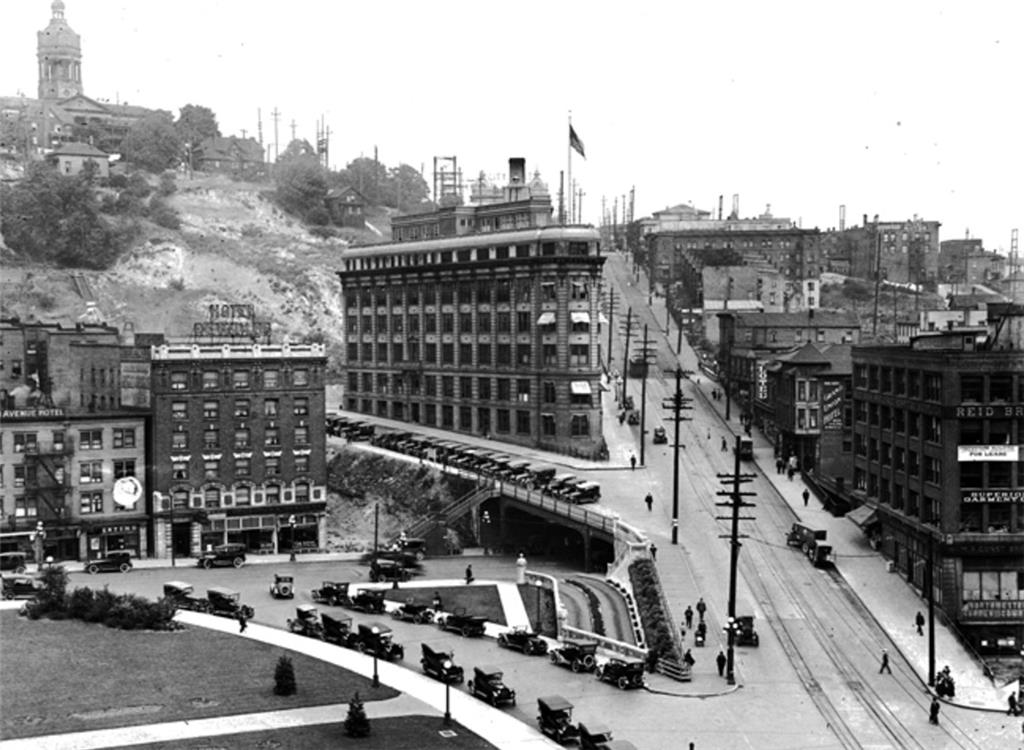
The Skid Road operated for several decades and helped Seattle become a major center of the timber industry. Without that clever road the city might have developed very differently. Today Yesler Way runs where the original Skid Road once lay—one of the main streets of Seattle’s historic center. Beneath the asphalt you can still find remnants of the old wooden skids—a reminder of the time when engineering smelled like frying bacon and trees slid down hills like a ride at an amusement park.
This story teaches an important lesson: you don’t always need the latest technology to solve a hard problem. Sometimes it’s enough to understand how the world works—gravity, friction, angles—and use that knowledge creatively. The engineers of the Skid Road didn’t build rockets or invent computers, but they created a system that changed a whole city and gave the world a new phrase. And they did it with wood, fat, and mathematics.