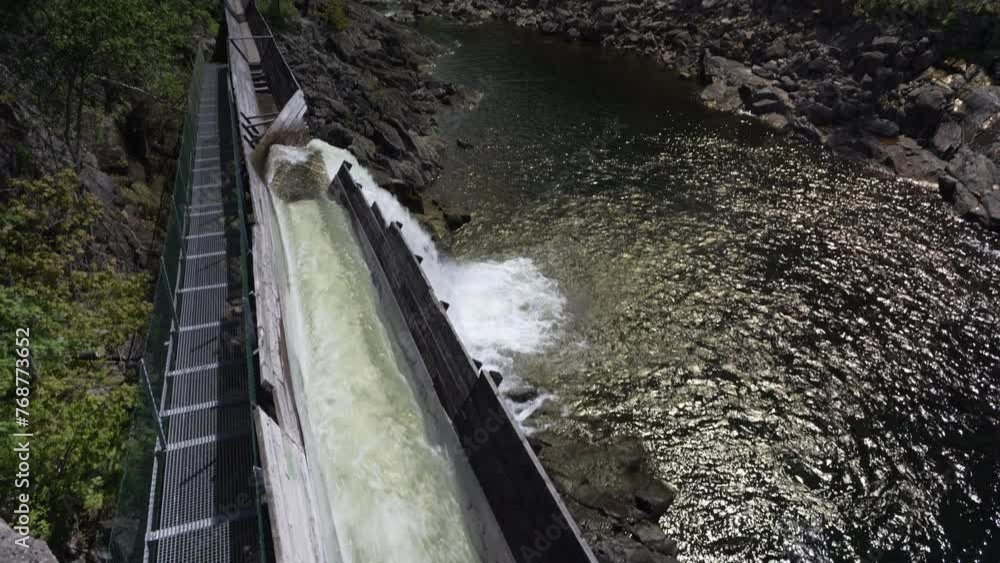
Imagine a giant tree — so big that five children holding hands couldn't wrap around its trunk. Now imagine you need to get that tree down a steep hill to the sea, where a sawmill sits. No trucks, no cranes, just you, a few oxen, and a big problem. That was the task people in Seattle faced in 1852. And they came up with a solution so simple and ingenious that it changed the whole city.
A problem you couldn’t avoid
When Henry Yesler built the first steam-powered sawmill in Seattle, he chose a site right on the waterfront — it made loading sawn lumber onto ships easier. But the best trees grew high on the hills. Those giant firs and spruces were so heavy that a single trunk could weigh more than three cars combined.
Loggers felled the trees with axes (imagine how long that took!), limbed them, and then a real puzzle began. How to get those trunks down? Dragging them over the ground was impossible — the oxen bogged down in mud, and logs snagged on rocks and other trees. A road was needed. But not an ordinary road — a special one for logs.
A road to slide on
Yesler came up with what now seems obvious, but at the time was a real breakthrough. He built a road of logs laid crosswise along the slope like railroad ties. These logs were smoothed and placed very close together. Now the clever part: every morning special workers walked the road and smeared it with... fat! Yes — ordinary animal fat left over from slaughtering cattle.
The result was a slippery road over which huge logs could slide down almost by themselves. Oxen or dogs (yes, in Seattle they used big strong dogs for this work!) hauled the logs to the top of this road, and then the log slid down the slope — ssshhh! — straight to the sawmill. This was called a "skid road" — a sliding road.
How it actually worked
Picture a typical workday on this road. Early morning, fog still hanging. A twelve-year-old boy walks the wooden road with a large bucket of fat. He dips a rag into the fat and spreads it on the logs. It’s greasy work, hands slick, but vital — without it nothing will move.
Then the loggers come with oxen. They hook chains to the huge trunk, the oxen strain and pull with all their might, and the log begins to move. It reaches the greasy road and... starts to slide! Now the oxen don’t need to pull so hard — they just steer the log so it doesn’t veer off.
The log slides down, making a loud creaking sound — skrii-i-ip, skrii-i-ip — as it rubs against the wooden rails. Sometimes the friction even produces smoke! If a log began running too fast, workers drove wooden wedges between the log and the road to slow it. It was dangerous work — you had to jump clear before the multi-ton log rolled over you.
The street that grew out of the road
That slippery road worked so well that a city grew up around it. First came the loggers’ shacks — convenient to live near the work. Then shops selling food and tools opened. Taverns followed, where tired loggers drank and rested after a hard day.
Gradually the forest around Seattle was cleared, the sawmill closed, but the street remained. It became known as Yesler Way — named for the man who invented it. But old-timers still called it the "skid road" — the sliding road. And here something sad happened.
When the work disappeared, many loggers were left without pay. They continued to live on that street in the old shacks. The street became poor and run-down. People began saying, "He’s gone down to skid road" — meaning a person had become poor and unfortunate. Over time the phrase changed to "skid row," and now it’s used to describe impoverished neighborhoods in various American cities.
What remains of the slippery road
Today the spot where that greasy wooden road once lay is an ordinary city street with asphalt and cars. But if you look closely you’ll see small metal plaques in the sidewalk that tell the story of the skid road. In one place even old wooden logs are preserved under glass — a piece of the real road down which giant trees slid 170 years ago.
Interestingly, the idea proved very clever. People realized: if something heavy has to be moved, you don’t necessarily have to lift and carry it. You can make it slide! The same idea is used today — when movers shift heavy objects they put slick sheets under them. It’s much easier than lifting.
The lesson of the slippery road
The history of the skid road teaches an important lesson: the best solutions are often the simplest. People had no complex machines or computers. They had logs, fat, oxen, and a steep hill. They looked at what they had and figured out how to use it. They didn’t fight the hill — they used it! Gravity did the hauling; they only had to make the road slippery.
That simple idea — greasing a wooden road — helped build a whole city. Without it, Seattle couldn’t have grown so fast, because there would have been no boards to build houses. And the road also gave the English language a new expression still used today.
So the next time you face a tough problem, remember the skid road. Maybe the solution is right in front of you — look at what you have and ask, "How can this be used differently?" Sometimes a bucket of fat and a few logs can change everything.