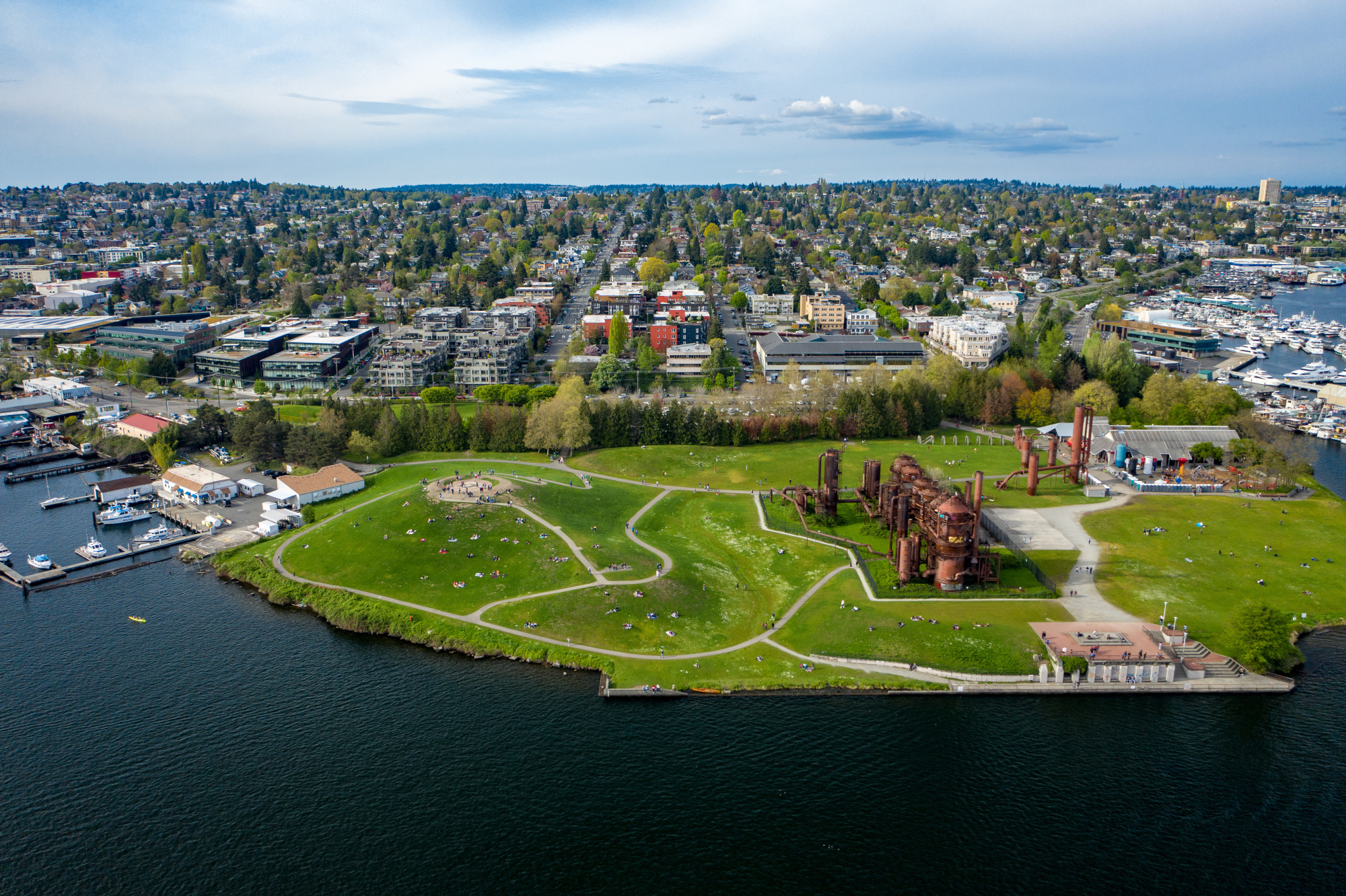
Imagine adults decided to build a playground right on the site of an old factory where the ground is soaked with poison, and huge rusted pipes rise into the sky like metal monsters. Most parents would scream, "Are you out of your mind?!" But that is exactly what happened in Seattle in the 1970s, when a designer named Richard Haag turned one of the city's most polluted sites into a park where children today fly kites and families picnic. This is the story of how one person convinced an entire city that even the worst mistakes of the past can be turned into lessons for the future—if you have the courage not to hide them.
The plant that poisoned the ground for 100 years
In 1906, a huge plant, the Seattle Gas Light Company, was built on the shore of Lake Union in Seattle. The plant produced gas for lighting homes and cooking—at the time electricity was not yet in every house. The process was this: workers heated coal to very high temperatures, and gas was released from it. It sounds simple, but in reality it was one of the dirtiest processes imaginable.
Every day the plant released black smoke into the air, and dangerous chemicals seeped into the soil: benzene, toluene, cyanides, heavy metals. Imagine someone pouring a bucket of paint into your schoolyard every day—after 50 years not a blade of grass would grow. That’s what happened on the plant’s grounds from 1906 to 1956, when it was finally closed. By then so much poison had accumulated in the soil that scientists said: this land will be dangerous for another century.
When the plant stopped, what remained on the site was a graveyard of metal: giant towers as tall as a 12-story building, miles of rusted pipes, enormous boilers and generators. The city bought the land in 1962 and wanted to make a park. But what to do with all that metal junk? Everyone was sure: it must all be torn down, hauled away and covered with fresh soil. Everyone, that is, except one person.
The designer who fell in love with rust
Richard Haag was hired in 1970 to design the new park. When he first arrived at the former plant site, most people would have seen only ruin and danger. But Haag saw something else. He walked among the rusted towers, touched the cold metal of the pipes and thought, "These structures tell a story. They show how people worked, how technology developed, what mistakes we made. If we destroy all this, we’ll lose an important lesson."
It was a revolutionary idea. In the 1970s no one left industrial ruins in parks. Parks were supposed to be "pretty"—with tidy lawns, flowerbeds and benches. Haag’s idea seemed crazy: leave giant rusted towers for children to climb on? Preserve boilers and generators as sculptures? Many Seattle residents were furious.
At public hearings parents shouted, "Our children will get hurt on rusty metal!" Environmentalists warned, "This land is poisoned, you can’t even plant grass there!" City officials shook their heads, "This will look like a dump, not a park!" But Haag didn’t give up. He explained again and again: "We cannot simply forget what was here. These towers are a memorial to our mistakes. If we preserve them, every child who comes here will ask, ‘Mom, what’s that?’ And you will tell them about how important it is to care for nature."
How to clean soil contaminated by 50 years of poisoning
While adults argued about the towers, the hardest work began—the cleanup of the soil. Engineers and ecologists ran hundreds of tests and discovered that the contamination was far worse than anyone thought. In some places concentrations of toxic substances were 1,000 times above safe levels. That meant simply covering the site with fresh soil was insufficient—the poison could leach upward or reach the lake.
The team developed a complex cleanup plan that took several years. First, workers in special protective suits excavated thousands of tons of the most contaminated soil and transported it to specialized hazardous-waste landfills. It was like an operation: the "sick" parts had to be removed without contaminating everything around them. Then the remaining soil was treated with special bacteria that "eat" certain pollutants. Yes, there are microbes that feed on poisons and convert them into safe substances!
But the smartest solution was creating a multi-layered "cake" of different materials. Imagine making a sandwich: at the bottom they placed a layer of clay (which doesn't let water and poisons pass), above it a layer of clean soil, then a layer of compost to feed plants, and only then grass and trees. This "cake" protected people from what remained in the deep layers of soil while allowing nature to return to the poisoned land.
The work was dangerous and slow. One worker involved in the cleanup later recalled, "We knew we were doing something important. Every day we were turning dead ground into a place where children could play. It was frightening, but we believed in the project." By 1975, after five years of work, the site was declared safe and the park was finally opened to visitors.
Towers that taught the city a new view of beauty
When Gasworks Park opened on July 30, 1975, many Seattle residents came with skepticism. They expected to see a gloomy, depressing place. But something surprising happened: people began to fall in love with those rusted towers. Children eagerly climbed the metal structures, which Haag had specially reinforced and made safe. Artists came to paint the unusual silhouettes against the sunset. Families picnicked on the hill with a view of the lake and the towers.
Richard Haag was right: the industrial ruins became not frightening but mesmerizing. They told a story. Parents explained to their children how gas used to be made, why it was harmful to the environment, and why it’s important to think about the consequences of our actions. The towers turned into a giant outdoor textbook.
Over time the park became one of Seattle’s most popular spots. Every Fourth of July thousands gather there to fly kites and watch fireworks. The rusted towers that once symbolized pollution and destruction have become symbols of hope and transformation. They show that even the greatest mistakes can be turned into lessons and something new.
Haag’s idea influenced the world. After the success of Gasworks Park, designers in other countries began preserving industrial structures in parks. In Germany an old coal mine was turned into a cultural center. In New York an abandoned railway line became the High Line park. They all followed the principle Haag proved in Seattle: history—even dirty and unpleasant—deserves to be remembered.
What we learned from the poisoned park
The story of Gasworks Park teaches us several important things. First, it shows that "ugly" does not always mean "bad." Rusted towers aren’t like traditional park sculptures, but they are honest—they don’t hide the past behind a pretty façade. Second, this is a story about courage. Richard Haag risked his reputation by proposing an idea everyone thought was crazy. But he believed in his concept and managed to persuade others.
Third, Gasworks Park proved that even the most poisoned soil can be healed if enough effort and knowledge are applied. The scientists and engineers who cleaned the site developed methods later used to restore hundreds of other contaminated sites worldwide. Their work saved not only this park but helped clean many other areas.
Today, almost 50 years later, Gasworks Park remains one of America’s most unusual and beloved parks. The towers still stand, though now they are patinated by time and look like ancient monuments. The grass on the hills is green and thick, trees have grown tall, and ducks swim in the lake again. A place that once symbolized industrial pollution now teaches us that the mistakes of the past can become lessons for the future—if we are brave enough to face them.
The next time you see something old, rusty or "ugly," consider: maybe it’s not junk to throw away but a story to preserve. That’s what Richard Haag thought, and thanks to him a whole city learned to see beauty where they once saw only a problem.