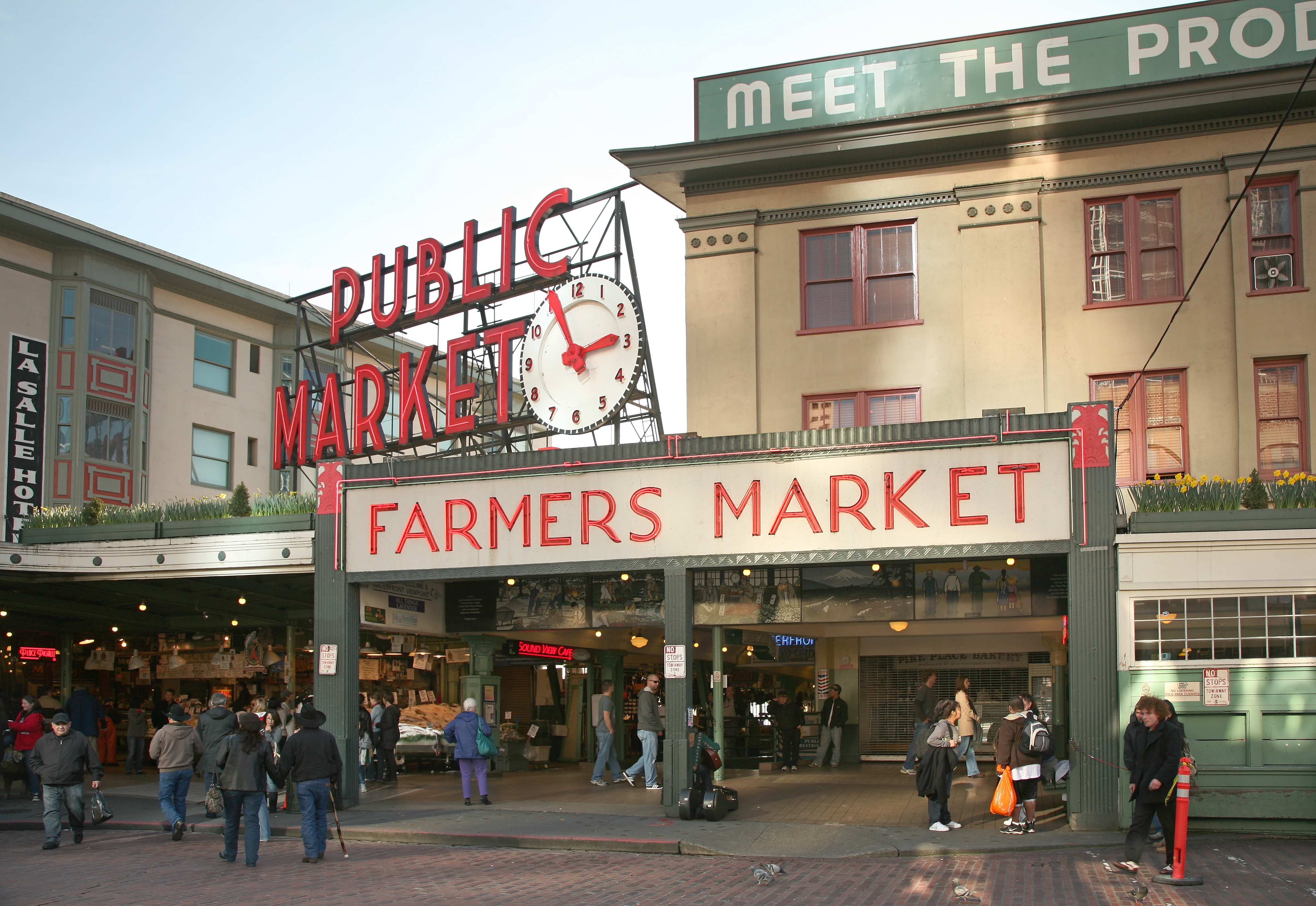
Imagine a market that hangs over the sea. Literally—it sits on the edge of a steep cliff above a bay, and if you look at it from the water, it seems like it’s about to drop straight into the waves. This is Pike Place Market in Seattle—one of the oldest markets in America, where more than a hundred years have been selling fish, flowers, cheese, and just about everything else. Tourists think it’s always been like this—loud, colorful, and eternal. But in reality, this market was nearly wiped out twice. And both times, it was saved by the most ordinary people—along with engineers who came up with something very smart.
Who built this market—and why it matters to know
The market opened in 1907, and from the very beginning its main owners were immigrant farmers. The largest number of workers here were Japanese families. They arrived in America in the late 19th century, rented land around Seattle, and grew vegetables and fruit. At the market, they sold everything themselves, without middlemen—first directly from carts, and then from their own stalls. By 1938, nearly 200 out of 500 trading spots at Pike Place were run by Japanese-American families. These were people who got up before dawn, hauled baskets of strawberries and cabbage across the whole city, and knew each of their customers by name.
The market was more than just a place to trade—it was a real center of life for people who in America had it extremely hard. Japanese immigrants were barred from some restaurants, they weren’t sold homes in “good” neighborhoods, and their children attended separate schools. But at the market, they were in charge. They were respected there—for fresh strawberries, for fair prices, for a smile.
The first blow: a war that emptied the market
In December 1941, Japan attacked the U.S. naval base at Pearl Harbor. America entered the war—and immediately began to view its Japanese-American residents with suspicion. In February 1942, President Roosevelt signed an order requiring all people of Japanese ancestry on the West Coast of the United States to leave their homes and relocate to special camps deep inland. Not because they had done something wrong. Simply because their ancestors were from Japan.
Families packed up in a matter of days. Farms were abandoned. Market stalls too. Some families managed to sell their property for next to nothing; others just lost everything. Children took their favorite toys with them—and never returned to their homes. On Pike Place Market, it instantly became quiet and empty. Almost half of the stalls emptied overnight.
After the war, many families tried to come back—but their farms had been sold or left to ruin, their money was spent, and the market would never be the same again. The market survived, but something important about it was broken.
The second blow: bulldozers and big plans
Years passed. The 1960s arrived, and Seattle city officials decided that the old wooden market was nothing more than worn-out junk. “Let’s demolish it,” they said, “and build a modern hotel, a multi-story parking garage, and beautiful offices on this spot.” This was called “urban renewal”—at the time, across America old neighborhoods were being torn down and new concrete buildings raised.
You’d think no one would argue with the city authorities. But there were people who said no. Architect Victor Steinbrück and his friends founded an organization called the Friends of the Market and began explaining to everyone why the market couldn’t be destroyed. They made posters, went door to door, talked with neighbors. In 1971, the people of Seattle voted in a city referendum—and the majority said the market should stay.
It was a victory. But right away, a new question appeared: how do you preserve a building that’s already more than sixty years old, sits on a steep hillside above the sea, and is made from old wood?
Smart construction: a market like a multi-layer cake in a hillside
This is where the most interesting part begins—the engineering miracle. Pike Place Market stands on a hillside that drops right down into Elliott Bay. From the outside, it looks like a simple one- or two-story building. But in fact, the market goes down the slope in several levels—like a cake where each next layer sits a little deeper into the hill.
The lower levels are a whole underground city: shops, workshops, small cafés. Some halls are cut right into the hillside, while others are supported by old wooden pilings over the cliff. When engineers took on the restoration in the 1970s, they had to solve a real puzzle: how to reinforce the old wooden structures so they wouldn’t slide down the slope. They strengthened foundations, inserted steel beams inside wooden walls, built retaining walls—everything was done so carefully that nothing looked different from the outside.
In addition, the engineers built a special descent staircase—the “Pike Place Hill Climb”—which connects the market with the waterfront below. This isn’t just a walkway. It’s an entire system of passages, platforms, and elevators built into the cliff. Thanks to it, the market “connects” with the city above and with the sea below.
It seems to me that’s what makes Pike Place special: it’s not just sitting on a pretty spot—it’s grown into it, like a tree with roots in the ground. You can’t simply pick it up and move it. It is the hill, the cliff, and the view of the water.
The market as living memory
Today, Pike Place Market is one of the most visited places in Seattle. Tourists take photos by the famous clock sign, watch fishers toss huge salmon to one another, buy bouquets of flowers and hot soup. Few of them know that under their feet there are several floors of history climbing up the hill. And even fewer remember that, once upon a time, there were stalls of Japanese farmers here—until one morning they were asked to pack up and leave.
The market survived twice—first when the war took away the people who built it, and then when bulldozers were already almost coming up to its walls. It was saved not by money or power, but by ordinary people with posters and engineers with blueprints. That’s probably the most important thing: sometimes a place stays alive not because it’s made of stone and built to last, but because someone decides to fight for it.