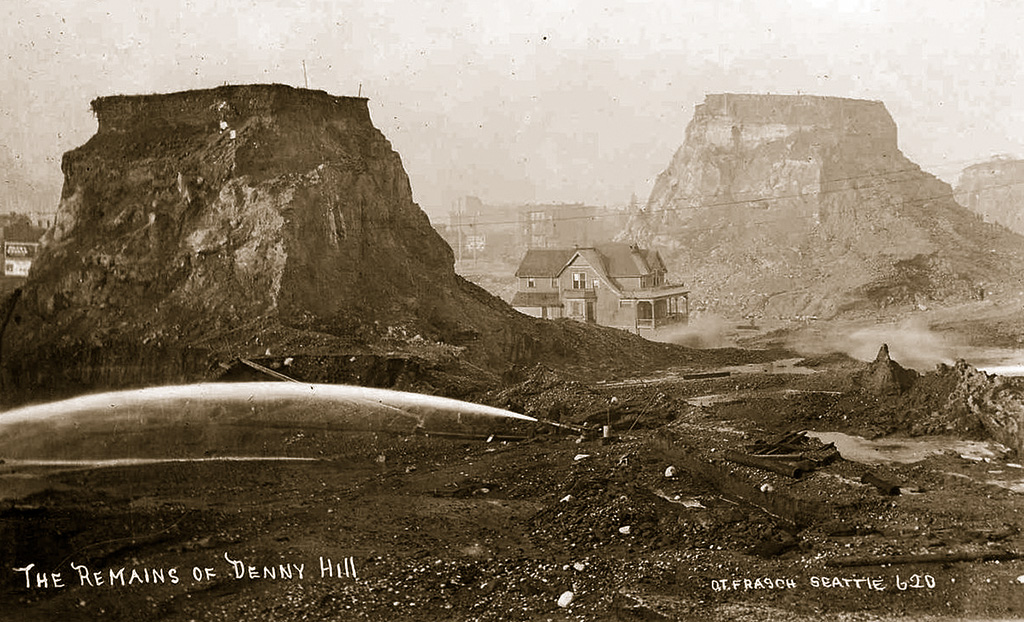
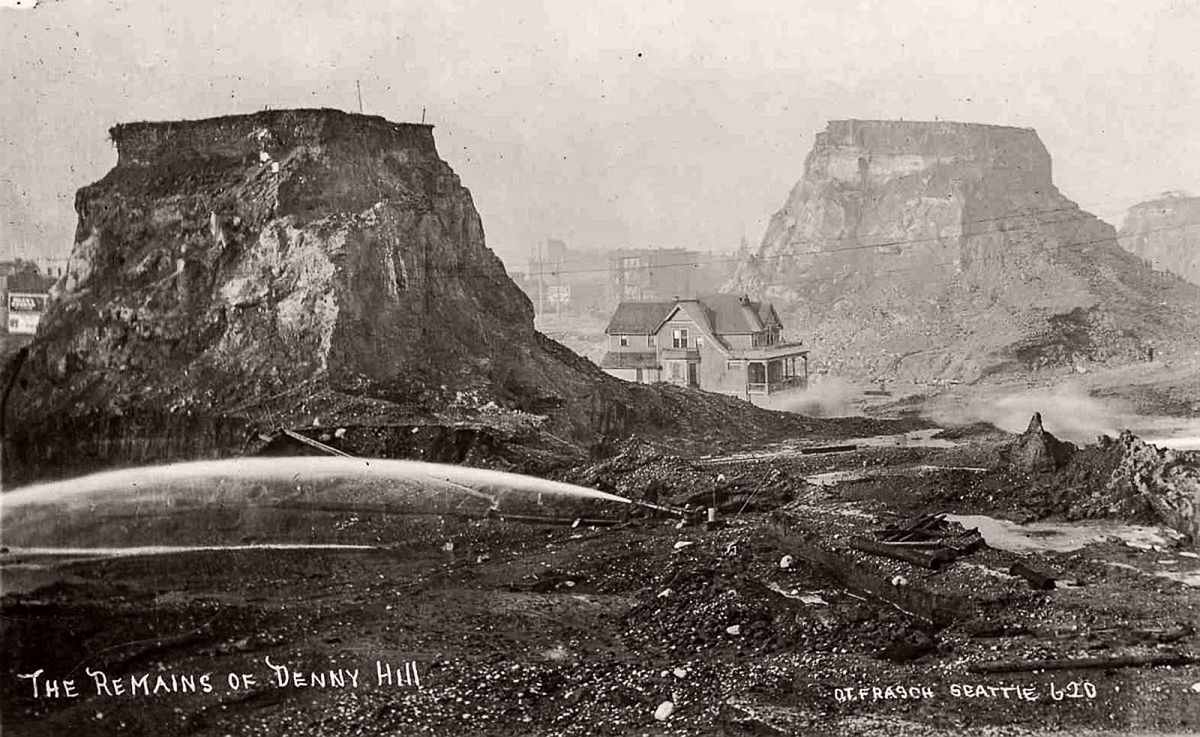
Imagine that one morning you wake up and learn that your home will be washed away by water. Not because of flooding, not because of a hurricane—simply because someone decided that a smooth road would be better built on that spot. That is exactly what happened to an entire hill in Seattle more than a hundred years ago. The hill was called Denny—and it was literally washed away with giant water hoses. But the most astonishing part of this story isn’t how the hill disappeared. It’s where the people who lived on it ended up.
A Hill With Beautiful Homes and a Big Dream
In the late 19th century, Denny Hill was one of the most beautiful places in the young city of Seattle. It was lined with tall Victorian mansions with carved balconies, small shops, and cozy cafés. And at the very top stood the huge hotel “Washington”—so elaborate that locals called it “a castle on the hill.” Artists, musicians, shopkeepers, and ordinary families lived there. People loved this hill. From it, you could see the entire bay.
But the hill had one “drawback”—at least, from the point of view of those who wanted to make money. It was too steep. Horse-drawn wagons struggled to climb up. Trams also slipped and stalled. Which meant that the land there sold poorly.
Money Over Memory
That’s where the main character of this story comes in—not kind, not cruel, just extremely practical. His name was James Moore, and he was a developer: a man who buys land, builds houses on it, and sells them. Moore looked at Denny Hill and saw not beauty, but a problem. “Build the hill down—you’ll get a flat place,” he thought. “A flat place can be developed. If you develop it, you’ll make money.”
City officials agreed. They, too, wanted Seattle to grow and prosper. And in 1898 what became known in history as the “Denny Regrade” began—Denny Regrade in English. Workers directed powerful water hoses straight into the slopes of the hill. The water eroded the ground, the mud drained into the bay, and the hill slowly—year after year—disappeared. The process took more than thirty years, continuing until 1930. An entire generation watched as a mountain was turned into a plain.
The “Washington” hotel was demolished. The mansions were torn down. The streets where children walked vanished under layers of mud and water.
A Balloon of Culture
This is where the most interesting part begins. When you squeeze a balloon on one side, the air doesn’t disappear—it shifts to the other side. Something similar happened to the people of Denny Hill.
Artists, musicians, owners of small theaters and bookshops—all of them were forced to move. And many of them relocated to the neighboring district called Capitol Hill. They brought with them their habits, their ideas, and their talent for making life beautiful and interesting. Gradually, Capitol Hill became the most lively, creative, and unusual place in all of Seattle. Galleries, coffee shops, theaters, and bookstores appeared there. Anyone who wanted to hear new music or see an unusual painting started coming there.
Today, Capitol Hill is the heart of Seattle’s cultural life. Many researchers of urban history say that without the disappearance of Denny Hill, this district would never have become what we know today.
What Remains When a Hill Leaves
Of course, it was heartbreaking for the people who were evicted. They were losing homes, neighbors, and favorite places. It was unfair—and it’s important to remember that. No one asked the residents whether they wanted their hill to be washed away for someone else’s profit.
But the story of Denny Hill teaches us something else that’s important: culture can’t be washed away with water. You can destroy a building, you can level a hill, you can tear down a hotel. But you can’t destroy people with their talents, their friendships, and their desire to create. They’ll simply find a new place and start all over again.
Denny Hill disappeared from the map of Seattle forever. But the spirit of those who lived there is still alive in the street cafés, galleries, and theaters of Capitol Hill. Sometimes the most important things don’t disappear—they just move.