Imagine you have a magic hen that lays golden eggs. What’s better: eat the hen now or keep feeding it for life to get eggs every day? In the 1890s Seattle faced a similar choice — except instead of a hen they had an entire forest on the Cedar River.
This is the story of how ordinary people — laborers, shopkeepers, teachers — voted to pay a huge sum for a forest they would never see and trees they would never cut. And that decision still, 130 years later, provides the city with clean water.
The fire that changed everything
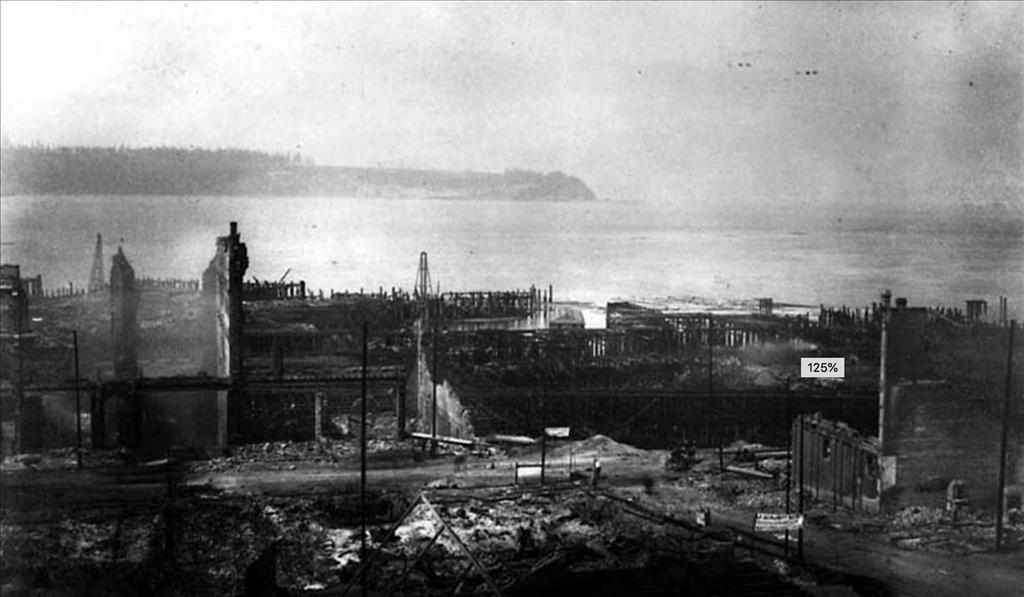
On June 4, 1889, disaster struck Seattle. In a carpentry shop on Front Street a pot of glue being heated on a stove tipped over. The glue caught fire. The flames spread to wooden walls, then to neighboring buildings. Firefighters rushed to put it out, but thin streams dribbled from the hoses — there wasn’t enough pressure.
Within a few hours the blaze destroyed 25 city blocks. More than a thousand buildings burned. People lost homes, shops, everything they had. The worst part: firefighters stood next to burning houses and could do nothing. The water in the pipes ran out.
After the fire, Seattle’s residents realized: the city needed reliable water. Lots of it. Clean water. Water that would never run out. And then a man with an unusual idea appeared.
The engineer who counted trees as money
Reginald Thomson was the city engineer — the person who designed roads, bridges, and water systems. He was tall, wore a serious suit, and always carried a notebook full of calculations. Thomson studied every river around Seattle and chose the Cedar River. It flowed from the mountains; its water was cold and clear.
But Thomson had an unusual idea. He told the townspeople: “We must buy not only the river but the entire forest around it. Thousands of acres. And we must build nothing there, cut nothing there. Just protect it.”
People were surprised. Forest land was valuable then because trees were used to build houses, make furniture, and heat stoves. Logging companies were making huge profits by cutting the forests around Seattle. Why buy a forest and do nothing with it?
Thomson explained: “Trees are a natural filter. Their roots hold the soil so it doesn’t wash into the river. Their leaves capture rain and release it to the river slowly. If we cut the forest, the river will get dirty. Soil, animal waste, sawmill runoff will wash into it. Our children will drink dirty water and get sick.”
The choice that cost a fortune
In 1895 Seattle residents voted. The question was simple: are you willing to pay higher taxes so the city can buy the forest on the Cedar River? It was a lot of money — roughly like every family giving up a few months’ wages.
Many opposed it. Logging companies said: “This is foolish! The forest should work, make profit, provide jobs!” Some businessmen thought the city was wasting money: “We can just build water filters, that’s cheaper!”
But most people remembered the fire. They remembered standing and watching their houses burn, and that there was no water. They voted “yes.” The city began buying land around the Cedar River — parcel by parcel, farm by farm, forest by forest.
By 1900 Seattle owned about 40,000 hectares of forest. That’s more than 40,000 soccer fields! And the city banned everything there: cutting trees, building houses, grazing livestock, even simply walking without special permission.
Loggers who became guardians
The most interesting part of this story is what happened to the loggers. Many had spent their lives cutting trees. It was hard, dangerous work. They knew the forest better than anyone: where the biggest trees grew, where animals lived, where streams ran.
When the city bought the forest, some loggers lost their jobs and were very angry. But the city needed people to guard the forest. Who did they hire? The very loggers!
Imagine: a man who cut trees yesterday now protects them. One such man, John McKay, recalled: “At first it felt strange. I spent my life felling trees, and suddenly my job was to make sure no one touched them. But then I understood: I’m protecting water for my children. That’s more important.”
Forest guards patrolled on horseback, caught poachers, put out small fires. They built fences and posted “No Entry” signs. Some lived right in the woods, in small cabins, with their families.
Economics turned upside down
Economists call Seattle’s decision an “investment in natural capital.” Fancy words, but the idea is simple: sometimes the most profitable way to use nature is not to use it at all.
Let’s do the math. If the city had allowed logging, logging companies would have made money once. They would have built houses, sold wood — and then the forest would be gone. Afterwards the city would have had to build expensive treatment plants because the river would be dirty.
But the city chose another path. The forest remained untouched. And here’s what happened:
| What a protected forest provides | Savings for the city |
|---|---|
| Clean water without chemical treatment | Millions of dollars a year on filters and chemicals |
| Flood protection (trees absorb rainfall) | Fewer damages and repairs after storms |
| Habitat for wildlife | Preservation of fish (salmon) that are caught and sold |
| Clean air | Better public health, lower medical costs |
It turns out the forest “works” even while being left alone. It cleans water better than any filter, stores water better than any reservoir, protects against floods better than any dam. And it does this for free, every day, for 130 years.
A lesson that lasts
Today the Cedar River supplies water to 1.5 million people in Seattle and neighboring towns. It’s one of the cleanest water systems in America. The water needs almost no treatment — it comes from the forest already pure.
The decision ordinary people made in 1895 still pays off. The trees they chose not to cut have grown enormous. Bears, deer, and eagles live in the forest. And the water runs cold and clean, just as it did 130 years ago.
This is a story that sometimes the smartest economic choice is to think beyond today, to value the long-term benefit over quick profit. Seattle’s residents chose to protect the forest, and that forest still takes care of them.
Reginald Thomson, the engineer, lived to an old age and saw his idea succeed. He said: “We do not own this forest. We merely hold it in trust for those who come after us.” And you know what? More than a hundred years later his words are still true.