
Imagine an ordinary net used to catch shrimp. Sea turtles often got caught in it along with the shrimp, and many died. So someone came up with a simple idea: build a “door” into the net that a turtle could use to escape. It seemed like a small thing. But that door became the reason for a dispute that spilled onto the streets of Seattle in 1999—and people are still arguing about it today.
Why the Net with a Door Mattered
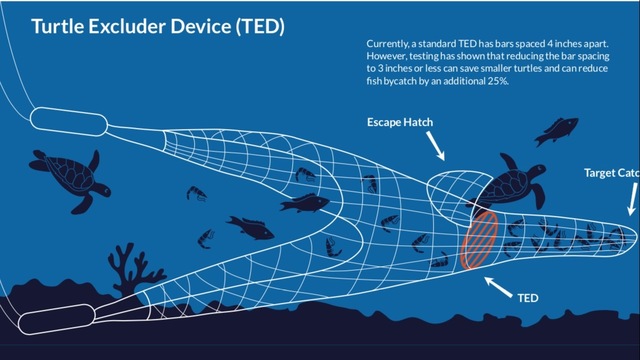
The device is called a TED, short for “turtle excluder device.” Inside the net is a grate with an opening. Small, slippery shrimp pass through into the net, while the grate guides larger turtles toward the exit. It’s a little like a cat flap in a door: one kind of visitor can get through, another can’t.
The United States decided that if you wanted to sell shrimp in the country, you had to catch them in a way that kept turtles from dying. This rule is known as Section 609. It was mandatory for American fishers, and later it was extended to those bringing shrimp in from other countries.
The Judge Called the WTO
Then the World Trade Organization, or WTO, stepped in. Put simply, it’s a bit like a referee in a soccer match, except the players are goods instead of balls. The referee has rules: you can’t treat some countries better than others, and you can’t block foreign goods without a good reason.
Several countries—India, Malaysia, Pakistan, and Thailand—complained to the referee: “The American rule is unfair. We have to adapt to someone else’s laws, while some other countries get help with training and equipment, and we don’t.” In 1998, the WTO ruled that the way the United States was enforcing its rule did indeed violate trade rules. One important detail: the goal itself—protecting turtles—was recognized as legitimate. The question was how the rule was being applied. The United States later changed its approach, and the dispute gradually died down.
But many people took away a different message: “So trade rules can outweigh concern for nature?” That feeling brought people out into the streets.
Seattle, Late November 1999
In the last days of November, ministers from many countries gathered in Seattle to negotiate new trade rules. Tens of thousands of people were there to meet them: union workers, environmentalists, and students. Some even showed up dressed as turtles. They wanted to say: “Trade rules should take account of more than just money—they should consider living creatures, too.”
The days were difficult. Some protesters marched peacefully, carrying signs and singing. Others blocked intersections, preventing delegates from reaching the meeting hall. A state of emergency and a curfew were declared in the city, and police took to the streets. The meeting had to be cut short, and the ministers went home without agreeing on a common plan. Those events became known as the “Battle of Seattle.”
What It Reminds Us of Today
If you hear phrases in the news like “environmental requirements for imported goods,” “tariffs,” or “whose rules are fairer?”, know that this debate goes back to that November. Countries today are still considering whether they can keep out goods made in ways that harm nature—and whether doing so might simply be a way to protect their own companies. The same questions, only now the goods might be cars, steel, or clothing instead of shrimp.
I think the most interesting thing about this story is that both sides were right in their own way. Environmentalists were right to worry about the turtles. And the countries that filed the complaint were right to want equal conditions for everyone. Disputes like these are rarely settled by labeling one side “good” and the other “bad.” They are settled by listening and finding a solution that leaves a door in the net without leaving room for injustice.
In Conclusion
A small grate in a net became the key to a much bigger conversation: who should decide how we trade with one another, and how do we make sure not to forget those who cannot speak for themselves? In 1999, Seattle had no answer. But people understood one thing: nature needs advocates, too, and every set of rules needs a door for common sense.

.jpg?itok=AKb2vRrU)