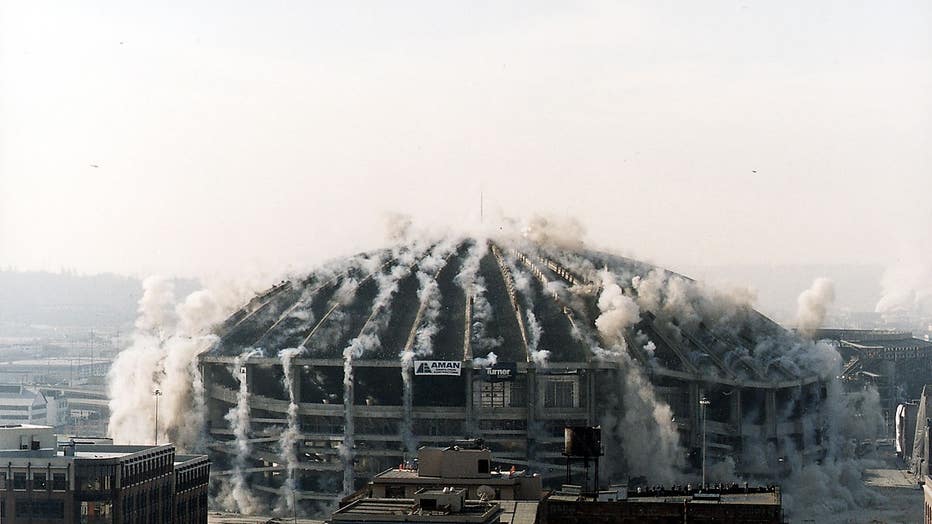
Imagine a huge concrete shell the size of an entire city block. Fifty years ago—not a hundred—people cheered for football and baseball inside it. Then it was blown up to make way for something better. This is the story of Seattle’s old stadium and the debate over what a true urban stadium should be.
A Huge Shell in the City Center
The old stadium was called the Kingdome—“kingdom” with a “K.” It opened in 1976, and at the time it was a marvel: a massive concrete dome with no supports beneath the roof. It was about as tall as a 25-story building. The builders were proud that its roof held itself up, like an eggshell.
But the shell had its downsides:
- It was dark and echoey inside, even on sunny days.
- Fans sat under the roof and couldn’t see the sky or the city at all.
- Games took place “inside a box,” even though Seattle’s surroundings were beautiful: the bay, the mountains, the port.
Many residents said, “We live in one of the most beautiful places on Earth, but we watch football in a concrete can.”
Tiles That Fell from the Roof
In 1994, an incident took place that would be debated for years. Before a baseball game, four tiles fell from the stadium roof. They were sound panels, each weighing about 12 kilograms. Fortunately, there were no spectators in the stadium yet, and no one was hurt. But the stadium was closed, and it became clear that the building was aging and would be very expensive to repair.
Then came new concerns: the Seahawks’ owner wanted to move the team to another city. For residents, it was like losing a beloved friend. That was when wealthy businessman Paul Allen, one of Microsoft’s founders, stepped in. He agreed to buy the team on one condition: the city would build a new stadium.
An Election Decided by Half a Percentage Point
Some of the money for the stadium had to come from public funds, which meant the residents themselves had to decide. In 1997, a statewide vote was held. The result was almost a tie: just over half voted “yes”—about 51 out of every 100 people. Interestingly, Allen even paid for the vote to be held.
Here’s a quick timeline:
| Year | What happened |
|---|---|
| 1976 | The Kingdome opened |
| 1994 | Tiles fell from the roof, and the stadium was closed |
| 1997 | Residents voted in favor of a new stadium |
| 2000 | The Kingdome was demolished in an implosion |
| 2002 | The new stadium opened |
While the new stadium was being built, the Seahawks played two seasons at the University of Washington’s Husky Stadium.
The End of the Old Dome
On March 26, 2000, the Kingdome was demolished in a controlled implosion. About two tons of explosives were placed in the concrete. The building came down in about 16 seconds, as thousands of residents watched from a distance.
But what happened next was most important: how they dealt with the rubble. The building wasn’t simply hauled off to a landfill. They tried to reuse whatever they could: metal from the rebar was sent for recycling, and some of the crushed concrete was used right there as fill. I like that idea. Pieces of the old building become part of the “foundation” for the new one, and nothing goes to waste.
The New Stadium: Open, Loud, and “Next to the Trains”
The new stadium was built near the old one, in an area served by rail lines and bus routes. That was an environmental choice, too. If a stadium is next to a station, fans can travel by train or bus, which means fewer cars on the roads and less exhaust in the air. A light rail station was added nearby later on.
The site itself also has a complicated past. Many years ago, this was shoreline; later, it was filled in and turned into land. Buildings on this kind of “reclaimed” ground require extra care to make sure they stand securely.
Most importantly, the architects made the stadium open-air: part of the stands are covered by a roof that shields fans from the rain, but there’s nothing over the field, so the sky is visible. The roof is like the brim of a cap: it keeps raindrops off spectators without cutting them off from the city. Its shape also reflects sound back toward the stands. In 2013, Seahawks fans cheered so loudly during a game that they were listed in the Guinness World Records as the loudest crowd in a stadium. It was almost like the roar of a plane taking off!
What This Story Teaches Us
When I think about this debate, it seems to me that it wasn’t really about football. Residents were deciding what kind of building they wanted: closed and dark, or bright with a view of the city. They were deciding whether to throw the old one away entirely or give it a second life. And they were thinking about how people could get to the stadium without polluting the air.
A good building, like a good friend, thinks about more than itself. It thinks about the people who use it, its neighbors, and the natural world around it. And the result of that vote—a half a percentage point in favor of “yes”—is a reminder that sometimes a single vote can change the face of an entire city.