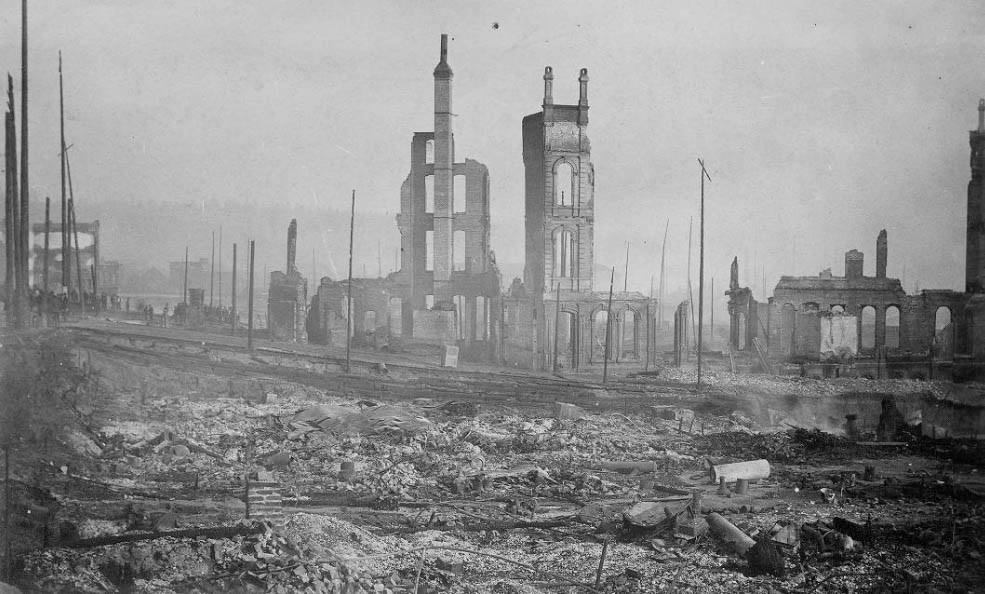
Imagine this: you’re walking along an ordinary street, looking down—and then you realize that right beneath your feet, just a few meters away, there’s another city. Old. Dark. Real. With storefronts, sidewalks, windows, and doors—only they no longer lead anywhere. This is exactly what happened in Seattle. And it all began with one terrible fire.
One Day That Changed Everything
On June 6, 1889, something went wrong in a furniture workshop in downtown Seattle. They say a worker accidentally tipped over a pot of boiling glue onto the fire. A small flame quickly spread to the wooden floor, then to the walls, and then—on to neighboring buildings. Back then, nearly the entire downtown was built of wood, and the fire hoses were too short to reach the water in the bay.
The fire raged for more than ten hours. When it finally died down, about twenty-five city blocks in the very center had turned to ash and charred beams. Hundreds of buildings burned, and thousands of people were left without work and without shelter. It seemed as if Seattle had simply ceased to exist.
But here’s the surprising part: no one was planning to give up. The very next morning, residents began clearing the rubble and rebuilding. And it was at that moment that someone proposed an idea that initially sounded crazy.
A Solution That Sounded Like a Joke
The thing is, Seattle had a long-standing problem everyone knew about—but no one could solve. The city sat on hills that ran straight down to the sea. During high tide, the streets in the lower part of town were literally flooded. The sewer system didn’t work properly—the water flowed back the wrong way. In other words, in 1889 the city center was not only wooden and fire-prone, but also dirty and damp.
And then—fire. Everything burned. So now it had to be rebuilt. And city engineers said: why not take this chance and raise the streets higher? Just build a new city one or two stories above the old one.
That sounded like a joke. But it was a serious plan.
Workers began filling in the lower parts of the city with earth and gravel, raising the street level by anywhere from one to nearly ten meters in different places. New buildings were constructed on this new, higher level—out of brick and stone, not wood. Seattle literally grew upward, like a cake that had gained a new layer.
But there was a catch: while the workers were raising the streets, shopkeepers were already opening their new stores at the old level. They still needed to earn a living! And for several years—roughly from 1889 to 1907—people walked on streets that were a full story below the sidewalks. To cross the street, you had to go down stairs, walk along the old street, and then climb back up on the other side. Can you imagine what that looked like?
A Phantom City Under Your Feet
When the new streets were finally completed and everyone moved upstairs, the old level was simply… shut. Entrances were boarded up, parts of the passageways were filled in, and people forgot. Old sidewalks, storefronts, basements—all of it remained underground, untouched. As if someone had tucked the old city under an enormous blanket and said, “Sleep.”
Today, this underground Seattle still exists. It’s known simply as Seattle Underground, “the Seattle underground.” Tours are held there. You can descend by stairs right in the middle of a modern street and find yourself back in 1889: here are the old brick walls, here are windows that once looked out onto a sunny street—but now they stare into darkness. In some places, glass blocks have been inserted into what used to be the ceiling—what was once the sidewalk. They used to let light shine down. Now they’re purple; the glass changed color after more than a century under the effect of ultraviolet light.
One of the guides once told tourists: “You’re walking down a street that only horses and people in top hats have ever seen.” Of course, that’s a bit of an exaggeration—just a little.
Why This Matters Right Now
You might think this is a beautiful, old story. Why care about it today?
Because right now, in different parts of the world, cities are facing problems very similar to this one—not fires, but water. Due to climate change, sea levels are rising, and entire city districts risk going under. For example, Jakarta—the capital of Indonesia—is sinking literally by a few centimeters every year. Parts of Bangkok are regularly flooded. In many cities across the United States and Europe, after major hurricanes and floods, people debate how to build going forward.
And you know what answer is increasingly being heard at those meetings? Raise the streets. Rebuild the waterfront higher. Create “buffer zones” between the city and the water. Some architects propose building whole districts on stilts—like houses on the water. Others say, let’s move part of the infrastructure underground so that floods can’t destroy it.
Seattle did all of this—only in 1889, after a fire, not after a flood. And it wasn’t because the city had been smart in advance, but because the catastrophe gave it a rare chance: to start from scratch and do everything the right way.
Sometimes that’s how history works: the smartest decisions aren’t born from good times—they’re born out of a big disaster.
When Ash Becomes a Foundation
There’s something very important about how Seattle responded to the 1889 fire. The city didn’t just recover—it became better. The new buildings were sturdier, the streets were higher and drier, and the sewer system finally worked properly. And underground, the city preserved a living memory of what it used to be.
Maybe that’s the main lesson of underground Seattle: disaster isn’t the end. It’s a moment when you can stop, look at what wasn’t working, and come up with something better. It’s hard, frightening, expensive—but it’s possible.
And the next time you hear about a city that was hit by a fire, a flood, or a hurricane, remember this: beneath Seattle’s streets, old storefronts still stand where nothing has been sold for more than a hundred years. And it’s not sad. It’s a reminder that people can rebuild—and each time, a little better than before.