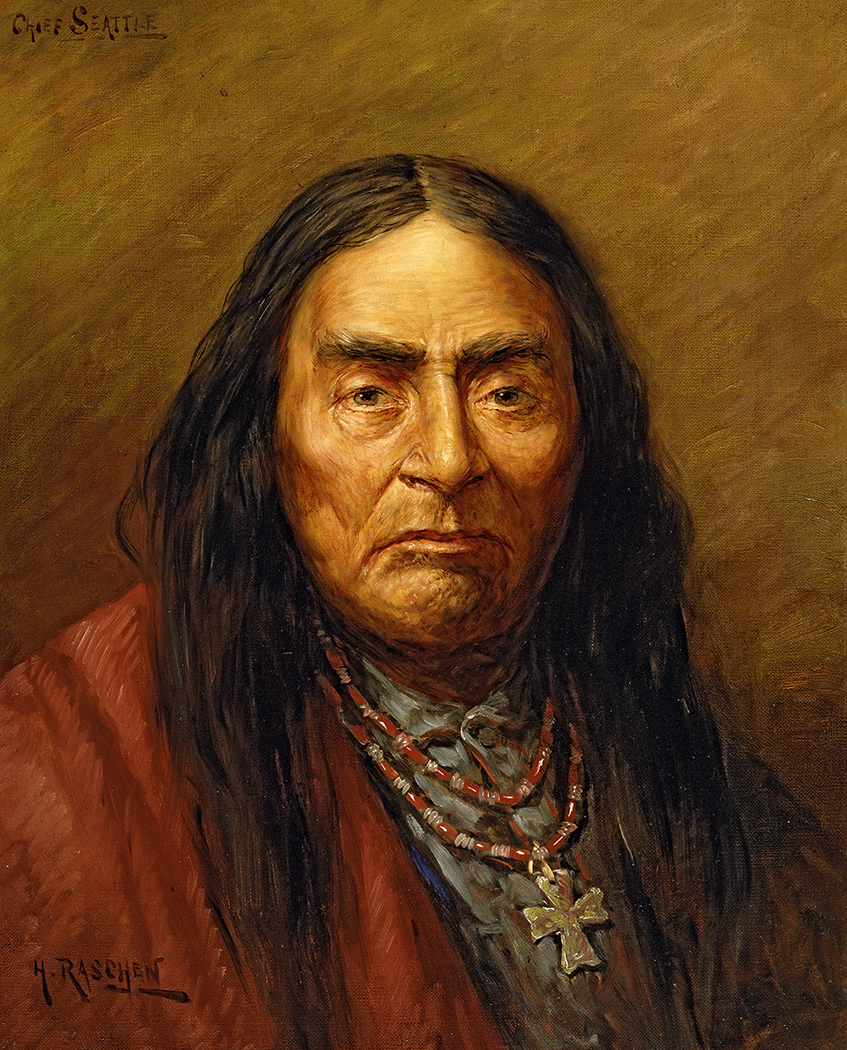
Imagine having an entire city of skyscrapers, ferries, and a huge glass library named after you. It sounds like a fairy tale, but that is exactly what happened in the U.S. state of Washington: the city of Seattle is named after a real person—Chief Si’ahl of the Duwamish and Suquamish peoples. The most surprising part is that the famous speech attributed to him was probably never delivered in that form. Let’s investigate this story like real detectives.
Who Was Chief Si’ahl?
Chief Si’ahl (whose name in his native language sounds roughly like “See-ahth”) was born around 1786; the exact date is unknown. In those days, no one recorded birthdays on calendars. He lived along Puget Sound, where green forests meet cold waters. His peoples fished for salmon, gathered berries, and built enormous houses from cedar planks. One such house, called Old Man House, is considered one of the longest wooden buildings in North America: hundreds of people lived under its single roof. Imagine an entire village living in a school hallway!
Si’ahl was a respected leader and a wise diplomat. When the first European settlers arrived on their land, he did not choose war but sought a peaceful path. He became friends with a doctor named David Maynard, who was known as “Doc.” Maynard suggested naming the new settlement after the chief. When the town received its name in the 1850s, it was spelled “Seattle”—an easier way for Europeans to pronounce “Si’ahl.”
Here is an interesting detail: according to some accounts, the chief was not initially pleased. In his people’s tradition, a person’s name was not supposed to be spoken aloud after death, so as not to disturb the spirit. And now there would be an entire city where his name would be repeated every day! It is said that he even joked that Maynard would have to pay a “tax” for this after his death. Historians disagree about how accurate this story is, but it shows how differently people viewed the world.
The Famous Speech: A Century-Long Game of Telephone
You have probably played the game of telephone: one person whispers a word into a neighbor’s ear, the neighbor passes it on, and by the end it has become something completely different. Something similar happened to Chief Si’ahl’s speech, only over many years.
In 1854, the chief spoke at a meeting where a land treaty was being discussed. He spoke in Lushootseed, while an interpreter rendered his words into another language. In other words, the speech had already passed through a “translation.” More than thirty years later, in 1887, Dr. Henry Smith published a text he had written down from memory. Smith himself honestly acknowledged that he had conveyed the meaning in beautiful language rather than recorded the exact phrases. By then, the speech had already been significantly altered.
Then came another transformation. In the 1970s, a text known as “Chief Seattle’s letter to the president” became popular across the United States. It contained beautiful words about the earth, rivers, and animals being our brothers and sisters. People were beginning to think more seriously about environmental protection, and the text became famous. But it later emerged that screenwriter Ted Perry had written most of those words in 1971 for a documentary film. In other words, the best-known phrases were created by someone who lived more than a century after the chief.
Here is the chain of events:
| Year | What happened |
|---|---|
| 1854 | Chief Si’ahl speaks at a meeting; an interpreter translates his words |
| 1887 | Henry Smith publishes a text recorded from memory |
| 1971–1972 | Screenwriter Ted Perry creates a new, heavily altered version for a film |
| 1970s and later | The text spreads around the world as the “chief’s letter” |
So, we can only guess at the chief’s actual words. But that does not mean he failed to care about nature. For his people, the river and forest were both home and pantry, so treating the land with care was part of everyday life—not a fashionable new idea.
What Reminds Us of the Chief in Seattle Today
If you visit Seattle today, you can find traces of the chief everywhere—you just have to know where to look.
Statue. A bronze statue of Chief Si’ahl stands in the Belltown neighborhood. It was unveiled back in 1912. He stands with one hand raised, as if greeting passersby. Flowers and small gifts are always placed nearby.
Language. Lushootseed, the language spoken by the chief, has nearly disappeared, but efforts are being made to revive it. Signs and names in the language are appearing around the city, and some schools and cultural centers teach it to children.
Longhouse. In West Seattle, the Duwamish Longhouse and Cultural Center was built as a modern longhouse for the Duwamish people. It presents their culture, displays traditional objects, and hosts celebrations.
Indigenous Peoples’ Day. In 2014, Seattle decided to celebrate Indigenous Peoples’ Day in October instead of Columbus Day. In doing so, residents recognized that people with their own history had already lived on this land before Europeans arrived.
An Injustice That Continues to This Day
Now comes the saddest part of the story. The city is named after a Duwamish chief, but the Duwamish people still have not received official recognition from the U.S. government. This means they do not have the same rights and support as many other Indigenous tribes. They have submitted applications for many years, and the issue remains disputed. If I could choose, I would want the city named after their chief to help them first.
I think that is the main lesson. We can say a name on a map a thousand times without stopping to think about whose home it once was. Or we can pause for a moment and ask: “Who lived here before us? What mattered to them?”
What We Learned
Seattle is one of the rare cities named after a real, wise person who befriended the newcomers. His most famous speech turned out to be a mixture of memories, retellings, and imagination—a game of telephone lasting a century. But Chief Si’ahl’s true legacy is not found in beautiful quotations. It lives in the city itself, in the language people are trying to preserve, and in those who continue his work. And perhaps the next time you hear an unfamiliar place-name on a map, you will want to find out whether a real person’s story lies behind it.