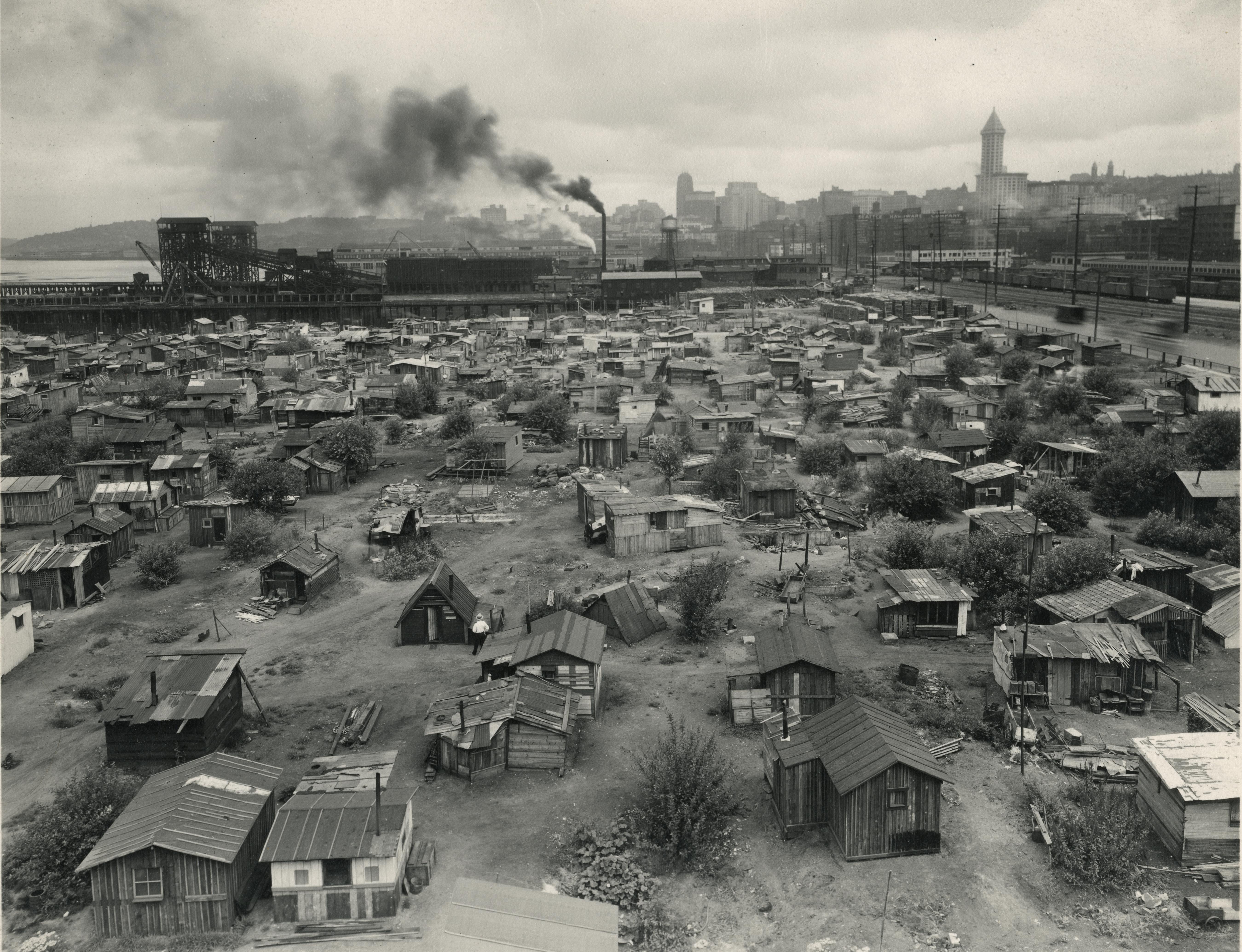
Imagine building a fort in your backyard out of boards and old boxes. Now imagine that it isn’t a game, but a real home—and you have to live in it through the winter, when the rain pours down. Almost a hundred years ago, hundreds of people in Seattle lived this way. Their settlement was called Hooverville, and it lasted for a full ten years because its residents refused to give up and knew how to stick together.
How it all began: when the jobs suddenly disappeared
In 1929, the Great Depression began in America. It was a very difficult time: factories closed, shops emptied, and people suddenly found themselves out of work. When parents have no jobs, there’s no money for housing or food. Many families and single workers in Seattle lost their homes.
They went to a vacant mudflat by the bay, not far from the port. The ground was wet and nobody wanted it. People gathered boards, boxes, pieces of metal and plywood, and built small shacks. At first there were only a few, then dozens, and then several hundred. This was around 1931.
The settlement was nicknamed “Hooverville.” During those years, similar settlements across America were given the same name, as a dig at President Herbert Hoover. Many people felt he was doing too little to help those who had lost their homes. The name was a little insulting, but the residents didn’t change it.
A real city within a city
The most remarkable thing about Hooverville wasn’t the shacks, but the way people lived there. It wasn’t chaos. The settlement had its own self-government, like a real little city.
The residents elected a “mayor.” His name was John F. Sowers. There was also a committee that settled disputes and kept order. The rules were simple and easy to understand, like the rules in a good classroom:
- don’t steal from your neighbors;
- keep your own space clean;
- help those who are having a harder time;
- respect one another.
Imagine if your class elected its own class monitor and decided for itself how to behave—and it all worked without a teacher. That’s how life in Hooverville worked, too.
Another distinctive feature was that people from many different backgrounds lived there. There were Americans, immigrants from Scandinavia, sailors, Filipino workers, Japanese people and others. They spoke different languages, but shared the same difficult way of life. When someone had extra food, they shared it. The shacks stood close together, and neighbors knew one another well.
The shacks varied greatly. Some were very basic, made from boards and metal. Others were neat, with small windows, doors and even flower beds. People tried to make their homes cozy, however modest they were.
The fight for the right to stay
Not everyone in the city liked Hooverville. The land by the port was valuable, and some businesspeople considered the settlement a “disgrace.” The city authorities wanted to remove it. Arguments began over what to do with people who had nowhere else to live.
In 1934, the city decided to destroy the settlement by fire. The shacks were burned down. It was a very sad day: people lost even the little they had. But what happened next was most important. The residents didn’t leave. They came back and rebuilt their shacks, board by board.
Others helped them, too. Among the settlement’s defenders was city sheriff John F. Haines, remembered as someone who was in no hurry to drive the poor away. Community organizations and townspeople also offered support, understanding that people with nowhere else to live had nowhere else to go. Newspapers wrote about the settlement, and many city residents began to see Hooverville not as a “disgrace,” but simply as a community of people in trouble.
Historians are still clarifying the details of these events, and accounts differ slightly. But one thing is certain: the settlement was burned, its residents returned, and Hooverville continued to exist for another seven years.
The settlement’s end and the memory it left behind
In the late 1930s, life in the country began to change. When the war began in 1941, work became plentiful at shipyards and factories. People from Hooverville were able to find jobs and rent proper homes. The settlement gradually emptied out, and in 1941 it was finally cleared.
There are no shacks there today. But Hooverville lives on in people’s memories. Seattle museums tell its story; books are written and films are made about it. Historians study it because it was one of the best-known and longest-lasting settlements of its kind in America.
What is most moving about this story
I think the most important thing isn’t that people lived in difficult conditions, but how they behaved. They elected a mayor, came up with rules, shared food and rebuilt their homes after the fire. They didn’t wait for someone else to solve their problems; they did everything they could themselves. That’s profoundly human: even when the world around us is falling apart, people can build a little world of their own, where there is order and kindness.
Home is the people around you
Hooverville’s story shows that home is more than a roof and walls. It’s also the people around you—the ones who will help, share what they have and stand by you in hard times. The wooden shacks disappeared long ago, but the lesson remains: together, people can endure even the most difficult times.
If you ever build a fort out of blankets and chairs, remember Hooverville. The people who once built a real “city of boards” knew that the strongest home is held together by friendship and mutual support.