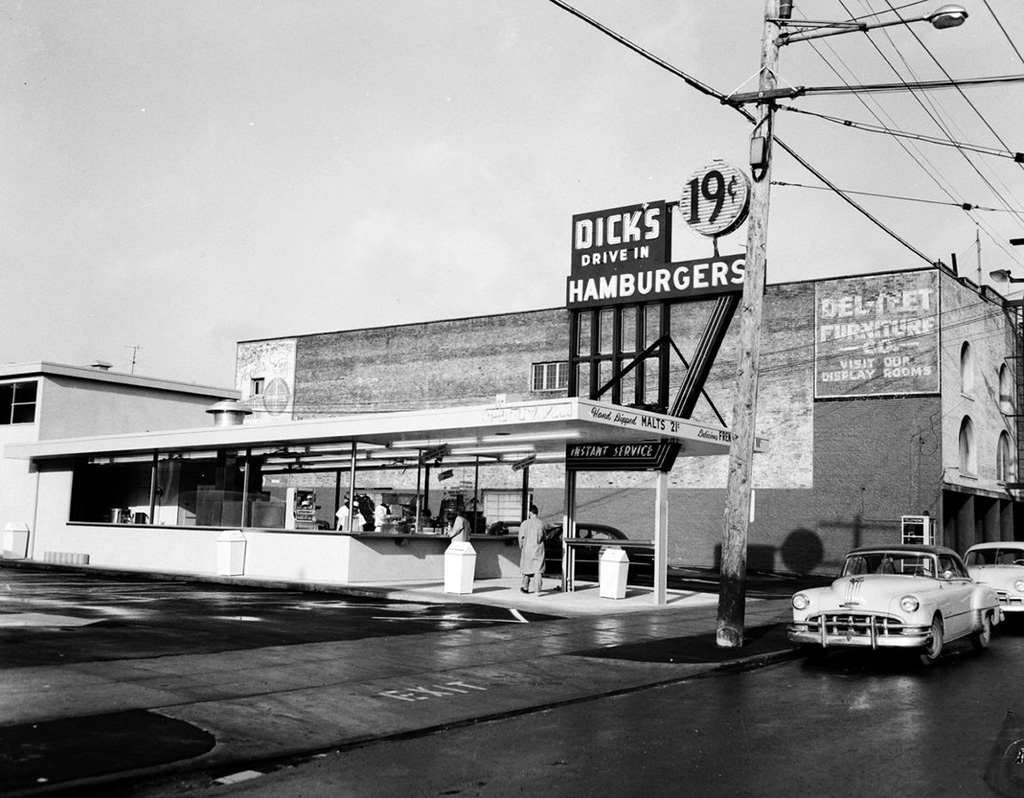
Imagine that in your city there’s one special little cafe. There’s always a line—not because it’s expensive or trendy, but because it’s delicious, fast, and every worker genuinely smiles. That’s exactly what Dick's Drive-In became in Seattle. But few people know that the secret of its kindness is tied to a very sad story—and to people who, despite injustice, didn’t lose faith in the good.
A small restaurant with a big personality
Dick's Drive-In opened in Seattle in 1954. It was the idea of several friends—Dick Spou n and his partners. They wanted to create a simple place: burgers, fries, milkshakes. Nothing extra. Prices were set so that any family could afford them.
But Dick's had something other restaurants of that time didn’t. All employees received fair pay—even then, when other places paid far too little. If a worker wanted to keep studying, the restaurant helped with money. If someone got sick, there was health insurance. That sounds ordinary today, but in the 1950s it was almost impossible for a regular neighborhood diner.
Where did that philosophy come from? The answer is hidden in the history of the neighborhood where the first Dick's opened.
People who were driven out of their own homes
Seattle has long been home to many Japanese American families. They’re called “Nikkei”—a Japanese term for people of Japanese origin who live in another country. They opened shops, grew gardens, and educated their children in local schools. They were the most ordinary neighbors.
But in 1942 something terrible happened. World War II was underway, and the U.S. government made a brutal decision: all people of Japanese ancestry—even those born in America—were sent to special camps far from the coast. Not because they had done anything wrong. Simply because they looked different and were feared.
Picture this: you come home from school and you’re told to pack up—you’re leaving. The store? Closed. The house? Leave it behind. The garden? Someone else’s now. Thousands of families lost everything they had built over years.
When the war ended and people returned to Seattle, they had to start over. Many searched for work. And some found it at Dick's Drive-In—in one of the few places where people didn’t look at you with suspicion and where you were paid the same as everyone else.
How kindness became a recipe
The Japanese American community brought something very important to Dick’s: it showed what it means to work with dignity. People who had survived injustice know how to value honesty. They worked hard, treated customers with respect, and looked out for one another.
The restaurant’s founders saw that. And they made a choice: to build a business not on paying less and earning more, but on making sure every person—both worker and customer—felt good.
“ If your people are happy, your guests will be happy too,” is roughly what the creators of Dick’s thought. It’s a simple idea, but not every business understands it.
Over time, Dick’s became a real symbol of Seattle. Locals don’t love it as a fashionable spot, but as an old friend. Rapper Macklemore mentioned Dick’s in one of his songs. Former President Barack Obama, visiting Seattle, also stopped by. But most of all, regular people go there—because they know they’ll be welcomed.
A lesson for other cities
The story of Dick’s Drive-In isn’t just a story about burgers. It’s about what happens when a business learns from people who were unfairly treated.
Seattle’s Japanese American community went through a very difficult time. But it was their experience, their hard work, and their values that helped a small restaurant become something bigger. Other cities can take an important lesson from this: when you respect people—everyone, no matter where they’re from—they make your city better.
Maybe the secret to a good city is the same as the secret to a good burger: you need the right ingredients, honest work, and a little warmth. And then the line will form on its own.