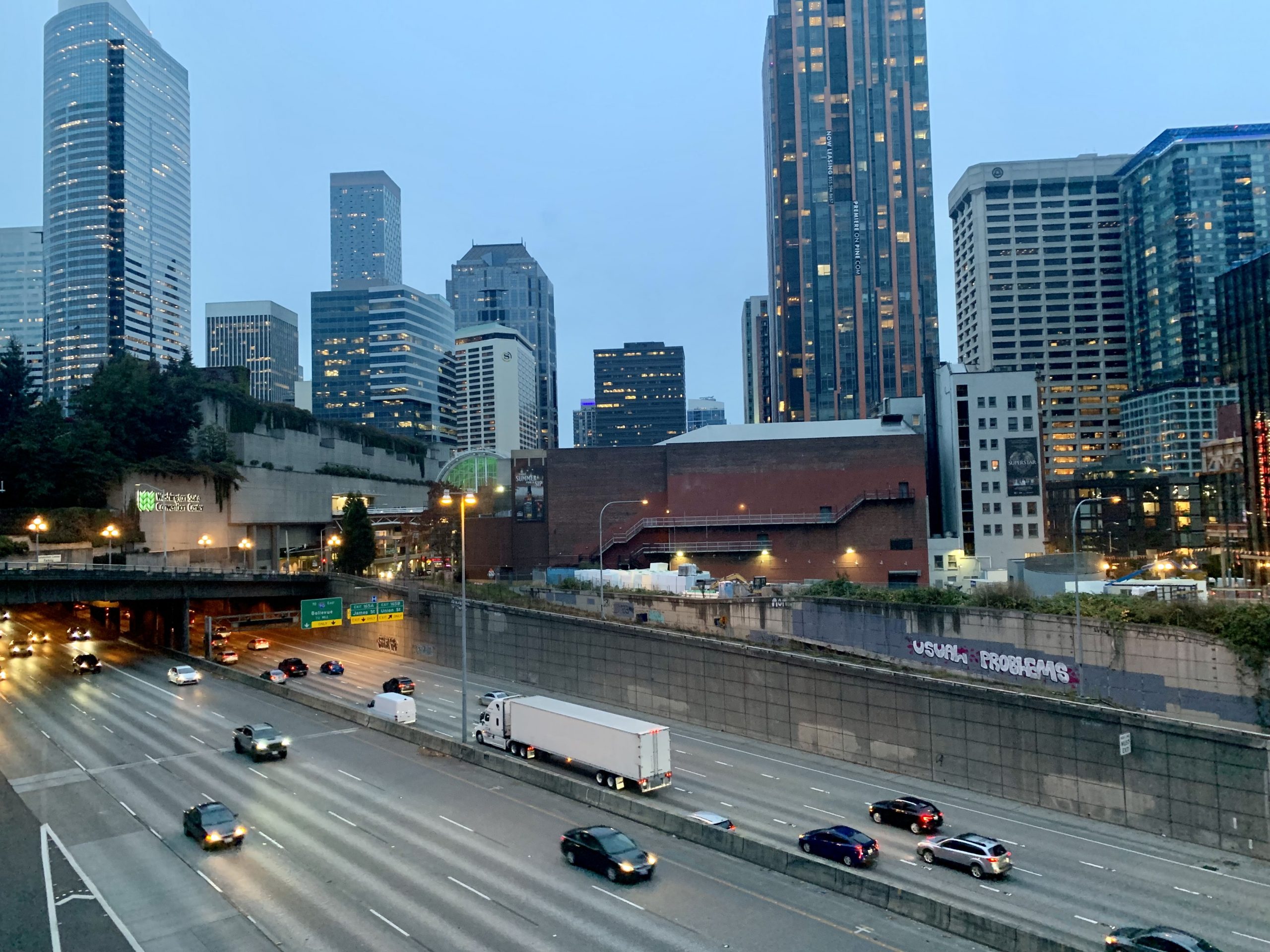
In the very heart of Seattle there’s a building that does something truly unbelievable. It stands directly over the highway. Not beside it, not near it—right above it. Beneath the floor of this massive building, thousands of cars stream by every day, while above them people drink coffee, hold meetings, and carry out important negotiations. This is where, in 1999, an event took place that people around the world still talk about today. And it all began when one engineer decided: if you can’t build near the road, you can build over it.
When there’s no space—build a bridge
Imagine you need to put a huge cabinet in a room where there’s almost no space. What do you do? You could lift it onto legs and position it so that, for example, a cat can pass underneath. That’s roughly how the engineers reasoned back in the 1980s, when the city of Seattle needed a large convention center.
The problem was serious: in the very center of the city, where they wanted to build the structure, one of America’s busiest roads—the Interstate 5 highway—ran right underneath the ground. Remove the road? Impossible. Build next to it? There wasn’t enough room. And then the engineers came up with something bold: they decided to build the building directly over the highway—like a giant bridge with rooms inside.
It was extremely difficult. You can’t simply put walls on asphalt—cars drive underneath, the ground vibrates, and the whole structure has to support the weight of thousands of people, furniture, and equipment. The engineers drove huge concrete columns into the ground between the highway lanes—thick, like trees in an old forest. On top of these columns, they placed special platforms, and then the building rose from the platforms. The Washington State Convention Center opened in 1988, and since then, tens of thousands of cars have been passing every day under its floor—while people upstairs don’t even notice the roar.
This building is a real engineering marvel. It proves that if you really want it and think things through, there’s a way out even of the toughest situations.
A big meeting—and a big question
In November 1999, this unusual building was set to host an important meeting. Representatives arrived from nearly one hundred and forty countries—ministers, diplomats, officials. They were there for an organization called the WTO, which stands for the World Trade Organization. This organization sets the rules: who can sell what to whom, how much it should cost, and which goods can cross borders.
Sounds kind of dull? But behind these rules are very real things. For example: if a large, wealthy country sells its goods cheaply, a small, poor country can’t compete—and its farmers lose jobs. Or: if trade rules don’t take nature into account, factories can pollute rivers and the air just to produce cheaper goods. Many people believed WTO rules were unfair—that they helped the rich get richer and the poor get poorer.
And these people decided to come to Seattle—not to the meeting inside the building, but to the streets around it.
When the street is smarter than the hall
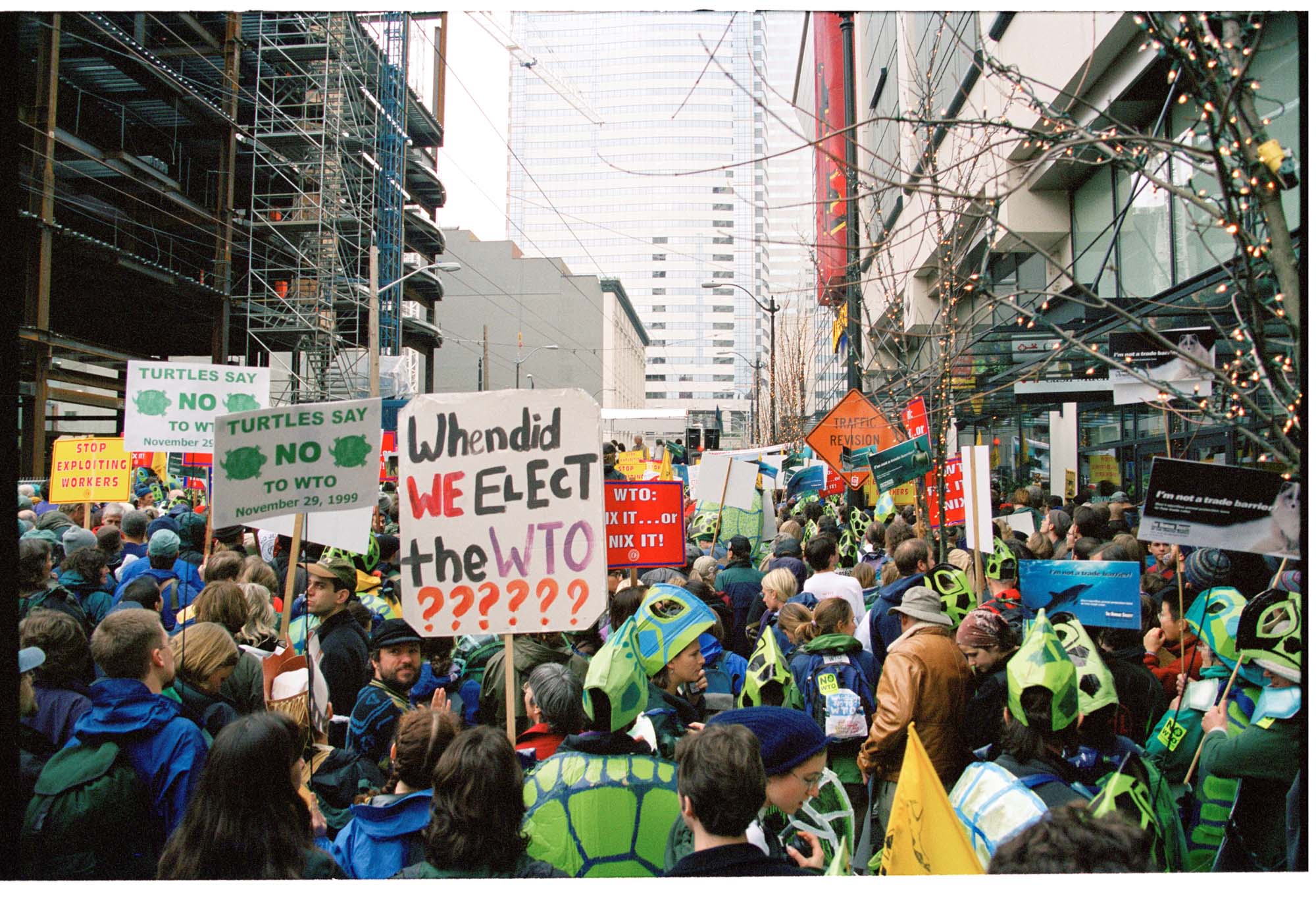
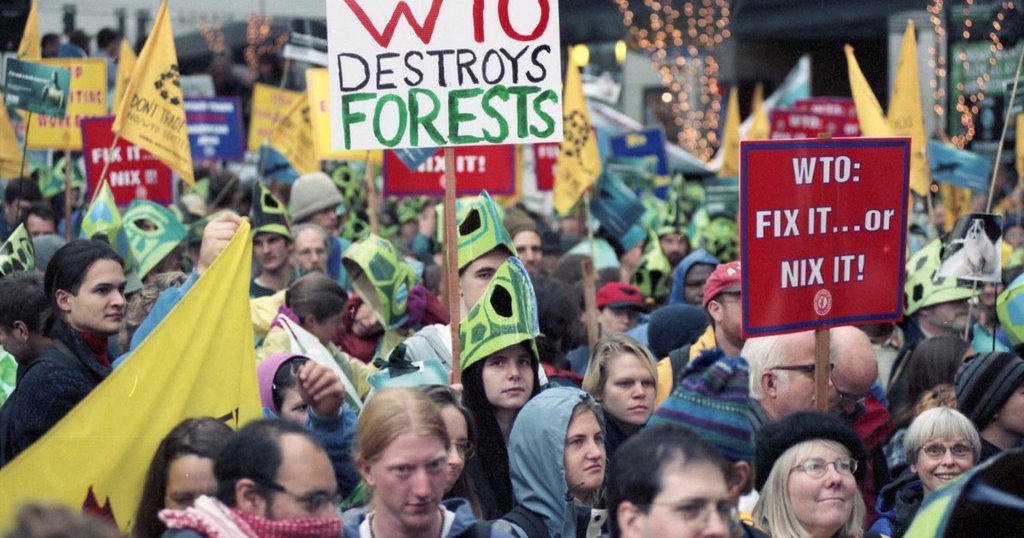
On November 30, 1999, tens of thousands of people came to Seattle. Workers and students, farmers and scientists, environmental activists and just anyone who felt what was happening was unfair. They took to the streets with signs, in costumes of turtles and butterflies, with drums and songs.
But the most interesting part was how they organized it. In 1999 there were no smartphones. No messengers. And for most people, there weren’t even ordinary mobile phones. So how did thousands of strangers manage to act in such a coordinated way?
They studied the city map in advance. They split into small groups—each group was responsible for its own intersection. They came up with a system of hand signals: a raised fist meant “stop,” fingers spread meant “go your separate ways,” a wave of the hand meant “move forward.” They knew which streets led to the convention center and blocked them all—by forming living human chains, holding hands.
Delegates from different countries simply couldn’t get to the meeting. The opening of the conference was disrupted. It was the first time in history that protesters managed to stop a WTO session.
Journalists dubbed these events “the Battle of Seattle.” But it wasn’t really a battle—it was a demonstration that ordinary people, armed only with knowledge of city streets and the ability to negotiate with one another, can be just as inventive as engineers building houses over highways.
Why it matters—even today
After the events of 1999, a lot changed. Cities around the world began to think differently about how streets around major buildings—where important meetings take place—should be arranged. Architects and urban planners started asking new questions: how can we ensure that people can gather safely and express their views? Where should there be plazas, where should there be pathways—how do you organize space so it’s fair both for those inside and for those outside?
The Washington State Convention Center still stands over its highway. Cars still stream beneath its floor. And on the streets around it, there are now special areas for gatherings and demonstrations—because the city realized that voices from outside matter at least as much as negotiations inside.
To me, there’s something in this story that’s important for all of us. The engineers who built a house over a road showed that impossible tasks don’t exist if you think outside the box. And the thousands of people in Seattle’s streets showed the same thing—just in a different way. Sometimes the most powerful tool isn’t a crane or concrete, but the ability to reach an agreement with your neighbor and stand together at the right intersection.