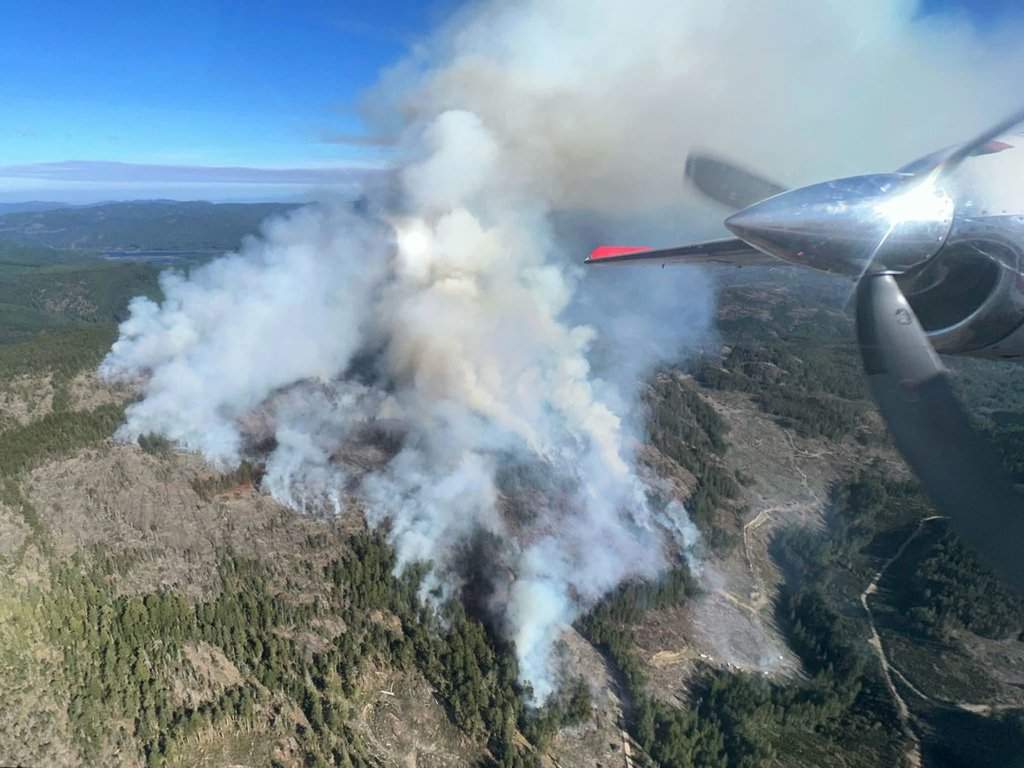
A wildfire is raging near Mount Jack in British Columbia, reform-minded judge Thomas Gove has died, and Vancouver’s mayor is urging officials not to hold provincial and municipal elections at the same time.
Mount Jack wildfire on southern Vancouver Island: Fire out of control, but no current threat
A new wildfire is burning in southern Vancouver Island, several kilometres from the town of Sooke, and has already drawn the attention of residents across the region. According to BC Wildfire Service, the fire near Mount Jack was discovered late Sunday evening and grew to half a square kilometre within just one day. The blaze is burning in warm, dry conditions that are favourable to further spread. Smoke from the fire is visible well beyond the site—even as far as Shawnigan Lake and Greater Victoria—making the incident noticeable even to people far from the epicentre.
As Global News reports, firefighters are already working at the scene in an effort to contain the flames. However, the service warns that the fire’s area is likely to continue growing. Despite this, the blaze currently poses no threat to residents or critical infrastructure. That clarification is important because, during a dry season, any fire in southern British Columbia causes heightened concern among local residents.
The incident is occurring as the wildfire season draws to a close. Although fire activity usually begins to decline by this time of year, more than 100 fires are still burning across the province, four of them classified as out of control. This shows that even at the end of the season, nature can deliver unpleasant surprises—particularly when weather conditions remain warm and dry.
For context, the status “out of control” does not necessarily mean that a fire is completely chaotic or impossible to manage. In BC Wildfire Service terminology, it means that the fire is not following its planned trajectory and has not been contained—in other words, firefighters have not yet been able to surround it and stop its spread. The designation is used when there is a possibility that the flames will continue to grow, as is happening near Mount Jack.
The key point is that there is no threat to people or infrastructure, confirming the service’s measured approach to assessing risk. However, smoke visible as far away as Victoria is a reminder that even a local fire can affect air quality and visibility across a wide area. Officials have not reported any evacuations or alerts, but the situation remains under observation. With more than 100 fires still active across the province, this is only one of many incidents, but it underscores that wildfire season is not over yet—and that it is too early to let down one’s guard.
The judge who changed the system: Thomas Gove’s legacy in British Columbia
In a world where the justice system is often seen as a heartless machine, some people remind us that justice can be humane. Thomas Gove, who died of heart failure at Vancouver General Hospital on September 10 at the age of 79, was one of those people. His life was not simply the biography of a provincial court judge, but a story of how compassion and persistence can transform entire institutions that protect the most vulnerable.
Gove began his career as a lawyer specializing in family law, child protection and criminal cases. He spent 16 years in that work before being appointed to the provincial court in 1990. During more than three decades on the bench, he did more than issue rulings—he reimagined the role of a judge in society. His legacy is measured not by the number of cases he closed, but by the lives he helped save and the systems he helped reform.
A pivotal moment in his career came with the inquiry into the death of five-year-old Matthew Vaudreuil, who died in 1992 after prolonged neglect by his mother, despite being under the supervision of dozens of social workers. The case exposed deep systemic failures. The inquiry led by Gove, completed in 1995, found that only about half of the province’s child-protection workers had degrees in social work. Gove issued 118 recommendations, including requirements that front-line workers hold at least a bachelor’s degree in social work and that everyone working with children be professionally regulated. The recommendations led to the creation of a separate Ministry of Children and Families, as well as the Commission for Children, an agency that reviewed child deaths and the operation of the protection system. The commission existed from 1997 to 2002, but after it was dissolved, another tragedy—a high-profile child death—prompted a further inquiry led by Judge Ted Hughes. It found that the commission’s dissolution had created a dangerous gap in oversight. As a result, in 2006, the legislature unanimously passed the Representative for Children and Youth Act, creating a new independent oversight body that remains in operation today.
However, Gove’s work was not limited to reforming the child-protection system. He helped establish Canada’s first community court in Vancouver’s Downtown Eastside, which began operating in 2008. As the court’s presiding judge, Gove helped radically change the approach to justice: rather than relying solely on punishment, the court integrated medical and social services into the judicial proceedings. Gove understood that many people appearing before the court were living with mental illness, serious drug addiction or brain injuries, often linked to methamphetamine use. “We often sentence people without having any real understanding of who they are or what drives them,” he said at the opening of the community court in 2008. In his final remarks as a judge, he emphasized that the number of people appearing in court with mental illness, severe addictions and brain injuries was dramatically different from what it had been 30 years earlier—and that this reality needed to be recognized.
Thomas Gove retired in 2020 but was extended for another year as a senior judge, ending his career in 2021. “I hope that over the years I solved more problems than I created,” he said upon retiring. “Especially when it comes to family matters and criminal sentencing.” His cousin, Aaron Chapman, wrote on social media that Gove had had an enormous impact on Vancouver and the province as a whole, and that the family was immensely proud of him. Gove is survived by his wife of 54 years, three children and five grandchildren.
At a time when justice systems around the world face criticism for being overly formal and disconnected from people’s real problems, Thomas Gove’s example shows that justice can be not only fair, but also healing. His work is a reminder that behind every statistic, every law and every reform are individual human lives—and that even one person with compassion and determination can change a system from within.
Vancouver mayor urges B.C. not to hold snap election during municipal campaign
Vancouver Mayor Ken Sim has called on the British Columbia government not to call an early provincial election before the municipal vote scheduled for October 17. In his view, the municipal campaign deserves residents’ “full and undivided attention,” and holding two electoral campaigns at the same time would dilute the focus of public debate. The situation has been complicated by Premier David Eby’s statement last week to NDP members that they needed to be “ready for an election,” prompting widespread speculation that the legislature could soon be dissolved. Such a political move could significantly affect the municipal race, as voters’ attention and media coverage shifted to the provincial agenda.
Speaking at a news conference on Monday, where he presented his ABC Vancouver party’s election platform, Sim said his position fully aligned with that of the Union of British Columbia Municipalities. The organization adopted a resolution last week calling on the provincial government to protect the integrity of local elections by avoiding overlapping campaigns. In essence, the issue concerns protecting the principle that municipal elections are an independent democratic institution, not an extension of provincial politics, with local electoral cycles dictated by the tactical considerations of the governing party. For Sim, the issue is particularly sensitive given his own political history: in 2018, he ran for mayor with the Non-Partisan Association and narrowly lost to Kennedy Stewart, then won in 2022 with ABC Vancouver. He is now seeking to present his party as a force focused on strictly urban issues, and an early provincial election could push that agenda out of the centre of public attention.
The ABC Vancouver platform unveiled at the same news conference is built around three “anchor commitments”: public safety and addressing street disorder; affordability and accountability in city government; and jobs and the economy. Under the first priority, the party promises to ban the use of hard drugs outdoors in public spaces—a measure that, amid Vancouver’s overdose crisis, has sparked intense debate over the balance between public order and the rights of people who use drugs. On tax policy, ABC has pledged to impose no property-tax increase in 2027, a bold promise amid chronic municipal budget shortfalls and rising infrastructure costs. The party also plans to rebuild the Vancouver Aquatic Centre and revitalize the entertainment district on Granville Street, an iconic area that has suffered from vacant storefronts and a declining nightlife scene in recent years.
The central question is whether Sim can keep the municipal agenda in focus if a provincial election is actually called in the coming weeks. On one hand, his appeal has institutional support from the Union of British Columbia Municipalities, giving it political weight. On the other, Premier Eby may be guided by his own electoral calculations, judging by his signals to fellow party members. In that case, the argument for giving local elections “full attention” risks remaining merely rhetorical. For Vancouver voters, this could mean an overloaded information environment in which debates over taxes, safety and urban infrastructure are drowned out by the provincial campaign. The fact that the mayor of the province’s largest city has been forced to publicly ask the premier not to call an election illustrates the tension between municipal and provincial governments—and how fragile attention to strictly local issues can be when larger political concerns dominate.