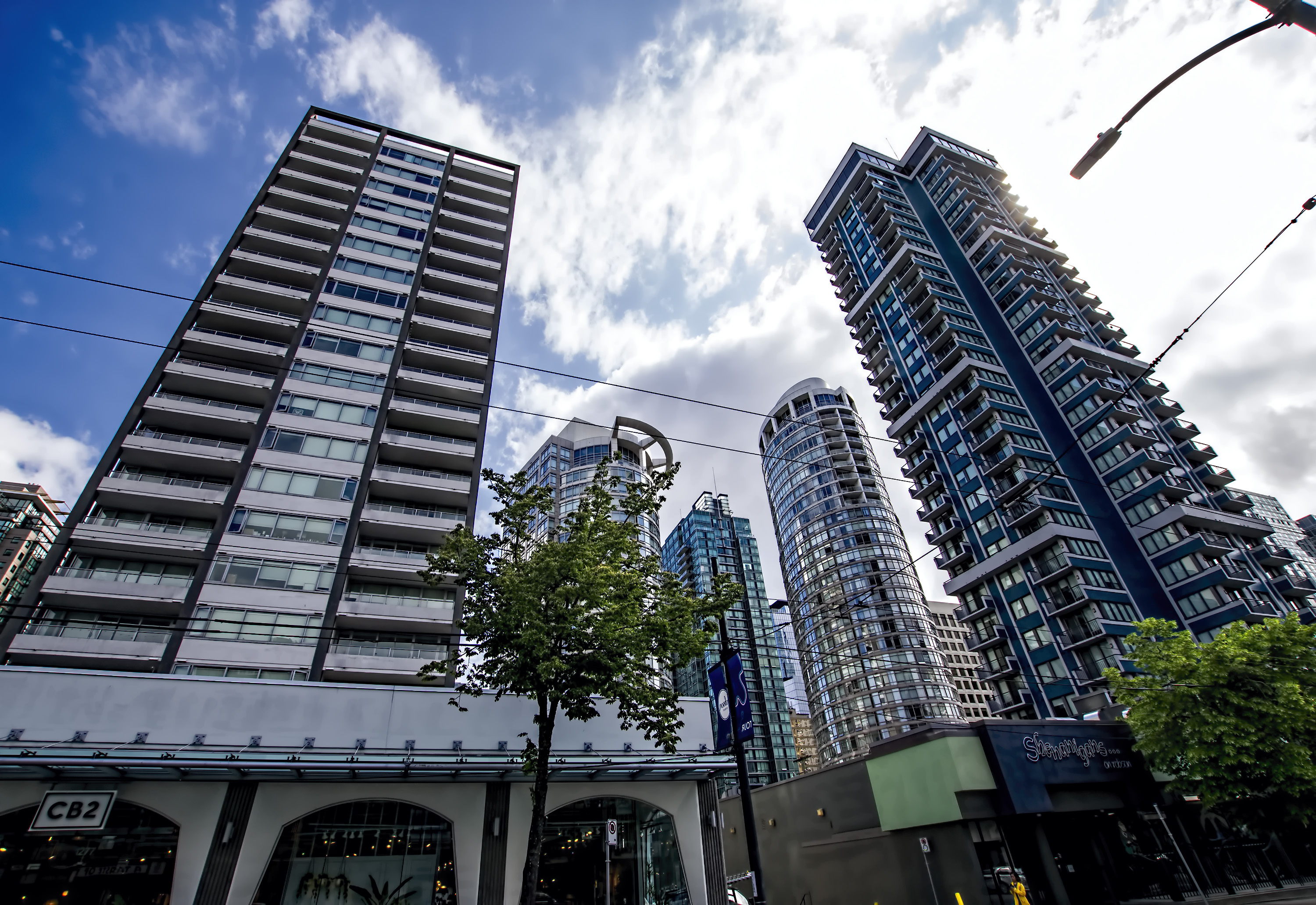
In today’s digest: Vancouver’s housing market is being weighed down by an overhang of unsold condominiums, leading to a 35% drop in new builds; WestJet is suspending five winter routes out of Vancouver due to low demand; and city council has approved the placement of a floating spa facility in Kitsilano Marina, despite residents’ protests over its size.
Unsold condos are weighing on Vancouver’s housing market: analysts warn of further decline
The accumulation of unsold units in Vancouver is seriously delaying new construction and causing a sharp drop in housing starts, analysts at Canadian research firm Signal49 Research (formerly The Conference Board of Canada) warn. In their July 27 report, the number of new construction projects in the city fell 34.8% in June 2024 compared with the same month last year, to just 2,008 units. The decline was especially pronounced in the multi-family segment: housing starts dropped 40.8% to 1,561 units. Single-family home construction fell 12.1% to 167 units. The data are based on information from the Canada Mortgage and Housing Corporation (CMHC).
Signal49 chief economist Robin Wib, commenting on the situation in an interview with Business in Vancouver, said the weakness is due to an “extraordinary” surplus of unsold homes—mainly condominiums. That inventory, he said, helped drive a recently announced federal-provincial plan to convert more than 2,200 vacant units into affordable housing. “Without clearing out these piles, new construction isn’t possible—at least that’s what developers say,” Wib explained. “They simply can’t keep that many unsold condominiums on their books and still expect a strong start for new projects.”
In addition to oversupply, the market is being pressured by a shrinking population and a shrinking workforce. Vancouver has historically relied on immigration and foreign demand, but now population growth has slowed here much more than in other regions of the country. Another worrying sign is the ratio of sales to new listings in the resale market. According to the Canadian Real Estate Association, Vancouver’s seasonally adjusted figure was just 41.3%, compared with 50.2% across Canada on average. This measure, Wib explains, tracks the balance between demand and supply: if sales rise relative to listings, demand is outpacing supply and prices move higher; if listings grow faster than sales, there is excess supply on the market, weighing on prices. Vancouver’s number is “a fairly weak figure,” giving buyers leverage in negotiations.
The problems are compounded by the fact that Vancouver is Canada’s most expensive city and one of the most expensive in the world. “That is definitely an additional challenge for Vancouver,” said the economist. On top of that, British Columbia is facing sluggish employment and softwood lumber duties, even though its service-based economy is less vulnerable to American protectionism than Ontario’s auto sector. All of this piles on top of broader Canadian challenges: heavy pressure on interest rates, low consumer confidence and geopolitical uncertainty. “There are a lot of reasons Vancouver may be further from stabilizing than the rest of Canada. The situation looks pretty tough,” Wib sums up.
Jock Finlayson, chief economist for the Independent Contractors and Businesses Association of British Columbia, agrees that Vancouver’s housing market is weak compared with normal long-term conditions and other Canadian metro areas. The causes are a shrinking population and unsold inventory. “Three or four thousand new builds or recently built vacant condominiums is, obviously, a cloud hanging over the market,” he said. In his view, having a large number of empty, unsold units in a falling market is an absolute obstacle to a recovery that will likely take a long time. At the same time, the federal-provincial plan is unlikely to fundamentally change things: “It might slightly improve the outlook for future condominium construction, but population growth isn’t there. In fact, population is shrinking and there are fewer households. Until that changes, I don’t see prospects for a meaningful recovery.” Finlayson expects home-building volumes to decline this year and next—meaning at least two more years of falling starts, including in the Metro Vancouver area. “If we’re talking about housing, I might as well bring out the funeral music,” the economist said with bitter irony.
WestJet cancels five popular routes out of Vancouver: what lies behind the airline’s decision
WestJet has announced changes to its winter schedule for 2026–2027, affecting five routes out of Vancouver International Airport (YVR). The moves involve the temporary suspension of flights that had previously seen demand. The carrier says the decision is not related to the recent pilots’ strike; instead, it is driven by insufficient load factors during the winter months. Meanwhile, an article published by Vancouver Is Awesome hints at potentially deeper reasons: higher fuel prices tied to the conflict in Iran and reduced interest in traveling to the United States amid Donald Trump’s policies. WestJet, however, officially points to demand analysis and the need for “long-term network sustainability.”
In a statement, airline spokesperson Julia Kaiser said, “Network change decisions are never taken lightly, and we understand this may be disappointing for passengers and communities we serve.” The company did not comment on whether the cuts are directly tied to the fuel crisis or to a drop in U.S. travel demand resulting from Trump’s foreign-policy stance. Instead, WestJet explained that last winter, five destinations did not show enough demand to be profitable in the cold season. At the same time, the carrier says it will preserve access to these cities via its Calgary hub (YYC), as well as through agreements with partner airlines.
Passengers whose flights are affected will be notified directly or via travel agents. WestJet has not yet released a specific list of the canceled routes, but data from Aeroroutes indicate five destinations from Vancouver that will disappear from the winter schedule. It’s important to understand that this is a seasonal pause, not a permanent cancellation of flights forever. Even so, for Vancouver residents and tourists, it is a significant narrowing of options for direct flights—especially as other airlines also adjust their networks amid global instability.
It’s worth noting that the aviation industry is going through difficult times. Jet fuel prices are rising due to fighting in the Middle East, and demand for trips to the United States may be falling because of tighter visa policies and trade disputes. As a Canadian carrier, WestJet is sensitive to these factors. In its Vancouver Is Awesome article, the publication points to a possible connection to tariffs and Trump’s policies, but the airline prefers to explain the decision purely in market terms—insufficient passenger numbers in winter. For travelers, that means planning trips in advance and considering connecting itineraries via Calgary.
The key takeaway: WestJet is not dropping these destinations entirely, but shifting its focus to more heavily served routes. For passengers, the implication is potential inconvenience and higher prices on alternative flights. For the air travel market, it is another sign that even major players are being forced to optimize their networks amid global uncertainty. As noted in the original Vancouver Is Awesome article, the decision was made before the strike, underscoring its long-term strategic nature. It remains to be seen how other airlines respond—and whether these routes return next season.
A floating spa facility will dock in Vancouver despite residents’ protests
Vancouver city council unanimously approved the placement of a floating hydrotherapy spa facility in Kitsilano Marina, sparking mixed reactions among local residents. The plan involves a repurposed World War II-era vessel transformed into a modern spa complex with saunas, cold pools and green spaces. The project is being carried out by HAVN Saunas, which already runs a similar business in Victoria Harbour. According to information published in a CBC article, council voted to change zoning for the marina and the museum area in Hadden Park, allowing the spa to be located directly in the water.
Kitsilano residents have been actively opposing the decision. Local resident Elvira Lount organized a petition that collected more than 2,500 signatures. She said the 45-metre-long ship, with a height of 10 metres, simply does not fit in the small marina and will block views of the waterfront. Another resident, Amanda Slayter, admitted that the idea of a sauna on the water initially seemed great—but after she saw the actual size of the structure, her view changed: it turned out to be too bulky for the cove.
Not everyone is against it, though. The Vancouver Maritime Museum, located in Hadden Park, initiated a partnership with the spa operator to secure additional funding. The museum’s executive director, David Jordan, said the museum will receive an annual docking fee of $250,000 from HAVN. The money will go toward educational programs, exhibits and the museum’s ongoing operations. “We’re on cloud nine with happiness. It’s transforming our museum,” he said during the hearings. Critics, including Lount, question whether the deal is worthwhile, noting that a museum with a $1.6-million budget could earn more from a higher-paying tenant than a fixed docking fee.
The floating spa facility is planned to open next summer. For those unfamiliar with the term, a hydrotherapy spa is a wellness venue that uses water-based treatments: saunas, steam rooms, cold plunge pools and hot tubs. Facilities like these are becoming increasingly popular along Canada’s west coast, but placing them in public waterways is controversial because of the balance between commercial benefit, public access to water space, and preserving the historical character of marinas.