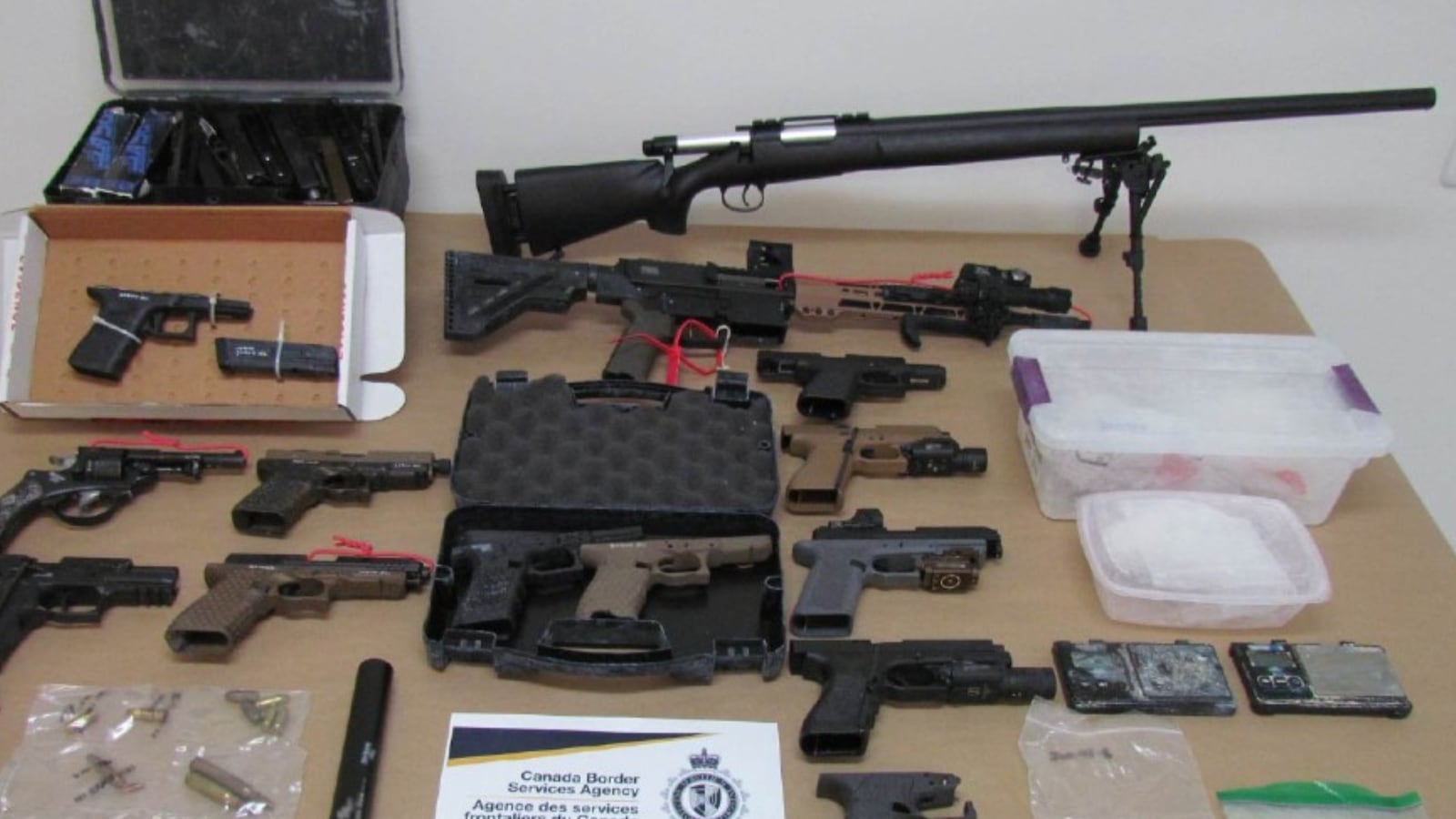
Today’s digest covers high-profile Vancouver stories: a local man facing trial over an arsenal of 3D-printed weapons and drugs, the opening of a new $183-million amphitheatre at the PNE, and a unique Bowen Island mansion that has dropped $13 million in price.
Federal charges: Vancouver man to face court over arsenal of 3D-printed guns and drugs
The Canada Border Services Agency (CBSA) has laid 21 charges against a Vancouver resident following an operation conducted last summer. According to CTV News, in August 2024 officers searched a private home and seized an arsenal that included six firearms, drawing particular attention to two pistols printed on a 3D printer.
These are so-called “Glock-type” pistols — copies of one of the world’s most popular handgun brands that, unlike factory-made counterparts, were entirely homemade. Investigators also found a semi-automatic rifle. In an official statement, CBSA emphasized that such homemade devices pose particular danger because they often lack serial numbers and can be produced outside any regulatory control.
The defendant’s exact age and name have not been released, but charges cover not only illegal weapons trafficking but also possession of drugs for the purpose of trafficking. This suggests the arsenal discovered may have been used not merely as a personal collection but as part of criminal activity. Experts note the Vancouver case is part of a growing global concern: 3D-printing technology is rapidly getting cheaper and more accessible, enabling criminals to circumvent firearms-control laws. For non-specialists, “Glock-type” refers to a design that replicates the internal mechanics of Austrian Glock pistols — semi-automatic models known for their reliability and widely used by both police and criminals. The accused now faces lengthy prison terms on multiple counts, which will test Canada’s judicial system in confronting new technological challenges. The CTV News piece (https://www.ctvnews.ca/vancouver/article/cbsa-announces-21-charges-against-vancouver-man-in-gun-drug-investigation/) notes this is not the first time CBSA has encountered 3D-printed weapons, and the agency intends to strengthen measures to cut off supply channels for such items.
Vancouver’s new stage: $183-million amphitheatre opens its doors
A new concert venue — the Freedom Mobile Arch — has officially opened at the Pacific National Exhibition (PNE) in Vancouver. The inaugural concert, featuring Jann Arden and Colin James, marked a new era for the historic site. The amphitheatre cost taxpayers CAD 183 million, nearly three times the original estimate. City officials and PNE leadership, however, place high hopes on the venue, expecting it to become not only a cultural landmark but also a strong revenue generator.
According to CBC News (http://www.cbc.ca/news/canada/british-columbia/new-pne-amphitheatre-opens-9.7226203), the new venue, built using timber from British Columbia, can hold up to 10,000 spectators. It will host the fan festival during the upcoming FIFA World Cup 2026, which begins June 11. Notably, this is the first major building constructed on PNE grounds since 1968, when the Pacific Coliseum opened. PNE president Shelley Frost called the amphitheatre, with its impressive roof, “an icon of music, art and culture” and said she is confident it will attract visitors from around the world.
The project’s significant cost overrun has raised questions. The amphitheatre was originally estimated at CAD 64.8 million. Frost explained that that figure was calculated before geotechnical studies were carried out. Unexpected difficulties arose during construction — in particular, 60 times more underground water was discovered than anticipated, which led to substantial additional costs. Despite this, PNE leadership is confident in the venue’s commercial prospects. The site is expected to draw hundreds of thousands of visitors annually, and ticket sales should allow construction costs to be recouped within 15–18 years. Frost emphasizes: “The plan is for this place to generate revenue. The return on investment is more than sufficient to cover construction costs and ensure PNE’s prosperity in the future.”
This optimism has a significant basis. For the past two decades, the annual summer PNE fair has faced a steady decline in attendance, which was especially exacerbated by the COVID-19 pandemic. In 2025 the fair attracted just over 612,000 visitors — 4% fewer than the previous year and the lowest figure in the 21st century, excluding the COVID years of 2020–2022. Thus, the new amphitheatre is seen as a lifeline for the organization, capable of attracting new audiences and reviving interest in the historic complex. Whether the Arch can fulfill expectations and become the growth driver remains to be seen, but its opening unquestionably marks a new chapter in Vancouver’s entertainment life.
Island mansion near Vancouver with indoor tennis court drops $13 million
Canada’s luxury real estate market continues to surprise. A unique mansion on Bowen Island, just a 30-minute ferry ride from Vancouver, is back on the market — but its price has undergone dramatic changes. In 2017 the property was listed at CAD 22.99 million; today it’s available for CAD 9.65 million. A decline of CAD 13.3 million, or 57 percent of the original price, is rare even for the luxury market.
The estate comprises two buildings on a 23-acre lot with 457 metres of shoreline in the prestigious Hood Point area. The main house was built in 1982 to a design by William Reid of the renowned architectural firm Thompson, Berwick & Pratt. A second building with an indoor tennis court and garage was later added. A totem pole by artist Richard Hunt was installed on the grounds in 1989. The total interior space is nearly 22,000 square feet, with seven bedrooms and eight bathrooms.
Interior details include massive concrete columns, cedar and other West Coast woodwork, and special wooden panels designed to accommodate large artworks. Windows offer panoramic views over Howe Sound toward Squamish and the Black Tusk mountains. In addition to the tennis court, the property features a 55,000-gallon (about 208 cubic metres) indoor pool, a private floatplane dock that provides direct access to downtown Vancouver, and even an industrial hot-dog machine as a quirky bonus.
The property’s history is linked to more than architecture. The mansion has appeared in Hollywood films: The Russia House (1990) starring Sean Connery and Michelle Pfeiffer, Double Jeopardy (1999) with Ashley Judd and Tommy Lee Jones, and Look Who’s Talking Now (1993). According to real estate firm West Coast Modern, the house was built for the Morse family, who are believed to have ties to Samuel Morse — the inventor of Morse code. In 1987 the property was acquired by the Campbell family, who, the listing says, “lovingly maintained it for almost four decades, caring for extensive gardens and curating art.”
In recent years the property has repeatedly appeared and disappeared from the market. In May 2024 it was listed for CAD 9.98 million, and in January 2023 for CAD 14.99 million. By October 2025, prior to the current listing, the price was already CAD 9.65 million. Castanet.net (https://www.castanet.net/news/BC/618330/Island-mansion-near-Vancouver-with-indoor-tennis-court-drops-13M-from-original-price) reports the current owner first listed the property in June 2017 for CAD 22.99 million. Thus, the price drop over eight years amounts to 57 percent. The case clearly illustrates that even the most unique properties with rich histories can struggle to find buyers amid changing economic conditions and tightening standards for luxury homes.