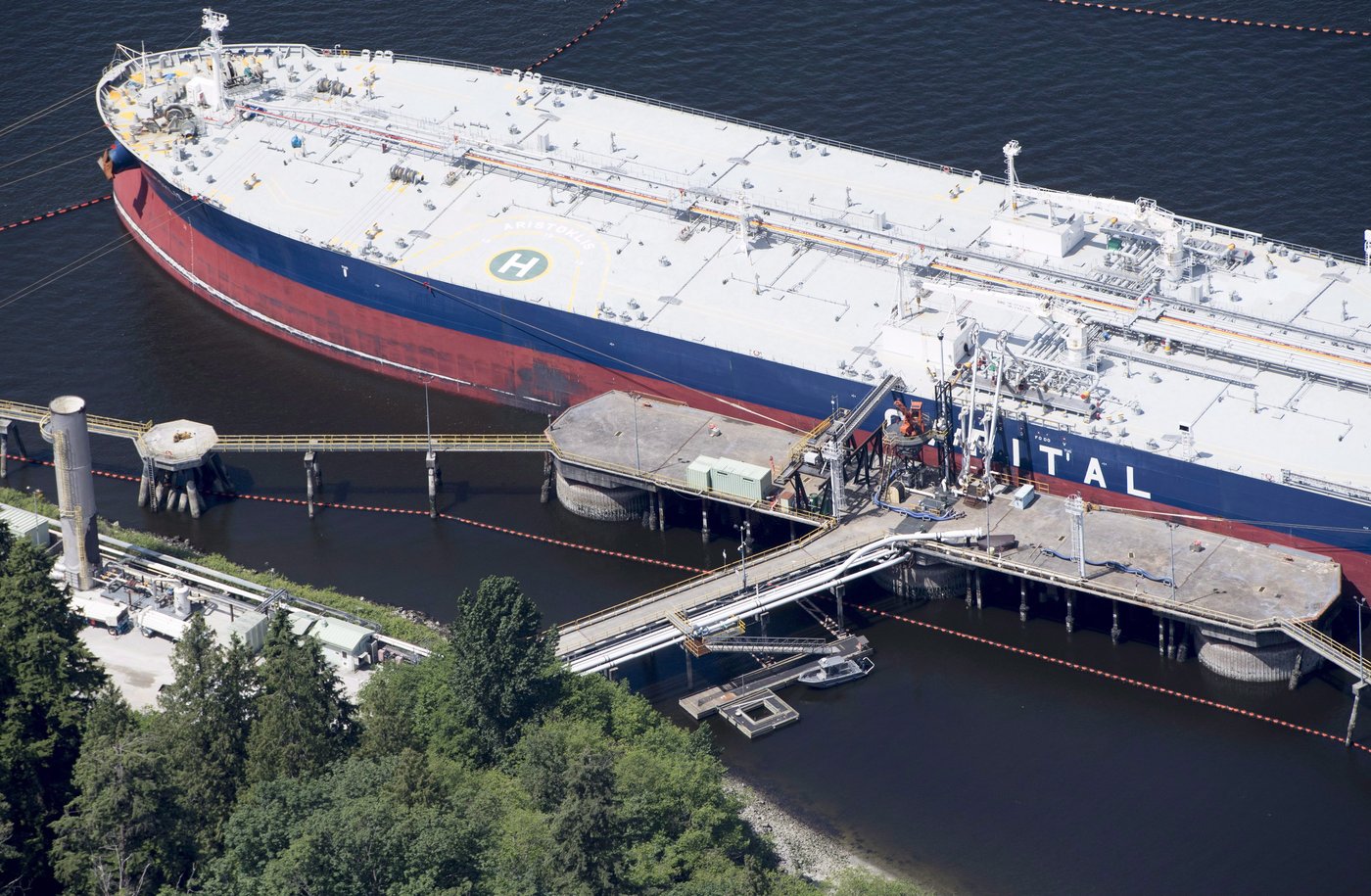
An Indigenous lawsuit challenging dredging for oil tankers, the deadly loss of fishermen linked to operator negligence, and $5 million earmarked for a pedestrian area—without details on how the money will be spent—are the main themes in this roundup.
Tsleil-Waututh Nation challenges dredging for large tankers in Vancouver
The Canadian government and port authorities are trying to deepen the shipping channel in Burrard Inlet so that large oil tankers can load to full capacity rather than just 80% of their capacity. However, the Tsleil-Waututh Nation—on whose traditional territory the work would be carried out—has filed a lawsuit against the plan, arguing that the consultation process was “rushed” and that their concerns were ignored, from the risk of oil spills to damage to the shoreline. This story is not just a local conflict; it’s a clash between two of Canada’s most important priorities: expanding energy exports in the context of trade wars with the United States, and the need to respect Indigenous rights—demands that Indigenous peoples have raised for decades to have their lands and way of life treated with respect.
As CityNews Vancouver reports, the case involves a plan by the Vancouver Fraser Port Authority to dredge Burrard Inlet so tankers such as Aframax vessels calling at the Westridge Marine terminal (Trans Mountain pipeline) can depart with full cargo holds. As Trans Mountain itself notes on its website, these ships are currently loaded at about 80% because of the limited depth of the channel under the Second Narrows bridge. The project involves extracting roughly 25,000 cubic meters of sediment down to as much as six meters below the seabed.
In an official statement, the Tsleil-Waututh Nation said it has gone to court over permits issued by the port authority. Chief Justin George emphasized: “The Tsleil-Waututh have a sacred duty as stewards—to care for our lands, air, and water. We tried to address these issues in good faith, but our concerns were dismissed, and we had no choice but to go to court.” The Nation acknowledges the project’s importance to trade, but argues that the existing cumulative impacts of shipping already prevent the community from living its traditional way of life—and that dredging would only worsen shoreline erosion, spill risks, and changes to marine shipping patterns.
The project has support at both the federal and provincial levels. Prime Minister Mark Carney first mentioned the dredging idea in spring 2025, and British Columbia Energy Minister Adrian Dix said it would allow “to reduce port traffic and make better use of vessels.” The federal budget, however, contains no specific references to dredging—only promises to invest in port infrastructure. The port authority stresses that the work will not change the number or size of the largest ships; Aframax vessels will remain the maximum.
Notably, the dispute is unfolding amid worsening Canada–U.S. trade relations. Since the expanded Trans Mountain pipeline began operating in May 2024, calls have grown louder to increase energy exports in order to reduce reliance on the American market. Dredging Burrard Inlet is a logical step toward increasing port capacity—but for the Tsleil-Waututh, it is yet another violation of rights that, in their view, have already been undermined by years of industrial pressures.
The key issue here is the balance between economic development and environmental and cultural safety for Indigenous peoples. While Canada is legally required to consult Indigenous communities (duty to consult), lawsuits like this one suggest that, in practice, many communities consider such consultations to be merely formal. The court’s decision could set an important precedent: will the port be allowed to continue the work, or will it require a deeper dialogue—and possibly changes to the route or loading technology? This story isn’t only about the bay; it’s about how the country manages resources and what sacrifices it is willing to make for energy independence.
Fishermen die off Vancouver’s coast: Operator bragged about the catch while a second vessel sank
The tragedy that occurred on June 28 in the Georgia Strait off the coast of British Columbia has raised a host of questions about the actions of the owner of the charter company. A smaller vessel, the Top Ocean, sank, killing six people, while the owner was aboard a second, larger boat and, apparently, did not immediately notice that the second vessel had disappeared. The story, covered by Global News, highlights not only a human tragedy, but possible violations in the way marine charters were organized.
On that fateful day, Top Vancouver Fishing Charter sent two boats out to sea. A few hours after departure, an 11-meter Axopar (on which the owner, nicknamed “Rocky,” was traveling) safely returned to the port of Steveston with a full hold of fish. At 12:24 p.m., a bragging post with video appeared on the Chinese social platform Red Note: “Two boats went out today, and the catch was just incredible.” But by then, the 9-meter Top Ocean had already been on the seabed for two hours. Its last signal from the automatic identification system (AIS) was recorded at 10:35 a.m.
The first distress call was not sent to the rescue coordination center until 11:45—reported by Angus Stauffer, a yachtsman passing by, who, along with his wife, spotted five people in the water without life jackets. They managed to pull three people out; the fourth was saved by other vessels. Later, one of the surviving women—Chinese—died in hospital. The search operation for the six missing people (ages 22 to 33, from British Columbia, Ontario, and Washington State) continued for several days, but a diving drone found only the sunken vessel at a depth of 153 meters—no bodies were recovered.
The owner’s behavior is especially puzzling. Ashley Lin, the 23-year-old captain’s mother, Chen Ming, met “Rocky” at the dock around 7 p.m., when he was dropping off clients from the larger boat. When she asked, the owner said the boats departed “with an interval of no more than five minutes,” and that he immediately called the RCMP once he lost contact. But why, with the second vessel still onboard the larger boat, did he not go check on it right after losing contact? Why did the social media post appear two hours after the tragedy? Lin said she couldn’t understand: “If you can’t get in touch with the other boat, you should at least drop off the clients and check on it immediately.”
The situation worsened because Transport Canada detained the larger Axopar boat after discovering serious violations: the vessel was operating as a commercial passenger craft, even though it was registered as a pleasure craft, and it did not have proper markings. It also emerged that the Top Ocean had a broken side door. The captain, Chen Ming, had complained to his girlfriend and mother about it days before his death. During one of the boat’s earlier trips, the door had swung open and the vessel began taking on water. RCMP’s investigation is now examining whether the malfunction played a role in the sinking.
All of this raises urgent questions about the safety of charter fishing trips in Canada. How could a commercial operator, with two vessels onboard, fail to track their locations in real time? In fact, the rescue vessel that passed by turned out to be more effective than the owner of the company itself. It is also concerning that, online, winning posts continued to be shared while people were drowning. Perhaps this tragedy will lead to tougher oversight of small charter vessels and mandatory use of reliable communication systems. For now, six families wait for news, while Canadian media are asking whether chasing a “full catch” caused human lives to come second.
Spending transparency: Vancouver earmarked $5 million for a Granville Street pedestrian zone—but how the money will be used is unknown
Vancouver authorities decided to keep five blocks of Granville Street closed to cars until Labour Day, extending a pilot project that began during the FIFA World Cup. City council approved nearly $5 million for the initiative, but a week later, neither of the funding recipients—the Downtown Vancouver Business Improvement Association and the police department—provided a detailed breakdown of the expenses. The situation drew criticism from some council members and raised questions about public accountability, especially ahead of the upcoming mayoral election.
On an emergency meeting convened just two days after, Vancouver City Council approved extending the pedestrian zone on Granville Street through the fall. Originally, the project was tied to World Cup matches and was supposed to end with the final. Now, the five blocks will remain car-free for an additional seven weeks. According to a report from Canada’s public broadcaster CBC News, the total budget was $5 million, including $2.1 million for the city’s internal costs—sanitation treatments, engineering work, and other services. Another $1.4 million would go to the Vancouver Police for security, and $1.25 million to the DVBIA Downtown Business Improvement Association for organizing events and activities not related to soccer matches.
But when CBC reporters tried to obtain a report on exactly how those amounts would be spent, they received evasive answers. DVBIA said it was “currently finalizing its plans and will be able to provide a clearer picture later.” The police, in its usual style, replied that it “does not disclose details of operational deployments.” Even in a follow-up request about why the financing details were being withheld outside the standard budget process, the police again pointed to security planning that was still not complete. This sparked anger among city council members who voted against the project—Rebecca Bly and Pete Fry—both of whom are running for mayor.
Bly stressed that she is not opposed to the idea of a car-free street itself, but is concerned that there is no well-developed plan. In her view, $5 million spent over seven weeks in a very small part of the city could have been used to support citywide festivals, creating “months and months of fun city atmosphere.” She also noted that despite DVBIA’s success at programming the street, it faced challenges: “unlimited graffiti” that has to be removed, and damage to temporary structures. Bly called for a focus on a long-term revitalization plan for Granville Street: “When the world leaves and the games end, what will be different on this street compared with what it was before the World Cup?” She described the extension as “cosmetic façade work without fixing the foundation.”
Brent Toderian, an urban planner and former Vancouver chief planner, who previously urged the city to continue the pedestrian experiment and now agreed to consult with DVBIA, offered a more measured perspective. He said that the success of pedestrian streets in North America is one of the key debates in city planning. In his view, it’s not worth trying to replicate the crowds and festive atmosphere of soccer matches, which were “hyper-energized” by tournament momentum and an influx of tourists. That mood doesn’t carry over to everyday life. Instead, Toderian said, pedestrian streets need variety of activities to attract residents and keep them engaged. He cited restaurant patios as an example: “When a street becomes an extension of a business, its owners become incredible advocates for the idea.” On safety, Toderian said the need is for “a golden mean in police presence”: too much policing can kill the atmosphere, but forgetting it isn’t an option either.
Councillor Mike Klassen, who supported the project, admitted that planning the seven-week extension was being done on the fly and that it was a risk—but “most of council decided that the risk was worth it.” He said he heard enthusiasm from the public about continuing the project and assured people there was no reason why staff could not prepare an expense report and early indications of cost reductions for future closures. Still, for now, none of the three-million-dollar share recipients have disclosed their plans (since the city’s internal costs, on the other hand, don’t require a public report?). For Vancouver, this is not just a budget discipline issue, but also a political challenge—especially since the mayoral election will take place this coming fall and candidates are actively using this topic in their rhetoric.