Canada is accelerating the expansion of the Port of Vancouver to tap into Asian markets, a move that has sparked disputes with Indigenous communities. Rare thunderstorms with large hail are expected along the south coast of British Columbia. In downtown Vancouver, 161 rooms in the Regent emergency hotel will be demolished to make way for social housing.
Canada accelerates expansion of the Port of Vancouver: a new strategy to reach markets beyond the US
The Government of Canada has announced that it is transferring the Vancouver Port Gateway Strategy (Port of Vancouver Gateway Strategy) to the Major Projects Office. The decision was announced by Minister of Transport Steven MacKinnon, who stressed that the initiative will support the country’s goal of doubling exports to markets outside the United States by 2035. A key element of the strategy is the project for a second terminal at Roberts Bank in the Fraser River delta (Roberts Bank Terminal 2), which could be designated as a “project of national significance.” According to CBC, citing a government statement, this is the first step toward a major modernization effort: expanding container capacity by 50% would allow the terminal to handle $100 billion worth of cargo annually.
The minister noted that the terminal is only part of a broader plan. The second pillar of the strategy will be a competitive selection process for an operator for the 16-hectare Fraser Surrey terminal in Richmond—described as the first major opportunity for port-area leases in the last ten years. In addition, the project involving an oil pipeline from Alberta will be considered; it is expected to run through the Delta area. “This is a process with clear timelines, and it begins today,” MacKinnon said, adding that the government has already developed what it called the “best possible package of proposed mitigation measures” to address environmental impacts.
However, not everyone is taking the news with enthusiasm. Laura Cassidy, Chief of the Tsawwassen First Nation, whose traditional territory includes Roberts Bank, emphasized that her community will feel the consequences of the construction most acutely. She pointed out that the band’s approval was granted based on “hundreds of binding conditions” to protect its interests. “Those obligations cannot be weakened or discarded in the name of efficiency or speed,” Cassidy warned.
Pieter Kxota, president and CEO of the Vancouver Fraser Port Authority, called the announcement a “turning point” and said the terminal project is ready to proceed. He said that while Roberts Bank is “much further along” than the Alberta pipeline, the current priority is to seize the economic opportunity. “Land, marine, landfill and rail infrastructure—all of that is needed if we as a country want to rise to the occasion,” Kxota said. He also stressed that the relationship with the Tsawwassen people remains “the foundation” for the next steps.
Recall that the Port of Vancouver moves $1 billion worth of goods every day and handles 40% of all Canadian international trade goods destined beyond North America. As part of the strategy, a rail infrastructure strategy will also be developed in coordination with the Major Projects Office and the Ministry of Transport. The move signals Ottawa’s desire to diversify trade flows amid growing reliance on Asian markets and reduced exposure to risks associated with trade with the United States.
Rare thunderstorm risk in Vancouver: heavy rain and large hail
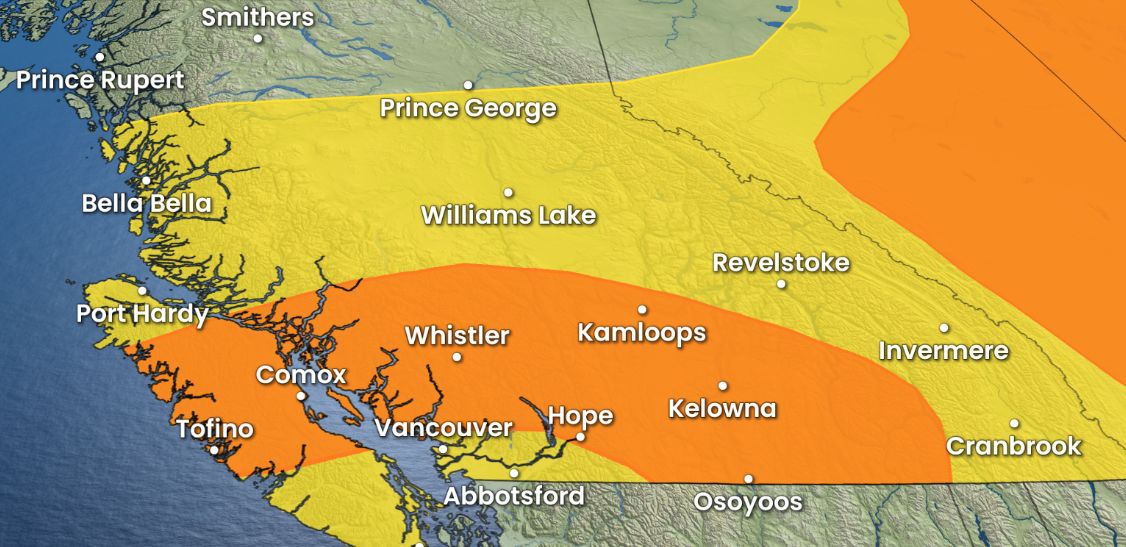
Along the south coast of British Columbia, including Vancouver, residents are bracing for an unusual weather event: a threat of thunderstorms that locals typically don’t see every year. According to data from The Weather Network, on Thursday an active cold front will move through the region, capable of producing not just downpours, but true storm clouds with large hail up to 2–3 centimetres in diameter, damaging wind gusts and heavy precipitation. The peculiarity of the situation for Vancouver is that thunderstorms are very rare there: the last time thunder was heard over the international airport YVR was in November 2024, making this event unusual in its own right.
Meteorologists say the cause will be an area of low pressure swirling off the coast of Vancouver Island. It will send moist, unstable air masses into the Strait of Georgia, and then, with intensification driven by the terrain—known as “topographic lift”—storms will develop rapidly along the North Shore. The highest likelihood of severe storms is in the evening hours, when heating and humidity peak. At the same time, there may also be a small risk of tornadoes developing in the northern interior of the province, although this is rare for the region. Forecasters emphasize that while the rain will help with fighting wildfires, the wildfire danger remains very high: along the south coast it is rated as high, and in the interior as extreme. Still, there is a downside: “dry lightning” without precipitation can spark new fires.
On Friday, the thunderstorm front will shift north of Vancouver but will continue to affect Vancouver Island and inland areas. Over the weekend, skies are expected to clear across the south of the province and conditions should improve. For residents and visitors, that means being ready for sudden changes: heavy rain could disrupt evening plans, and hail could damage vehicles and plants. Overall, such a thunderstorm serves as a rare reminder that even in the usually mild climate of the coast, extreme episodes are possible—and their impacts should be taken into account, especially amid a dry April and high fire risks.
In Vancouver, 161 rooms will be demolished in the notorious Regent hotel to build social housing
In downtown Vancouver’s Downtown Eastside (DTES), a major reconstruction of the historic Regent Hotel building has begun at 160 East Hastings Street. The 112-year-old building, constructed in 1913, has long served as an SRO (single-room occupancy hotel)—a residence where rooms lacked amenities and more than a hundred tenants lived. In 2018, the building was deemed unsafe and closed due to dangerous conditions. Now, authorities plan to demolish 161 rooms on floors two through eight to replace them with 77 modern studio apartments, each with its own kitchen and bathroom facilities. The new units will range from 21 to 62 square metres. The project is overseen by BC Housing, the provincial housing agency that leases the building from the City.
As reported by Business in Vancouver, in a report to city council that will be considered on July 16, the proposal is to approve a permit to demolish internal partition walls and carry out a full rebuild. In addition to the residential space, the project includes seismic strengthening, removal of hazardous materials (asbestos, etc.), installation of two code-compliant emergency stairwells, two new elevators, and replacement of all building systems—heating, electrical, and fire protection. On the ground and first floors, staff support spaces will be added: a room for heat processing (apparently for disinfection), showers, change rooms, offices, a medical room, consultant offices, a laundry room, as well as a commercial kitchen and dining area.
Although the building has been empty for eight years, former residents who want to return are promised priority access to move into the renovated building (as long as they meet the criteria). Recall that in December 2020 the City bought the Regent and Balmoral hotels from the Sohot family, the notorious owners of SROs. The deal amount was not disclosed despite Glacier Media’s request under freedom-of-information legislation. Then-former mayor Kennedy Stewart called the transition of the buildings to public ownership “a new hopeful beginning for Downtown Eastside residents.” Since then, Balmoral has been demolished, and a larger housing complex is planned for the site: planning and permitting are underway, with construction slated for late 2027 to early 2028.
The reasons Regent closed in 2018 and Balmoral closed in 2017 were the same: engineering reports found fire-prone conditions, rotting wood, sagging floors, mould and water damage. Notably, for the last 20 years, these hotels were repeatedly on the City’s “black list.” Police logged hundreds of calls: over a 16-month period in 2017–2018, Regent had 845 calls, while Balmoral had 248 (even though the latter closed in June 2017). Based on estimates from seven years ago, repairing both buildings would have cost $90 million, and the city had already spent at least $1.5 million on security and upkeep of the vacant properties. The Sohot family tried to challenge the seizure in court, but ultimately withdrew the lawsuit as part of a settlement.
In addition to Regent, at the July 16 meeting council will be asked to approve the demolition of six rooms in the Keefer Rooms building (222 Keefer St.) and 23 rooms in the Thornton Park hotel (956 Main St.)—both properties are owned by the province, and reconstruction is also planned there. At the same time, the non-profit Veterans Memorial Housing Society is asking the city for a $1.3 million grant for capital repairs to the Veterans Memorial Manor at 310 Alexander Street. The 133-room home, built in 1986 in partnership with the city, houses men over 55, including veterans and others at risk of homelessness. Rent there ranges from $460 to $640 per month. Funds will be used to replace a boiler, modernize the ventilation system, replace bathtubs with shower stalls, install new windows and surveillance cameras. Tenants will remain in their rooms during the renovations.
What lies behind these changes? The Downtown Eastside is known for high levels of poverty, drug use and crime. Older SRO hotels such as Regent and Balmoral have, for decades, been breeding grounds for unsanitary conditions and crime. Authorities are trying to address the problem by replacing dangerous rooming houses with decent social housing that includes private amenities. But the process is slow: since Regent closed, eight years have already passed and tenants have still not returned. The central challenge is balancing the demolition of historic buildings (including the Regent building built in 1913) with the need to provide people with safe, modern housing. The project also shows how expensive it is for the city to maintain vacant properties and to fight legal battles with bad-faith owners. If everything goes according to plan, new apartments could appear in a few years, but one key question remains: will former tenants be able to return to the renovated building—or will gentrification ultimately push them out of the centre once and for all.