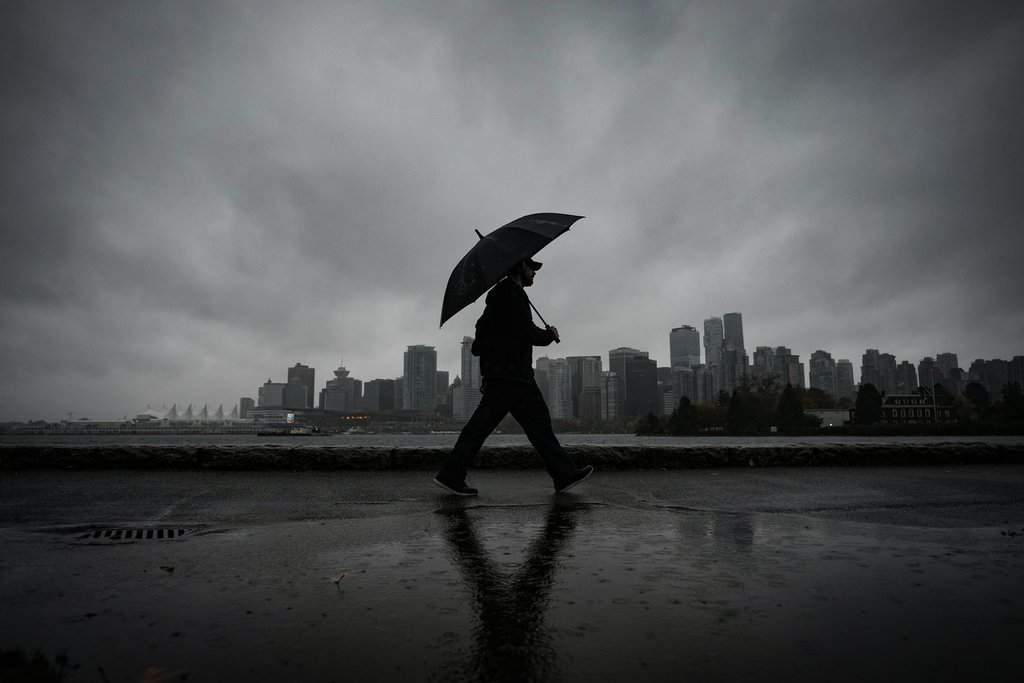
British Columbia news roundup: a third Pacific storm is bringing rain, wind and flood risks to a region already saturated with water; Stray Kids have announced a 2027 concert at Vancouver’s BC Place; and a Langley financial adviser has been found in contempt of court for concealing assets from his ex-wife.
British Columbia Braces for a Third Storm: Rain, Wind and Rising Concern
Canada’s West Coast, still recovering from a series of destructive weather events, is preparing for another test. The third Pacific storm is heading toward British Columbia, bringing an extended spell of heavy rain and strong, gusty winds. Last weekend’s storms left a troubling trail: thousands of residents lost power, evacuations were ordered in several areas, and one person died. Meteorologists are now warning that it is too soon to let down your guard—the severe weather is only gathering strength.
Global BC meteorologist Mark Madryga says a series of Pacific storms will move across the province’s coast throughout the week, bringing prolonged rainfall and occasional high winds. The heaviest precipitation is expected on windward slopes and in mountainous areas, where so-called orographic lift—when air is forced up mountain slopes and cools, producing precipitation—can significantly intensify rainfall. The new precipitation is arriving after several low-pressure systems have already soaked the ground, leaving the soil with very little capacity to absorb more water.
Although the precise rainfall totals and their distribution remain uncertain, meteorologists say they will issue rain and wind warnings as each new weather system approaches. The first, relatively moderate front moved through the coast on Monday, bringing rain to the south, though it was expected to ease by evening. The next round of severe weather, forecast to hit the region on Tuesday, looks much more serious. Northern Vancouver Island, as well as the North and Central Coasts and Haida Gwaii, are expected to experience strong southeasterly gusts of up to 110 kilometres per hour. The South Coast will also be windy and wet, with gusts in some areas exceeding 80 kilometres per hour by Tuesday evening and continuing into early Wednesday morning. Widespread rain is expected Tuesday and Wednesday morning. According to the SkyTracker forecast, West Vancouver could receive more than 100 millimetres of rain over that period, while the Greater Vancouver area is forecast to get 30 to 50 millimetres. With additional moisture expected throughout the week, total rainfall from Monday through Friday is likely to be substantial.
The rising freezing level—the altitude in the atmosphere above which precipitation falls as snow and below which it falls as rain—is a particular concern. A very warm air current from the subtropics is expected to lift the freezing level on the South Coast to 2,000 metres by Monday afternoon and to nearly 3,000 metres on Tuesday. In practice, this means even high-altitude areas will get rain instead of snow, adding to the volume of water flowing into rivers and streams and increasing flood risk. The BC River Forecast Centre has already placed the South and Central Coasts under a high streamflow advisory. This is a warning that rivers could overflow or approach critical levels, though no formal flood warning has been issued yet.
The situation is compounded by the fact that soil across much of the coast is already saturated from previous storms. More rain will run off the surface rather than soak in, sharply increasing the risk of landslides and flash flooding. Last weekend’s power outages affecting thousands of customers, evacuations and loss of life are a stark reminder of how vulnerable the region is to such extreme weather. As the third storm approaches, residents are advised to follow forecast updates and official alerts. Saturated soil, a rising freezing level and strong winds create conditions in which even moderate rainfall can have serious consequences. More information on the forecast and safety recommendations is available in this Global News report.
The key takeaway is clear: British Columbia is entering a period in which every new storm hits an already overburdened water system, and the cumulative impact could be more dangerous than any one storm on its own. Authorities and residents should prepare for the worst, even while specific rainfall estimates remain uncertain.
Stray Kids Choose Vancouver: K-pop Giants to Play BC Place in 2027
One of the most influential groups in contemporary pop music has added Vancouver to the itinerary for its new world tour. South Korean boy band Stray Kids, which has firmly established itself at the top of global charts in recent years, has announced a concert at BC Place. It is a major event for the Canadian city and one of the biggest music announcements on the horizon: Vancouver and Toronto will be the tour’s only Canadian stops on the new Run It tour.
The context behind the announcement is impressive. Stray Kids have long outgrown their status as a niche K-pop act and become a global phenomenon. Their latest album at the time, Karma (2025), and mini-album This and That (2026) topped charts in South Korea, the United States and Germany, while their combined streams on platforms such as Spotify and YouTube number in the billions. The group has also just completed the Latin American leg of its tour, becoming the first K-pop act to headline the legendary Rock in Rio festival—a clear indication of how far its audience has grown beyond Asia. The news was reported by Vancouver Is Awesome.
The new leg of the Run It tour begins in Seattle on May 16, 2027. Three days later, on Wednesday, May 19, the group will take the stage at BC Place, 777 Pacific Boulevard. One detail adds a dramatic twist: although Stray Kids traditionally perform as an eight-member group, Lee Know will remain in South Korea to complete his mandatory military service, so the group will tour as a septet—that is, with seven members. The opening act has not yet been announced, leaving fans to wonder what the evening’s format will be. As for tickets, the fan-club presale begins November 18, with general sales starting November 19. Organizers also note that purchases made through Ticketmaster partner links generate a small commission to support local journalism.
A few points help put the news in perspective. K-pop, or Korean pop music, is not just a genre but an industry built around high production standards, choreography and visual presentation, with groups formed by agencies and often organized around specific concepts. A “septet” is a group of seven performers, while Stray Kids usually perform as an octet of eight. BC Place is Vancouver’s largest covered stadium, with a capacity of more than 50,000. It hosts not only sporting events but also concerts by international stars, and the scale of the venue underscores the group’s stature. Finally, mandatory military service in South Korea is a reality for all men in the country, including pop idols. It often requires groups to perform temporarily with a changed lineup, directly affecting the format of concerts and fans’ expectations.
The main takeaway is simple: over the past few years, Stray Kids have gone from rising stars to stadium-level performers, and Vancouver’s selection as one of just two Canadian stops is clear evidence of that. Booking a date for May 2027 nearly a year and a half in advance reflects the industry’s long-term planning and the group’s enormous demand. The upcoming show with seven members will also be an interesting test of how ready audiences are to support the group with a changed lineup. For the city, it is another sign that K-pop is no longer an exotic niche on the fringes of the music market, but a major force capable of filling Vancouver’s largest venue.
“Totally Unbelievable”: BC Judge Calls Out Financial Adviser for Deceiving His Wife
The story unfolding in the Supreme Court of British Columbia reads more like a legal thriller than an ordinary divorce proceeding. Langley financial adviser Peter Cishecki, already under investigation by the British Columbia Securities Commission on suspicion of fraud, has now been found in contempt of court for breaching a spousal support agreement. Justice Joel R. Groves minced no words, calling the situation “just totally unbelievable.” He ordered Cishecki to return nearly $361,000 to a corporation—the money he had given employees as so-called loans, in violation of his obligations to his ex-wife.
The 61-year-old Cishecki is required to pay his former wife, 67-year-old Christine Lee Macbeth-Cishecki, $15,000 a month in interim spousal support, but he admitted in court that he is already $36,000 behind. At the same time, the judge found, he had no qualms about giving three employees personal loans totalling $900,000, of which $360,953 remains unpaid. Since the couple had previously been barred from taking actions that could reduce the value of their family property, the “loans” appeared to be an attempt to move assets out of reach. That was the basis for finding Cishecki in contempt of court. As Groves noted, the standard of proof in such civil proceedings is almost as strict as in a criminal case.
The ruling takes on added significance in light of the broader context: Cishecki is under investigation by the British Columbia Securities Commission, which said in July that it had evidence—not yet tested before a tribunal—that his companies, Everything Financial Group and Everything Financial Consultants Inc., may have “sold debt securities to investors and paid them principal and interest using money from other investors.” This is a classic Ponzi scheme, and the commission took the “unusual step” of obtaining a temporary court order against Cishecki. Justice Groves referred to that order as he assessed the overall financial picture in the spousal support case.
The divorce proceedings began after the couple separated in 2024, having lived together for 17 years. Justice Groves described what he called the “games” often seen in divorce cases where a husband controls the business assets and the wife remains a passive shareholder. The first “game” is the sudden disappearance of income. A business that was successful until recently, the judge said, “suddenly isn’t successful anymore.” Indeed, in 2025 the businesses brought in about $5.4 million in combined revenue against $2.65 million in expenses, leaving $1.1 million in retained earnings and $1.4 million in dividend income. Yet as the litigation dragged on, the business “suddenly had no prospects and no income”—a claim the judge found unconvincing.
The second “game” is the transfer of assets. Cishecki transferred a property in Pemberton to his longtime employee and friend, Brian Ikeda, for $600,000. But the company had already spent $2.5 million building a house on the property, whose market value was at least $3 million, the judge found. Moreover, Groves said, the deal was carried out using misleading statements made to Macbeth-Cishecki’s lawyer at the time. “What Mr. Ikeda and Mr. Cishecki did with the documents they both signed and promoted is tax fraud, pure and simple. They owe the provincial government $52,000,” the judge said. He added that “the most egregious aspect of this transfer is the deliberate deception”: Cishecki hid from his wife and her lawyer the fact that the corporation—of which she is a co-owner—had paid for the house. “All of this has the hallmarks of fraud,” Groves said, adding that “there is no explanation for this dishonourable conduct.”
The third “game” is an attempt to financially “paralyze” the wife. The judge cited a specific transaction: Cishecki allocated $731,000 in dividend income to his wife, though she received not a cent of it, leaving her with a tax bill of between $260,000 and $300,000. Business records suggest he likely declared a similar dividend for himself, but the companies paid his taxes; his wife was not offered the same arrangement. In effect, the manoeuvre saddled his ex-wife with the tax burden while denying her access to the money or any way to challenge the situation.
A few legal and financial terms help explain why the case is so striking. In civil proceedings, “contempt of court” means more than simply violating a court order: the court can impose sanctions, including imprisonment. In this case, the evidence must be almost as compelling as it would need to be in a criminal trial. “Interim spousal support” consists of temporary payments ordered during proceedings so that the less financially secure spouse can maintain their standard of living; failing to pay it typically has consequences. “Dividend income” is a portion of a company’s profits distributed to shareholders. In Canada, it is taxable to the recipient even if the money was never actually paid out—a feature Cishecki, the court believes, used to pressure his wife. A “Ponzi scheme” is a pyramid-style fraud in which returns to earlier investors are paid using funds from new investors, and the securities commission suspects Cishecki’s companies used precisely this model.
Justice Groves’s main conclusion was that the $360,953 recorded as loans to three employees “is part of Mr. Cishecki’s broader efforts to transfer value to these three individuals.” The judge also questioned the defendant’s account: if, as he claimed, the employees “stole his business” by using his name, why did he do nothing about it—and why was he paying them severance? Groves also made the telling observation that the business that once existed “no longer exists”—a claim that sounds absurd when the company has brought in $5.4 million in revenue. Ultimately, the court ordered Cishecki to return the remaining $360,953 to the corporation by November 12 or face a sentencing hearing. It also barred him and related companies—Christine Lee Holdings Inc., Everything Financial Mortgage Group Inc. and Everything Financial Consultants Inc.—from opening new bank accounts. An apartment in White Rock that Macbeth-Cishecki bought after the separation and $3 million in equity in property in Scottsdale, Arizona, remain under the court’s scrutiny as part of the family property, suggesting that the fight over assets is far from over. The story, reported in detail by Business in Vancouver, is a vivid example of how financial schemes built around corporate structures can unravel under close judicial scrutiny—especially when the person behind them is already under investigation by a regulator.