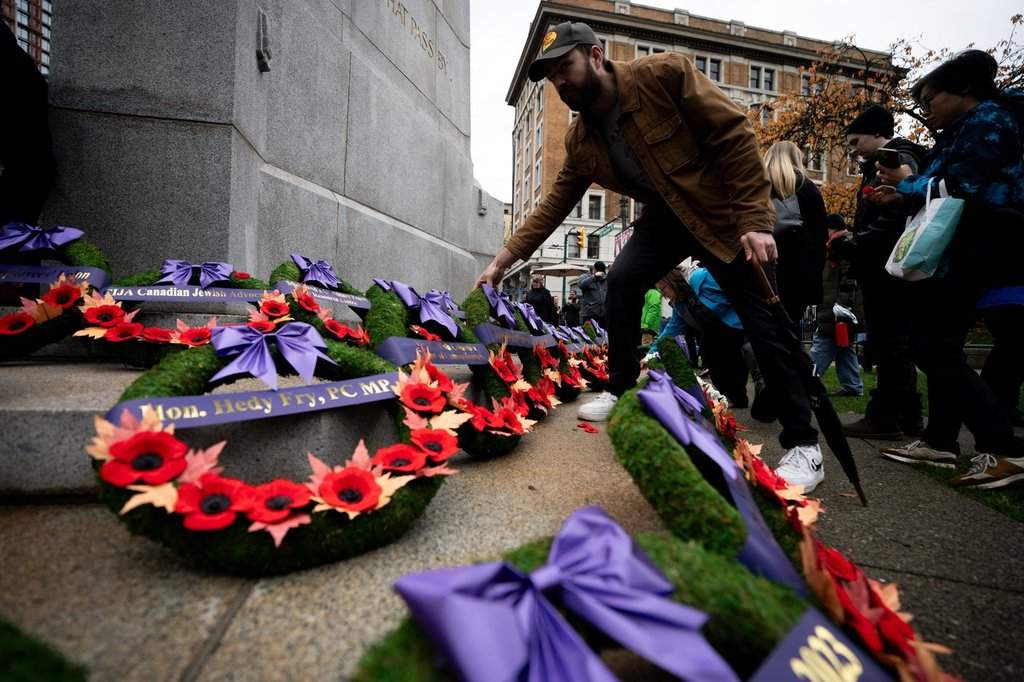
Powerful fall storms in British Columbia have left more than 400,000 people without electricity, raised the threat of flooding and isolated entire communities. Utilities warn that restoring power will take days. Meanwhile, Vancouver held its 102nd Remembrance Day ceremony at Victory Square, where thousands of residents honored the fallen with a moment of silence and wreath-laying.
British Columbia battered by severe weather: utilities warn power may be out for days
A series of powerful fall storms has swept across the Canadian province of British Columbia, leaving hundreds of thousands of people without electricity and raising serious concerns about flooding. According to utility B.C. Hydro, more than 400,000 customers lost power between Friday and Monday, and in some of the hardest-hit areas, service could take several days to restore. The situation is complicated by the ongoing severe weather: forecasters warn of further rain and wind, while river services are raising alert levels.
As CBC reports, on Wednesday, Environment and Climate Change Canada (ECCC) had a number of rain and wind warnings in effect across the province. More than 250 millimeters of rain could fall on the western and inland parts of Vancouver Island, with rainfall reaching 20 millimeters an hour in some places. By Thursday morning, up to 160 millimeters could fall along the Sea-to-Sky Highway. The warning states that localized flooding is likely and some roads may become impassable.
The River Forecast Centre raised the alert level to a flood warning for the South Coast, including Howe Sound, the Sea-to-Sky region and the North Shore mountains, as well as the Pemberton Valley, including the main stem of the Lillooet River and its tributaries. A flood watch is in effect in southwestern B.C. Authorities are urging drivers to be prepared for water and debris on roads after the storm made landfall on Tuesday. The Ministry of Transportation issued a special road advisory for the South Coast region, including the Lower Mainland, Sunshine Coast, Vancouver Island and Fraser Valley. The most vulnerable routes are the Sea-to-Sky Highway, Highway 1 through the Fraser Valley and Fraser Canyon, the Malahat Highway and the island’s western coastal communities.
The situation is especially difficult in the village of Zeballos in northwestern Vancouver Island, where an evacuation was ordered last week because of a landslide. B.C. Hydro estimates the community will likely remain without power for several more days. The company says specialized equipment is needed for repairs and must be brought in by helicopter because of the area’s remoteness and challenging terrain. Crews will be able to reach the site no earlier than Thursday, and only if the weather allows them to work safely. Overall, the utility said Tuesday evening that restoring power after a series of storms had proved difficult because of the scale of the repairs, while fallen trees, debris and waterlogged ground were making some areas hard to access.
A few terms used in Canadian agencies’ reports help put the situation in context. A flood warning means flooding is occurring or is imminent and requires immediate action. A flood watch is a lower alert level: conditions are favorable for flooding, and the situation is being closely monitored. There is also a High Streamflow Advisory, issued by the River Forecast Centre for the Fraser Valley, including Chilliwack and Hope, the Fraser Canyon and Chilcotin. It warns of fast-moving water and potentially unstable riverbanks, and urges people to stay away from rivers. These alert levels matter because they give authorities and residents time to prepare for evacuations and road closures.
The key factor is the combination of damage already caused and continuing severe weather. More than 400,000 outages in a few days, rain warnings for up to 250 millimeters, elevated flood alerts and isolated communities accessible only by air paint a picture of a prolonged crisis, not a one-off incident. Utilities are warning outright that some rain-soaked areas will be without power for days, meaning thousands of people could be left without electricity, heat or communications amid continuous rain. Authorities’ warning never to drive across flooded roads, bridges or fords deserves special attention. It is a familiar but critically important safety recommendation, since such decisions often lead to tragedies during floods. The situation in British Columbia remains fluid: much will depend on how quickly the severe weather subsides and whether conditions allow crews to reach the hardest-hit and most remote areas.
Vancouver honors the fallen for the 102nd time: the ceremony at Victory Square
At exactly eleven in the morning, silence fell over Victory Square in downtown Vancouver, broken only by a 21-gun salute, as the city marked its 102nd consecutive Remembrance Day. The ceremony began at 10 a.m. and ended at 11:30. It was livestreamed on Global BC’s platforms and hosted by Chris Gailus and Sophie Lui, along with retired Major-General Rob Roy MacKenzie, former Chief of the Reserves. For Vancouver, the occasion is more than a date on the calendar: Victory Square remains one of Canada’s oldest and most significant memorial sites, and the community’s unbroken tradition of gathering here for more than a century speaks for itself. Details and video of the event are featured in Global News’ report.
The formal program began at 10:30 with welcoming remarks, followed by the national anthem, performed by soloist Emily MacKinnon. The rest of the program ran almost minute by minute, as is typical of Canadian ceremonies of this kind: everything is timed so that the central moment—the minute of silence—falls precisely at eleven. At 10:42, the combined choir and band performed “Goin’ Home,” then young Hansona Wan read a poem, and Mayor Pete Fry presented an award to a student—a gesture underscoring how remembrance is passed on to the next generation. The prayer of remembrance was given by Reverend Captain Carla Wilks, followed by “The Maple Leaf Forever,” performed by Michael Horntvedt and the Vancouver Bach Family of Choirs.
The key moment came at 10:58, when Vancouver Fire Rescue Services trumpeters Robert Peskett and Brian Vilgash played “The Last Post,” the traditional signal marking the beginning of the act of remembrance. At eleven, two minutes of silence and a salute followed, then buglers played “Lament” and “Rouse.” A flypast was scheduled immediately afterward, weather permitting, and the choir performed “In Flanders Fields,” a poem written in 1915 by Canadian military doctor John McCrae that became one of the symbols of remembrance for the First World War. At 11:10, the official wreath-laying took place, along with a ceremony featuring a single white rose in tribute to veterans in long-term care homes. The ceremony concluded with “God Save the King” and closing remarks, after which the parade set off.
A few details help explain the context. Victory Square is no accidental choice of venue: it is home to the Cenotaph, Vancouver’s principal war memorial, and city ceremonies have been held at its base for decades. “The Last Post” and “Rouse” are the two signals that frame the moment of silence: the first symbolizes the beginning of mourning and the honoring of the fallen; the second represents waking and returning to life after remembrance. “In Flanders Fields” evokes the poppies growing in Flanders’ fields, which became a symbol of remembrance for the dead—and the reason for the tradition of wearing a red poppy on one’s lapel. A 21-gun salute is the highest form of military honor, while the white rose is a less familiar but moving element: it is dedicated to veterans who can no longer stand in the ranks and are marking the day in care facilities.
The main takeaway is that Vancouver’s ceremony remains a living, widely attended tradition, not a formality. Its 102nd consecutive year, meticulously timed program and participation by the mayor, clergy, fire service trumpeters, a children’s choir and a young reader all show how remembrance is sustained through ritual and passed on to young people. The livestream on YouTube extends the audience well beyond the square, allowing those unable to attend in person to take part. It is also significant that the program preserves elements familiar to every Canadian from childhood—from “In Flanders Fields” to the national anthem—and so connects generations. With almost no surviving witnesses to the world wars, ceremonies like these, with their precise schedules and symbolism, have become a means of preserving collective memory. Vancouver shows that this tradition continues to thrive.
Thousands honor the fallen: how Vancouver marked Remembrance Day
Thousands of residents gathered in Vancouver, Canada, to mark Remembrance Day, when the country honors military personnel who died in wars and armed conflicts. The ceremony took place in a solemn and dignified atmosphere, reflecting the special importance Canadians attach to remembering those who gave their lives for their country. CTV News published a report on the event.
Remembrance Day, observed in Canada and several Commonwealth countries on November 11, is more than a date on the calendar; it is a national ritual. Its symbol is the red poppy, worn on clothing as a sign of respect for the fallen. The date and time were chosen for a reason: the armistice that ended the First World War took effect at 11 a.m. on November 11, 1918. Traditionally, a moment of silence is observed across the country at that hour, as life pauses briefly and people bow their heads in memory of the dead.
The thousands of Vancouver residents who gathered for the ceremony became part of this shared tradition. Similar events take place across Canada at memorials, in squares and in public spaces, where wreaths are laid, veterans are thanked and those who never returned from the battlefield are remembered. The Vancouver event shows that the memory of war remains alive and meaningful to today’s generations, while the participation of thousands reflects society’s deep respect for history and its lessons.
The purpose of such ceremonies is not only to mourn, but also to pass remembrance on to future generations. Remembrance Day reminds us of the price of peace and the importance of valuing the stability and security won at the cost of human lives. The large turnout underscores that these values remain relevant today, more than a century after the end of the First World War.