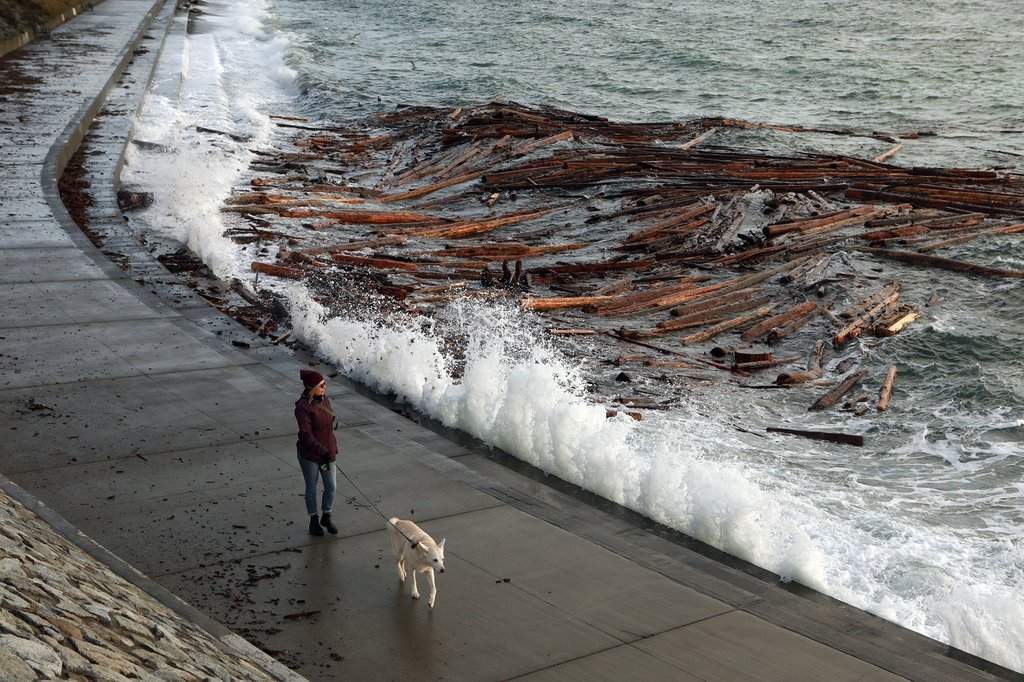
A third wave of storms threatens British Columbia with flooding and landslides, an RCMP motorcyclist was injured in a crash in downtown Vancouver, and a Fraser Institute report found that Vancouver incomes lag behind those in Victoria and Kamloops.
British Columbia Braces for a Third Wave of Storms: Up to 250 mm of Rain and Flooding Threats
Canada’s West Coast is enduring a prolonged spell of extreme weather, and conditions continue to worsen. After two previous rounds of storms battered British Columbia’s South Coast, forecasters are warning that a third wave is on the way and could be the most destructive yet. Environment Canada has raised the alert level, issuing orange rainfall warnings for western and central Vancouver Island, Howe Sound and the Sea-to-Sky region. Forecasts call for as much as 250 millimetres of rain in some areas, creating a real risk of flooding and landslides.
An orange warning means storms are classified as “severe” and are highly likely to cause significant damage and disrupt daily life. Some areas are expected to receive up to 160 millimetres of rain. The BC River Forecast Centre has issued a flood watch for the North Coast, the Sea-to-Sky region and parts of Vancouver Island, including the area north of the Fraser River in Metro Vancouver. According to Global News, rain is expected to continue through Tuesday and Wednesday, substantially increasing the risk of water pooling on roads and flooding in low-lying areas. Experts are especially concerned about landslides: slopes in mountainous areas, already unstable and saturated with water, could give way at any moment, threatening infrastructure and residents.
The severe weather has already had tragic consequences. The search for 35-year-old Dakota Smith, who went missing on Vancouver Island, was suspended because of the storm. He was last seen last Friday fishing from a motorized metal canoe in the Johnstone Strait. His boat was found several hours later on the opposite shore, about 11 kilometres from where he was last seen. Despite a large-scale search lasting several days in difficult weather conditions, the Royal Canadian Mounted Police said his chances of survival had fallen dramatically and that the current weather made further searches on the water and along the shoreline unsafe.
A few key terms help put the threat into perspective. An Environment Canada orange warning is the second-highest level of weather alert, below red. It signals the likelihood of significant damage and advises people to be prepared to evacuate and monitor updates. A flood watch means water levels in rivers and other bodies of water could rise to dangerous levels, though flooding has not yet begun—it is a call to be on heightened alert. As for 250 millimetres of rain, that is comparable to a month’s worth of precipitation in many parts of Canada falling in just one or two days, placing far greater strain on drainage systems and storm drains.
The key takeaway is clear: British Columbia’s South Coast is facing the cumulative effects of a series of storms, with the ground already saturated and rivers and other waterways nearing critical levels. That makes even moderate rainfall dangerous, let alone the forecast 250 millimetres. Authorities and residents need to prepare for possible road closures, power outages and evacuations. The tragedy of the missing fisherman underscores just how dangerous storms can be for anyone caught in their path. Emergency services are urging people to avoid mountain and coastal areas until the weather improves and to follow official updates closely, as this third wave of storms could be the region’s toughest test in recent memory.
RCMP Motorcyclist Injured in Downtown Vancouver Crash: What We Know So Far
Around noon on Monday, downtown Vancouver was once again a reminder of how fragile road safety can be—even for those whose job it is to control traffic. A Royal Canadian Mounted Police (RCMP) motorcyclist was injured after colliding with a passenger vehicle at the intersection of Davie and Burrard streets, one of the city’s busiest and most congested locations, where the business district, residential neighbourhoods and waterfront promenades meet. Police said the injuries were not life-threatening. Still, the fact that a uniformed officer on duty was struck by a car in broad daylight has drawn particular attention to the incident.
According to CityNews Vancouver, the collision involved a black Subaru. BC Emergency Health Services (BCEHS) received a call shortly before noon and sent two crews with primary-care paramedics, as well as another vehicle with an advanced-care paramedic. BCEHS spokesperson Brian Twaites said paramedics provided emergency care to one patient, who was taken to hospital in serious but stable condition. The other person involved was assessed at the scene and did not need to go to hospital. The outlet later clarified its initial report: only one person was taken to hospital, although the earlier wording may have suggested there were two injured people.
A few points are worth clarifying. The RCMP is a federal police force that, in addition to its federal duties, provides policing under contract in many provinces and municipalities, including parts of Metro Vancouver. The City of Vancouver itself, however, has its own police department, the Vancouver Police Department (VPD). This explains the jurisdictional distinction in this case: because the collision occurred within Vancouver, the investigation has been handed to city police rather than left with the federal force. This is standard practice, intended to ensure an independent review of incidents involving law enforcement officers. The description of the injured person’s condition also merits explanation. In paramedic terminology, “serious but stable” means injuries require urgent medical care and monitoring but posed no immediate threat to life at the time of transport. This differs somewhat from the police description, “not life-threatening”; the discrepancy reflects the different criteria used by paramedics and police.
Important details remain unclear. Police have not said exactly how the collision happened—whether the motorcyclist was travelling in his lane, making a manoeuvre, or whether the car entered the intersection on a green light. It is also unknown whether the Subaru driver has been charged. The incident is part of a broader and troubling trend: motorcyclists, including police officers on duty, remain among the most vulnerable road users in dense urban settings. Intersections such as Davie and Burrard, with heavy pedestrian and vehicle traffic, are traditionally high-risk areas. In Vancouver, where measures to reduce speeds and reallocate road space have been actively debated in recent years, this crash may add to the case for reviewing traffic patterns at downtown intersections and strengthening enforcement of traffic rules.
For residents and police alike, the practical takeaway for now is that the investigation is only beginning. The cause of the collision will be established after VPD investigators review the evidence, including surveillance footage, and interview witnesses. For now, it is clear that neither professional status nor training guarantees safety on the road, and the timely response by paramedics—two primary-care crews and one advanced-care crew—helped avert a worse outcome. The public will have to watch for official updates, which, as in similar cases, may significantly change the initial picture of what happened.
Vancouver Is Expensive, but Not Wealthy: Why Incomes Lag Behind Those in Victoria and Kamloops
A new report by the Fraser Institute upends the familiar image of Vancouver as the engine of prosperity in western Canada. Despite soaring housing prices and its reputation as a “premium” city, median household income in Metro Vancouver is considerably more modest than in much less glamorous places, from Victoria to Kamloops. The figures point to more than a statistical blip: they suggest a structural problem. The province’s largest metropolitan area, which should in theory drive growth and innovation, ranks only in the middle when it comes to prosperity. Here’s what lies behind the numbers, why Victoria has unexpectedly pulled ahead, and what risks this poses for British Columbia’s economy as a whole.
According to the Fraser Institute, median household income in the Vancouver census metropolitan area (CMA) was $75,348 in 2023, measured in constant 2025 dollars. This is technically just above the average across Canadian metropolitan areas of $74,948. In practice, Vancouver is barely around the national median, while Victoria reaches $84,431—about $9,000 more. Kamloops, at $77,909, and Kelowna, at $77,428, also outpace the “Paris of the Pacific,” while Nanaimo ($73,164), Abbotsford–Mission ($73,017) and Chilliwack ($70,645) rank lower. “Despite its reputation as a prosperous metropolis, median household income in the Vancouver area is significantly lower than in the provincial capital and even in other cities in the Interior,” Daily Hive quotes Ben Eisen, a senior fellow at the Fraser Institute and co-author of the report, as saying.
For context, median income is the point that divides households exactly in half: one half earns more, the other less. Unlike the arithmetic mean, it is not pushed upward by the incomes of a few exceptionally wealthy families, so it offers a better picture of typical residents’ financial well-being. Constant 2025 dollars mean the figures have been adjusted for inflation and can be compared across cities and years, rather than simply reflecting rising prices. A census metropolitan area is an official statistical unit that includes a city and surrounding areas linked to it by commuting patterns. In Vancouver’s case, it covers not just the city itself but a substantial part of Metro Vancouver.
The report’s main concern is that Vancouver, as the province’s “dominant commercial centre,” is not functioning as an engine of prosperity—that is, broad-based economic well-being. Major urban centres would normally be expected to drive growth, innovation and productivity. But, in the authors’ view, the Canadian reality is different: not only Vancouver, but also Toronto and Montreal, hover around the middle of the national rankings instead of leading them. “The fact that the province’s largest metropolitan area—and its traditional commercial centre—is experiencing economic challenges should concern policymakers and all British Columbians,” Eisen stresses. One explanation offered by the institute is immigration: Toronto and Vancouver both receive a disproportionate number of new immigrants, including temporary residents, whose incomes in their first years after arriving are generally below the national average. This partly “dilutes” the median, though it is unlikely to explain the situation fully.
Victoria’s outlier status is especially interesting. The Fraser Institute attributes its lead in income to a nationwide pattern in which prosperity is concentrated in capital cities—and Victoria is the provincial capital, with a large number of public servants. From 2019 to 2023, public-sector employment grew by 22 per cent, while private-sector employment rose by just 0.5 per cent. In other words, Victoria’s prosperity relies substantially on government spending rather than the market economy. The report directly raises the question of how metropolitan areas without major centres of government administration perform. The figures suggest: less well.
There is, however, another side to this. Since late 2024, the provincial government has imposed a hiring freeze, and its 2026 budget announced plans to cut about 15,000 jobs by the 2028–29 fiscal year as part of an effort to mitigate a record deficit of nearly $14 billion. If public-sector employment has fuelled Victoria’s high incomes, its contraction could weaken the city’s position—and the province’s prosperity rankings may yet change. For Vancouver, the main takeaway is less encouraging: a high cost of living does not create wealth on its own. Without a functioning engine of growth, innovation and productivity, the city risks remaining expensive but economically “average,” with clear consequences for housing affordability, its appeal to skilled workers and the resilience of the regional economy as a whole.