A heat wave has swept across the province, prompting health warnings and record-breaking energy demand. At the same time, Delta’s mayor and experts are raising concerns about the safety of an expanding port over a lack of police oversight and the risk of smuggling.
British Columbia in the Heat: Authorities Warn of Health Risks
Residents and visitors in British Columbia are preparing for a prolonged period of abnormal heat. According to meteorologists, heat warnings have been issued in more than a dozen regions of the province, and they could last until Thursday. The situation is further complicated by smoke already hanging in parts of the province due to wildfires, now compounded by exhausting temperatures.
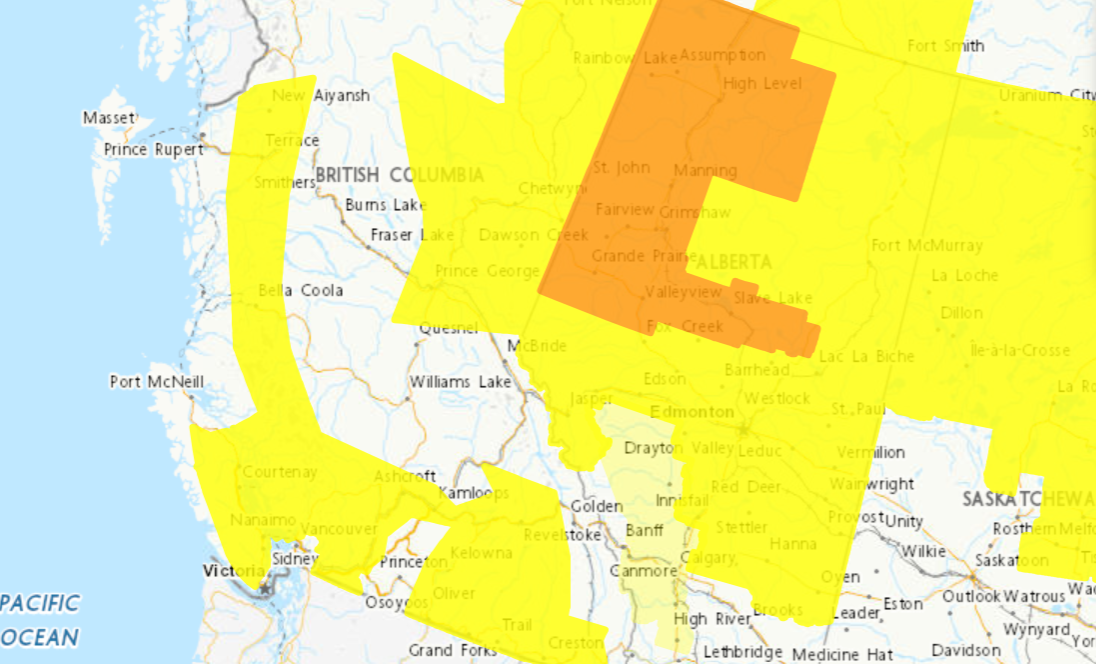
As reported by Daily Hive, Environment and Climate Change Canada (ECCC) has issued yellow warnings for 18 zones, including the Central Okanagan with Kelowna, the Fraser Valley, Whistler, and the Sunshine Coast. Temperatures are expected to rise to the mid-to-high 30s in degrees Celsius, while overnight lows are forecast to drop only to 15–20 °C. Such weather, according to forecasters, creates “a prolonged period of increased temperatures that poses a risk to public health.”
In its ECCC notice, it states that “a high-pressure ridge will bring above-season temperatures,” with only a slight cooling expected by the end of the week. Through the EmergencyInfoBC system, authorities strongly recommend that residents check on vulnerable neighbours, elderly relatives, and people with chronic conditions. Early signs of heatstroke include feeling unwell, fatigue, thirst, headache, and unusually dark urine. If these symptoms appear, people are advised to move immediately to a cooler place—out of the sun in a shaded area or into a room with air conditioning.
It will be especially hot away from the coast. In Metro Vancouver on Tuesday, temperatures could reach 35 °C in inland areas, and the ultraviolet (UV) index will be 8—very high. By Wednesday and Thursday, the heat is expected to ease slightly to 28–31 °C, but comfortable conditions won’t return until the weekend.
Notably, the warning also applies to mountain resort areas such as Whistler, and coastal regions like Howe Sound. That points to the unusual breadth of the heat wave. For anyone planning trips around the province this week, it’s important to remember that the combination of high temperatures, intense sun, and wildfire smoke can be dangerous for the respiratory system and the cardiovascular system. Emergency services are urging people to drink plenty of water, avoid physical exertion during the hottest parts of the day, and never leave children or pets in enclosed vehicles. In an emergency, call 911.
Port Expansion in British Columbia Raises Safety Questions Again: The Mayor and Experts Weigh In
Delta Mayor George Harvey has raised concerns for years about security and crime at the province’s port facilities, and now he says he has even more questions: the federal government has decided to speed up a major port expansion project in his city. The plan involves the Roberts Bank Terminal—currently the second terminal—which is expected to add $100 billion to the annual value of trade. The project includes building a new berth for three ships, which would increase the port’s container capacity by 50%, and is estimated to contribute $3 billion per year to Canada’s GDP. For Harvey, however, those numbers do not overshadow the longstanding issue: safety.
As far back as 2023, the city of Delta commissioned a report from Peter German, a former deputy commissioner of the Royal Canadian Mounted Police (RCMP), who identified serious gaps in port security. In an interview this week, German confirmed that nothing has changed since then. The main complaints involve smuggling—both incoming and outgoing—along with a lack of an ongoing police presence and the fact that only a small number of port workers undergo security screening. As one expert notes, while goods at points of entry are monitored by the Canada Border Services Agency (CBSA), it is not a police organization, and “right now, there isn’t a single police officer working in the ports.”
In a recent interview, Harvey said that even after speaking with colleagues in port police, who, he says, “were just shaking their heads” at why there still isn’t a more reliable security system at the Port of Vancouver. He is especially concerned about how the new capacity could affect flows of illegal drugs produced in Canada and shipped overseas. The mayor points out that in Europe, “rolling scanners” are already being used—devices that allow trucks to be inspected without creating traffic jams. In Canada, he says, similar technologies have still not been implemented.
Federal Transport Minister Stephen MacKinnon, who visited Delta last week to announce that the project will be included in the Major Projects Office for expedited review, said that port expansion and port security are “separate issues.” He emphasized that the government “spends a tremendous amount of time trying to keep up with evolving threats,” and he referenced the RCMP as one of the best police forces in the world, which, in partnership with the province and municipalities, is responsible for port security. But both the mayor and the report’s author doubt that the current fragmented system—where responsibilities are split among the RCMP, local police, CBSA, and private security—can handle growing volumes. After the dissolution of the specialized port police force back in 1997, these functions were never restored to the proper extent.
In a piece for CityNews Vancouver, journalist Daryll Greer highlights that accelerating a project meant to diversify Canada’s trade and reduce dependence on the United States is happening alongside unresolved problems. Peter German draws a parallel to the recently held FIFA World Cup: “The game itself matters, but so does the security of the games. The same with ports: expand, but don’t forget about security.” The open question remains: can Canada ensure proper oversight before new containers start arriving at the terminal? As the mayor says, there has been no answer from the federal government so far.
Record Heat in British Columbia: Warnings Expand and Energy Demand Breaks Records
In British Columbia, an abnormal heat wave has hit the southern and inland coastal regions. Meteorologists expanded the area covered by warnings, and data published by CityNews Vancouver indicates that temperatures have already broken multiple daily high-temperature records. Residents should prepare for sweltering conditions at least until the end of the week.
According to Environment Canada, heat warnings are now in effect over much of the east coast of Vancouver Island, in Whistler, and in the Fraser Valley. There, the heat is expected to last until Wednesday, while in the province’s interior it could continue until Thursday. Temperatures along the coast are expected to be above 30 °C, and in the southern interior and the Fraser Valley, the mercury is forecast to reach the mid-30s. Already on Monday, four daily records fell: in Kitimat, Dease Lake, Sechelt, and Squamish. Particularly notable is the record that was set in Squamish—34.6 °C—which had stood since 1990. The highest temperature recorded on Monday in the province, and across Canada overall, was in Lytton—36.3 °C.
Inevitably, the heat is taking a toll on the power grid. BC Hydro warns that summer electricity use across the province may reach historical highs—air conditioners and fans are creating massive strain on the networks. That means British Columbians should prepare not only for the stifling conditions, but also for possible spikes in electricity bills. For those unfamiliar with local geography: the Fraser Valley is a fertile lowland east of Vancouver that often suffers from summer heat, while Lytton is a small town known for extreme temperatures (in 2021, temperatures there were near 50 °C, a record for Canada).
The key takeaway: forecasters expect the heat wave to continue, so residents of British Columbia should take precautions—drink more water, avoid direct sunlight, and check in on elderly relatives. For the power utility, it will be a serious test, especially as climate change is making these heat waves more frequent and more intense.