A digest of how financial troubles at a historic Montreal church, a truckers’ strike in British Columbia and a lighthouse-shaped house for sale on Vancouver Island lie hidden behind weather reports and market headlines—stories about the fragility of urban infrastructure, independent haulers’ conflict with the pricing system and the quirks of the real-estate market.
Rain Over Vancouver and a Crack in a Montreal Church: What City News Leaves Unsaid
The headline of a Canadian news portal mentions a gloomy autumn day in Vancouver, but the article itself tells a very different story: St. James Church in Montreal, which has stood in the heart of the city since the late 1880s, is on the brink of financial survival. This contrast between an innocuous weather report and the fate of an entire community perfectly illustrates how modern media package serious social problems into unremarkable news briefs. The article, published by Yahoo News Canada, appears at first glance to be about an ordinary autumn rainstorm, but in fact raises the question of who will preserve historic heritage and public spaces—and who will pay for it.
The core of the problem is simple and unforgiving: maintaining and repairing St. James Church will require millions of dollars, which the congregation does not have. This is not a cosmetic renovation but major structural work, including replacing the roof, reinforcing the building and updating its mechanical systems. For a parish that has existed for more than 130 years, such sums are comparable to the annual budget of a small charitable organization. At the same time, the church has long ceased to be merely a place of worship: it serves as a community centre hosting neighbourhood meetings, concerts, charity dinners and gatherings organized by local initiatives. This dual role—sacred and social—makes the situation especially urgent.
To understand the scale of the problem, two key concepts need explaining. A “cash crunch” is not simply a shortage of money, but a situation in which expenses exceed income to such an extent that even essential payments have to be postponed. For religious organizations, this often means cutting programs and laying off staff. The second concept is “ministry.” In the Canadian context, this means not only religious activity but also the full range of social work carried out by a parish, from helping homeless people to organizing activities for seniors. When a ministry loses funding, it is not only the religious community that suffers, but the entire neighbourhood.
The article’s key message, hidden behind the weather headline, is this: historic buildings in Canada are deteriorating faster than funds can be found to save them. St. James Church is not an isolated case. Across the country, hundreds of religious buildings constructed in the 19th century face a choice between being sold to developers, demolished or converted into condominiums. In Montreal, where the central real-estate market is overheated, such a building is an attractive opportunity for developers. But selling it would mean losing a public space that cannot be replaced. This is the heart of the conflict: the market value of land versus the social value of a place.
Interestingly, the article itself contains no comments from officials or parish representatives—only a statement of fact. This makes the situation even more troubling: it creates the impression that the problem exists in an information vacuum, meaning that solving it will have to depend on the efforts of the local community and charitable donors. For readers, this is a warning: the next historic church in your city could find itself in the same position, and its fate will depend on whether anyone notices in time.
Ultimately, the report about a rainy day in Vancouver becomes a parable about the fragility of urban infrastructure and the fact that the most important news often appears under the most inconspicuous headline. St. James Church needs millions of dollars, and it remains unclear whether that money will be found. But one thing is already clear: if society does not learn to value places that generate no profit but hold a neighbourhood together, the next rain may wash away not only leaves from the sidewalks but an entire era.
Canadian Dump-Truck Drivers Stage Slow Protest from Abbotsford to Vancouver
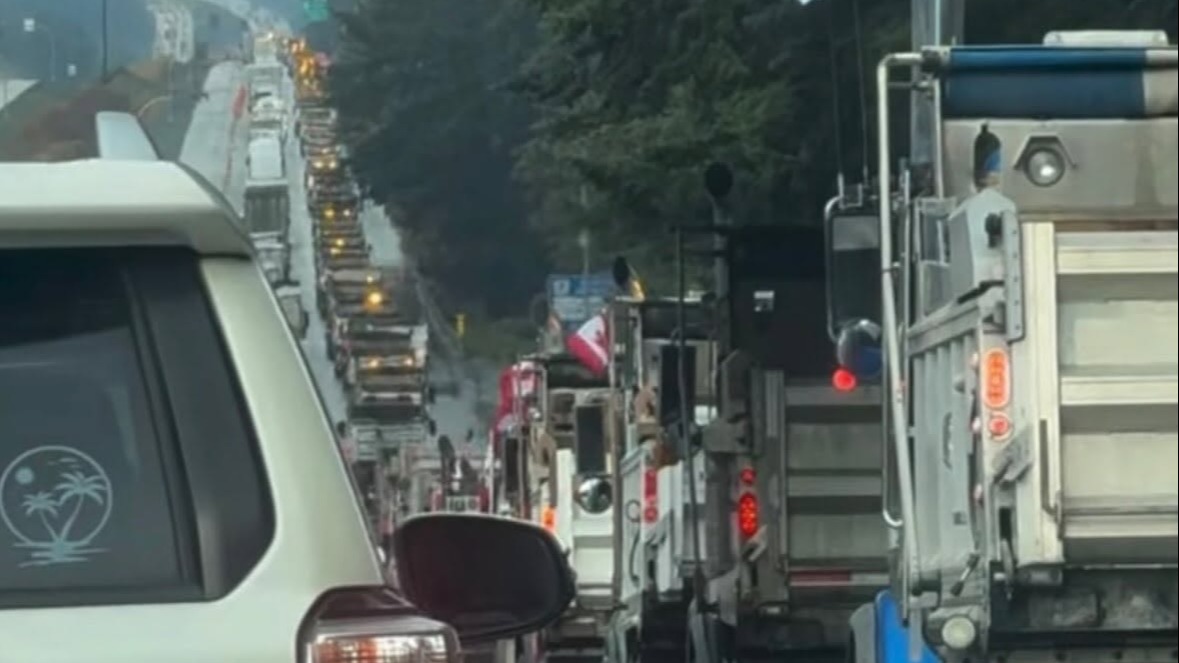
On Friday morning, September 25, traffic on several roads in British Columbia’s Lower Mainland came to a standstill: dump-truck drivers organized a slow-moving convoy stretching from Abbotsford all the way to Vancouver. The action, reported by local outlet Fraser Valley Today, was not authorized by the authorities and turned the usual morning commute for thousands of people into a test of patience. On some sections, traffic backed up for several kilometres, while the flow of vehicles slowed to a crawl.
According to an announcement posted in the public Facebook group “Dump Truck Life in Vancouver, BC Canada,” the convoy route ran from Highway 1 in Abbotsford to Hastings Street in Vancouver. The organizers initially called for fair pay, but videos that appeared online showed that the protest’s agenda was broader: trucks displayed banners calling for lower fuel costs and allowing haulers to set their “own” rates. In essence, the dispute involves three interconnected issues—the level of earnings, the cost of diesel fuel and the pricing system for trucking services, which drivers consider unfair and imposed from outside.
Several points need to be clarified to understand the conflict. Dump trucks are heavy vehicles used to transport loose materials such as sand, gravel, soil and construction waste. In British Columbia, many such drivers work not as employees but as independent contractors: they own their own trucks and pay for fuel, insurance, repairs and depreciation themselves, while receiving jobs through dispatchers, construction companies or intermediaries. Under this model, income depends directly on two variables—the rate paid per trip and the price of diesel. When fuel becomes more expensive while rates remain unchanged or even fall because of competition and pressure from customers, an independent driver’s profit margin can disappear or turn negative. This was the trigger for the protest.
The demand to set “their own” rates is the key and most controversial point. Rates are often dictated by customer companies or dispatch platforms, leaving individual haulers with almost no leverage to negotiate. Drivers are insisting on the right to determine the cost of their services themselves, which would effectively mean rethinking the entire pricing chain in the region’s construction logistics sector. This demand echoes a broader trend in recent years: in various Canadian provinces, independent haulers have increasingly complained that their economic situation is worsening amid rising living and fuel costs, as well as competition from larger operators capable of undercutting prices.
The implications for the region are fairly serious. British Columbia is experiencing a major construction boom, particularly in the Vancouver metropolitan area, and dump trucks are a critical link in the construction-material supply chain. Strikes and slow-moving convoys, even spontaneous and short-lived ones, can slow construction projects, delay deliveries of sand, gravel and crushed stone and, over time, increase construction costs if haulers succeed in raising their rates. Such actions also set a precedent: if dump-truck drivers win concessions, other parts of the trucking industry—from container transport to construction-material delivery—may adopt similar tactics. It remains unclear how the provincial authorities and customer companies will respond, but one thing is obvious: behind the paralyzed morning traffic lies a deep economic conflict between independent haulers and a system that, in their view, no longer allows them to earn a decent living.
Lighthouse-Shaped House Listed for $2.35 Million on Vancouver Island
An unusual property has appeared on British Columbia’s real-estate market. At first glance, it could be mistaken for a genuine lighthouse, but it turns out to have always been a residential building. The house is located near Maple Bay in the Cowichan Valley on Vancouver Island. Built in 1991, it has remained faithful to its original architectural concept ever since. Its main feature is an abundance of octagonal forms, with the centrepiece being a three-storey octagonal tower rising above the rest of the house. Two levels of the tower are equipped with wraparound terraces, giving the building the appearance of a real lighthouse—or at least an observation post. However, as Vancouver Is Awesome points out, the property’s location near the delta of a small creek hardly requires it to warn ships of dangerous rocks. These waters simply do not contain the treacherous reefs that captains usually fear.
Even so, functionality and style go hand in hand here. The house has three bedrooms and three bathrooms, one of them located halfway up the tower. At the very top is an office that, judging by the description, resembles a command centre with panoramic ocean views. In addition to the living quarters, the property includes a spacious workshop and a dock for kayaks or small sailboats. All of this is listed for $2.35 million—a sum that, the source emphasizes, is only slightly above the benchmark price of a detached home in Vancouver. The buyer therefore gets more than just a residence: they get an architectural curiosity with a history that, despite its outward resemblance to a lighthouse, remains an entirely private home.
Several points help put the listing into context. The benchmark price of a detached home in Vancouver is a statistical indicator regularly published by the Greater Vancouver REALTORS®, reflecting the typical value of a representative home and serving as a market reference. The Cowichan Valley is one of the scenic regions in eastern Vancouver Island, known for its mild climate and proximity to nature, making properties like this attractive to buyers seeking seclusion. The octagonal architecture so prominent in the house is not accidental: it is often used in lighthouses and fortifications to provide better visibility and resistance to wind. In this case, however, it is primarily an aesthetic choice emphasizing the building’s individuality. The article’s key insight is that British Columbia’s real-estate market, known for its high prices, sometimes offers properties that stand out not only for their cost but also for unique designs that challenge conventional ideas about housing. The quote that the house “could be a lighthouse and a pretty good lookout tower,” but that there is nothing nearby that needs to be warned about or guarded, highlights the ironic gap between form and function and hints at its marketing appeal to eccentric buyers. The impact on the market could go either way: on the one hand, such properties attract attention and may remain listed longer because their pool of potential buyers is limited; on the other, they sustain interest in the unique-property segment, where price is determined not only by square footage but also by architectural vision.