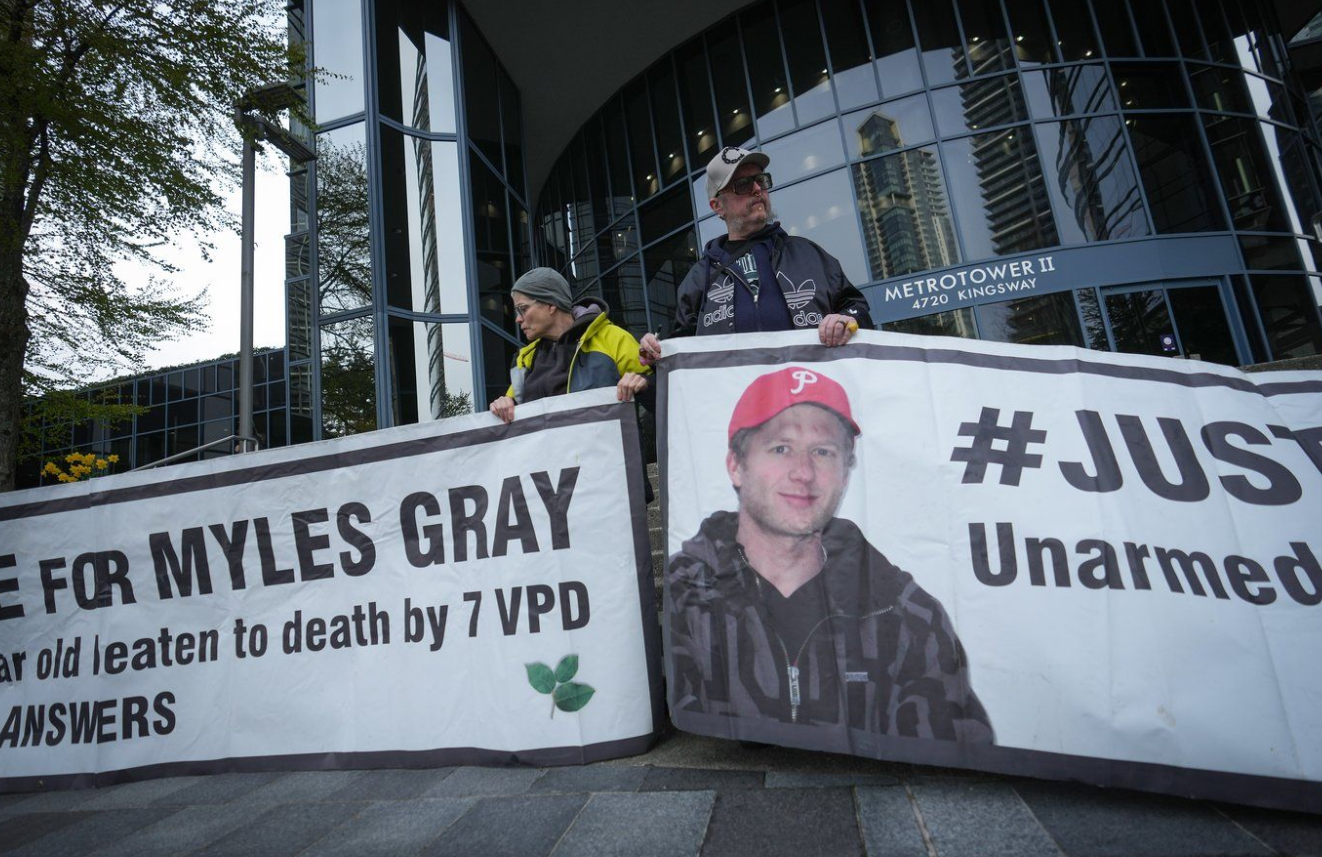
The most eagerly anticipated release in gaming history, GTA VI, comes with a time-zone quirk for players in British Columbia; Canada’s men’s field hockey team begins its campaign at the Sultan Azlan Shah Cup in Malaysia; and Detective Thompson testifies at hearings into the death of Miles Gray. Here’s today’s roundup.
Why GTA VI players in British Columbia will get the game an hour later — and why it matters
The global premiere of Grand Theft Auto VI — the most anticipated video game in history and perhaps the most anticipated entertainment release of all time — is becoming not just a technical event but a genuine cultural phenomenon. Because developer Rockstar is staggering the global launch by local time, some players have already started playing, including in New Zealand. The official launch is set for midnight local time on Thursday, November 19, and that is where an intriguing time-zone story begins — one that will directly affect residents of the Canadian province of British Columbia.
If the province had not switched to permanent daylight saving time, the game would have launched in Vancouver and the surrounding area at 9 p.m. But because of the change, local gamers will have to wait an extra hour and start playing at 10 p.m. British Columbia will therefore be playing at the same time as Alberta, while their neighbours across the border in Bellingham will get started an hour earlier, at 9 p.m. This time-zone quirk prompted a separate Daily Hive article, which drew attention to the regional specifics of the launch.
But behind this everyday detail lies a scale that is hard to overstate. The review embargo lifted at 3 a.m. Pacific time, and the game immediately received rave reviews, becoming, quite literally, the highest-rated video game in history and surpassing the original The Legend of Zelda: Ocarina of Time. At the time of publication, it had a Metacritic score of 99 based on 153 reviews. Rockstar had already earned more than $1 billion from pre-orders alone before release. According to Forbes, revenue before the game’s release reached $1.7 billion. Many experts believe the project will break records not only in the video game industry but across the entertainment industry as a whole.
For context, this is Rockstar’s first major release since Red Dead Redemption 2 (2018) and the first mainline GTA game since Grand Theft Auto V, which came out back in 2013. In 2021, the studio released Grand Theft Auto: The Trilogy – The Definitive Edition, a remaster of GTA 3, GTA: Vice City and GTA: San Andreas. The road to this release has not been straightforward: the developer delayed the game several times to polish it, after it was initially scheduled for release in 2025. Rockstar, Sony and PlayStation have also faced fan backlash over the fact that physical copies of the game do not include a disc, only a code for a digital download. PlayStation previously announced that it would stop printing discs for new projects starting in 2028.
Rockstar also has an interesting connection to Vancouver itself: in the early 2000s, the studio opened Rockstar Vancouver after renaming a team it had acquired. The studio is known for releasing Bully and contributed to the development and release of Max Payne 3. It later became Take-Two Interactive Software Vancouver, which still exists today. To mark the release, many news and technology outlets have already published stories about gamers taking time off work to play — a better indication than any figures of how GTA VI has become an event extending beyond the industry itself.
A few points help explain the details. Permanent daylight saving time is a system in which a region stays on daylight saving time year-round instead of turning clocks back in the fall; it was British Columbia’s switch to this system that pushed the local launch time back by an hour. Metacritic is a review aggregator that calculates an average score from professional critics’ reviews; a score of 99 out of 100 indicates near-unanimous acclaim. A review embargo is a ban on publishing reviews before a specific time, lifted for all outlets simultaneously. A pre-order is a purchase made before a game’s official release, allowing buyers to start playing as soon as it launches and often offering bonuses. Finally, the time difference between Vancouver and Bellingham is due to the Canadian province and the U.S. state of Washington following different time rules, despite being neighbours.
The main takeaway from this story is twofold. On the one hand, launching by local time inevitably creates an uneven playing field: New Zealand is already playing, British Columbia has to wait until 10 p.m., and Bellingham gets started at 9 p.m. For some, that is a reason to be jealous; for others, simply an oddity. On the other hand, the launch reflects unprecedented commercial and cultural scale: $1.7 billion in revenue before release, a Metacritic score of 99, and the status of the most anticipated entertainment release in history. The article’s claim that the game will become “literally the highest-rated video game of all time” is telling: if that holds true, GTA VI will set a new benchmark not just for Rockstar but for the entire industry. And the debate over digital copies without discs and repeated delays is a reminder that even the most triumphant launch comes at a cost — for developers and players alike.
Canada takes the field in Malaysia: the road to the Olympics begins
Canada’s men’s field hockey team is kicking off a new international season at the 32nd Sultan Azlan Shah Cup in Ipoh, Malaysia. For a team that has just completed a week-long training camp in Vancouver, this tournament is more than just another competition: it is an important test ahead of a packed schedule that ultimately leads to Olympic qualification. According to Field Hockey Canada, Canada, ranked 19th in the world, will face Pakistan on September 12. Their group also includes opponents from three confederations: Australia (ranked third), Malaysia (13th), Korea (22nd), the United States (26th) and Pakistan (12th). This range of playing styles makes the tournament especially valuable as preparation: it gives Canada a chance to test itself against teams from the Pan American, Asian and Oceania regions under the pressure of real competition.
The context of the tournament matters. Canada’s previous official test was a three-match series against the United States in July, which ended with a record of 1-1-1 — a result that is hard to call a clear success, but was not a failure either. The team then came together in Vancouver for a centralized training camp that served two purposes: it marked a reset and the start of preparations for the 2026–27 season, while also giving players essential training time immediately before the tournament in Malaysia. Centralized camps are common in Canadian field hockey, where players are usually spread across clubs and universities. They allow the team to build connections and practise tactical systems in a short period.
A key figure in the squad is Manvir Jhamat of Abbotsford, who is expected to earn his 50th cap for the national team next week. In an interview after the camp, he described the team’s mood: “We’ve got a great tournament ahead of us, and we’re really looking forward to it. The week at camp was tough — we worked on sharpening our technical skills, and now it’s time to go to Malaysia, perform and get wins. It’s a good opportunity to prove that we can compete with the best teams in the world.” Jhamat is also clear about the team’s broader ambitions: the Nations Cup in February and the Pan American Games in July are coming up, and the team hopes to build momentum through those tournaments. “The guys are excited and focused. We have these tournaments to grow, but our long-term goal is Olympic qualification. We understand how important that is,” he added.
Notably, four players in Ipoh will reach the 50-cap mark for Canada: along with Jhamat, they are Sam Cabral, Thomson Harris and Harbir Sidhu. All four are part of the generation of players in their mid-20s to around 30 who form the core of the current national team. This is no coincidence: it reflects a deliberate development cycle in which a group of players progress through the junior national teams together and gradually become the foundation of the senior side. At the same time, Satprit Dhadda, who stood out with the junior team, will make his international debut — another sign that Canada’s system is working to renew the squad.
A few terms help explain the tournament’s significance. The Sultan Azlan Shah Cup is an annual invitational tournament in Malaysia, named after the country’s former king. It is regarded as one of the oldest and most respected field hockey competitions in the world — a kind of “unofficial world championship” for invited national teams. A cap is an appearance for a national team; the tradition of awarding a symbolic cap for each appearance originated in football and cricket and is now used in most team sports. The Nations Cup, run by the International Hockey Federation (FIH), is a stepping-stone between regional competitions and the elite division, and its results have a direct impact on Olympic qualification. Finally, a centralized training camp is when players who usually compete for different clubs temporarily come together in one place to train under the national team’s coaching staff.
The main takeaway is simple: for Canada, the Sultan Azlan Shah Cup serves two purposes. It is not formally a qualifying tournament, but in practice it gives the team something no training camp can: matches against top-level national teams such as Australia, as well as strong mid-ranked sides such as Pakistan, Malaysia and Korea. With Canada’s next major test not coming until the Nations Cup in February, Malaysia is where the coaching staff will be able to assess how well the Vancouver “reset” went and whether the team is ready for the decisive stretch of its Olympic journey.
Miles Gray witness walks back “compassionate” description: how Vancouver police explain fatal incident
Public hearings into the death of Miles Gray in Vancouver continue to draw attention to how officers describe their actions during the investigation. This time, the focus was on Nick Thompson, now a detective constable, who described the officers’ conduct during the call as “incredibly compassionate” in a 2017 interview with a Royal Canadian Mounted Police (RCMP) investigator. Testifying at hearings initiated by the Office of the Police Complaint Commissioner, Thompson acknowledged that he had chosen the wrong word and apologized for the description. He said he should have had a thesaurus at hand. He now characterizes the use of force as “proportionate” to the threat he says Gray posed, describing Gray as “aggressive” during the struggle. CityNews Vancouver reported the story.
The events in question took place on August 13, 2015, when Miles Gray died after seven Vancouver police officers used force against him. The hearings are examining allegations of misconduct against the officers involved in the incident. During cross-examination by commission lawyer Brock Martland, Thompson was reminded of his earlier testimony, both during an investigation under the Police Act and at the 2023 coroner’s inquest. At the time, the officer said he had not seen other officers use force against Gray and rejected Martland’s suggestion that he was trying to avoid the “awkward and uncomfortable position of testifying against a fellow officer.” At the current hearings, Thompson stood by the account he gave at the inquest, while effectively disavowing his earlier description of the officers’ actions as “compassionate.”
A few concepts provide useful context. A coroner’s inquest is a formal proceeding held by a coroner to establish the circumstances of a death. It does not deliver a guilty verdict, but it can recommend changes to policy or practice. Hearings under the Office of the Police Complaint Commissioner are an administrative process that examines complaints about police conduct and can result in disciplinary measures. Finally, a Police Act investigation is an investigation conducted under the provincial law governing police conduct.
The key point in Thompson’s testimony is his attempt to reframe the use of force as “proportionate” rather than “compassionate.” That change in wording matters: “compassion” suggests humane treatment, while “proportionality” refers to the legal standard that force should match the level of threat. Thompson maintains that Gray was “aggressive,” which, in his view, justified the officers’ actions. But his statement that he did not see other officers use force raises questions about how complete his testimony is. Martland explicitly pointed to a possible conflict of interest — an officer’s reluctance to testify against colleagues, characteristic of the “blue wall of silence,” an unwritten code of solidarity among police officers. Thompson rejected the suggestion.
It is important to note that the hearings are ongoing, and Thompson’s testimony is only part of a broader picture. The Miles Gray case has been unfolding since 2015, and the current process is another attempt to establish whether the police acted lawfully. The officer’s admission that he chose the wrong word may seem minor, but it undermines confidence in the police’s initial explanations and highlights how closely the language used in earlier investigations is now being scrutinized. For the public, it is a sign that even years later, details of the incident are still being clarified and witnesses are having to revise their accounts under cross-examination.