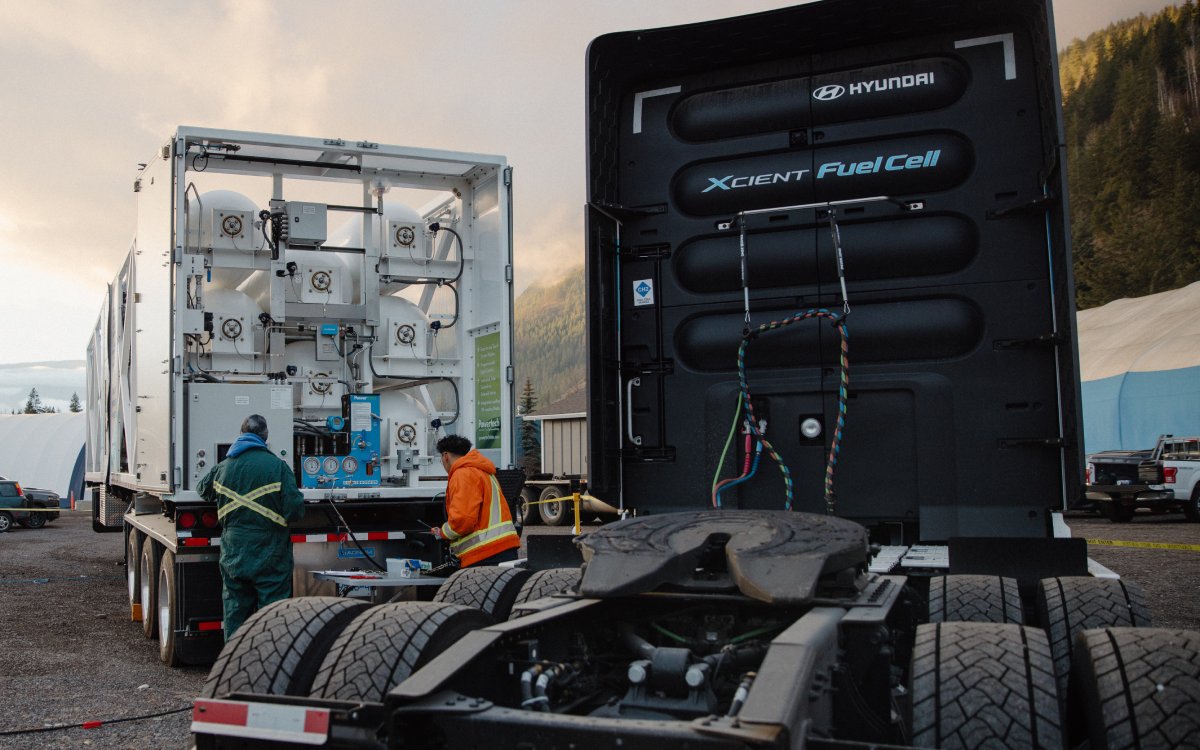
British Columbia’s Conservatives have formed a government for the first time, led by Lorne Doerkson. The 24-member cabinet has been sworn in, with two Vancouver Island representatives receiving portfolios. Separately, a Hyundai Xcient hydrogen truck completed a 1,046-kilometre test run from Vancouver to Calgary through the Rocky Mountains to gather data for a future refuelling network.
British Columbia’s New Cabinet: What Lies Behind Doerkson’s Appointments
British Columbia Premier Lorne Doerkson has unveiled his first cabinet, marking a major political shift in the province. The Conservatives won 64 seats in the legislature and are forming a government for the first time. The 24-member cabinet signals the priorities on which they intend to focus. Two Vancouver Island representatives have joined the government: Anna Kindy, MLA for North Island, became Minister of State for Rural Development, while Kathy Ounsted, MLA for South Saanich, was appointed Minister of Municipal Affairs, Housing, Sport and Culture. This is Ounsted’s first political role: she was first elected in the October by-election. Kindy, meanwhile, has served in the legislature since 2024 and was re-elected, defeating NDP candidate Sarah Lopez.
The formation of a Conservative cabinet is itself the result of tectonic shifts in provincial politics. For many years, British Columbia was considered an NDP stronghold, and the move to a Conservative government reflects voters’ demand for change. Doerkson said as much in a statement to CHEK News: “British Columbians voted for change, and our government is ready to deliver.” He outlined five priorities: affordability, prosperity, health care, safety, and “a strong and proud British Columbia,” encompassing education, the environment, reconciliation with Indigenous peoples and the protection of freedoms.
The cabinet’s structure includes several Ministers of State, who oversee specific areas within larger ministries. Anna Kindy, for instance, is Minister of State for Rural Development, while Zishan Wahla is Minister of State for Housing. This arrangement allows the government to highlight particular issues without establishing full ministries. At the same time, key portfolios have gone to experienced politicians: Peter Milobar has been appointed finance minister, Ryan Peterson health minister, and Claire Rattée deputy premier and minister of social development.
Kathy Ounsted’s appointment deserves particular attention. She is not only new to politics but also heads one of the most complex and politically sensitive portfolios: housing and municipal affairs. In a province where housing costs remain among the highest in the country, this role will be a litmus test of the new government’s effectiveness. Appointing a newcomer to such a position can be seen in two ways: as a chance for fresh thinking and unconventional solutions, or as a risk given her lack of experience.
It is worth explaining what a “snap election” is: an early election called by a government or provincial leader before the official term expires. In this case, it allowed the Conservatives to consolidate their success and form a cabinet reflecting the new balance of power. It is also important to understand that a Minister of State is a junior minister who reports to a senior minister but is responsible for a specific area. Doerkson’s cabinet includes several such positions, signalling an effort to cover more policy areas without creating additional full ministries.
The election results gave the Conservatives 64 seats, while the NDP retained 27 and the Greens won two. Judicial recounts are still pending in two ridings—Ladysmith-Oceanside and Kelowna Centre—and are set to begin next week. This means the final seat count could change slightly, although the overall picture is already clear. Doerkson himself said: “The people of British Columbia have given us an extraordinary responsibility. These five priorities will guide our decisions, and our task now is to earn their trust every day by delivering results and governing for everyone.”
The key takeaway from these appointments is that the Conservatives are forming a government focused on rural areas and housing policy, entrusting important portfolios to both experienced and new politicians. For Vancouver Island, this means that two of its representatives will have direct access to the levers of power. But the biggest tests lie ahead: whether the new cabinet meets voters’ expectations will depend on how effectively it performs.
British Columbia’s New Premier: Conservative Lorne Doerkson Swears In Cabinet
The transfer of power in British Columbia has taken place in a format that could be called historic for a Canadian province: a cabinet led by Conservative Lorne Doerkson has been sworn in. As CTV News reports, the ceremony marks Doerkson’s official assumption of the premiership—the transition from “premier-designate,” meaning a leader who has been elected and announced but not yet formally sworn in, to fully exercising the duties of the office. This is the moment when political agreements and election results become a functioning executive, along with concrete ministerial appointments that will determine how quickly the province’s new direction becomes reality.
The significance of the event extends well beyond protocol. The Conservatives are taking control of the government of one of the country’s most economically important provinces—a region where resource industries, port logistics, high technology and social policy intersect. For Doerkson, the cabinet’s swearing-in is also a test of his ability to govern. Until now, he had served as the party’s interim leader, tasked with keeping the political organization together during a period of transition. His authority is now formally confirmed, and the cabinet’s composition sends the clearest signal of the new government’s priorities: which ministries will receive expanded mandates, which figures are close to the premier, and which have been sidelined.
A key feature of the situation is the use of the word “designate” in the headline. In Canadian politics, it refers to a leader who has been recognized as the winner or given the right to form a government but has not yet taken the oath of office. Until then, the politician does not have full executive authority, even though they are already assembling a team and assigning future responsibilities. The swearing-in ceremony is therefore more than a ritual; it is the legal point of transition. From that day on, the decisions of the premier and his ministers take effect, and the cabinet becomes accountable to the legislature and voters.
The context of the change in government also deserves attention. British Columbia has long been associated with politics dominated by other forces, and the Conservatives’ arrival at the helm of the province marks a notable shift in the regional balance. For businesses, it signals the possibility of regulatory changes, especially in areas related to natural resources and construction. For the social policy sphere, it raises expectations of a new approach to health care, education and support for vulnerable groups. For the federal government, it means building a working relationship with a provincial government whose political outlook may differ from that of its predecessor. The cabinet’s composition and its first appointments will show how sharp the turn will be and which campaign promises will be put into practice first.
It also matters that Doerkson is taking power not as someone with years of experience leading a government, but as a leader who has gone through a period of interim party leadership. That path has given him insight into the party’s internal workings, but it also raises expectations: the new premier is expected to make swift, clear decisions, and any delay in putting together his team or any lack of clarity in ministerial mandates will be seen as a weakness. In that sense, the cabinet’s swearing-in is a public demonstration that the transition period is over and the province has a functioning government.
Finally, the event has symbolic significance. A photograph of Doerkson celebrating on election night captured the moment of political triumph; the cabinet’s swearing-in marks the moment that triumph turns into the routine work of governing. Between those two points lies the challenge of moving from opposition rhetoric to responsibility for the budget, public service and residents’ day-to-day concerns. How successfully the new premier makes that transition will be the main question facing British Columbia in the coming months—and a telling story for Canadian politics as a whole.
Hydrogen Truck Crosses the Rockies: Vancouver–Calgary Test Run Puts Future Logistics to the Test
A Class 8 hydrogen truck completed a commercial freight run from Vancouver to Calgary, covering 1,046 kilometres along one of Canada’s most challenging mountain routes. The test, organized by the Edmonton Region Hydrogen Hub (ERHH), is intended to provide real-world data for planning a hydrogen refuelling network in western Canada. A Hyundai Xcient fuel-cell truck operated by Loblaw Companies Ltd. delivered a load to the retailer’s facility in Balzac, north of Calgary, over two days. Along the way, it climbed the Coquihalla Highway, crossed Rogers Pass and travelled through the Kicking Horse Canyon, gaining a total of 8,783 metres in elevation—almost the height of Mount Everest. As Electric Autonomy reports, organizers stress that the goal was not to promote the technology but to collect practical data to guide future infrastructure investments.
Mohamed M. Khaja, ERHH’s director of mobility programs, explained that modelling hydrogen freight transport is one thing, while collecting real-world data is another. The route was chosen deliberately: it is a regular freight corridor that combines cold weather, high elevation and grades of up to 8.4 per cent at Rogers Pass. These are precisely the conditions that determine where refuelling stations are needed first and what they should be like. The hub, established by regional economic development organizations including Edmonton Global, the Alberta Industrial Heartland Association, Edmonton International Airport and Alberta Innovates, has been working on hydrogen trucks for three years. The run is part of the Western Canada Hydrogen Corridors Initiative, which aims to connect Edmonton, Calgary, Vancouver and other markets through a refuelling infrastructure network.
The test revealed both the strengths and the weaknesses of hydrogen logistics. Since there are no permanent hydrogen refuelling stations along the route, Powertech Labs, a subsidiary of BC Hydro, brought a mobile trailer carrying 1,050 kilograms of hydrogen at a pressure of 517 bar to Sicamous, British Columbia, for the first refuelling stop, then moved it to Golden for the second. Rob Wiebe, Loblaw’s director of supply chain, said that working with a wide range of partners helps clarify the technology’s real-world capabilities and limitations. Hydrogen trucks have traditionally had an advantage over electric trucks for long-haul transport: Hyundai says the Xcient has a range of up to 720 kilometres when fully loaded, while early Class 8 electric trucks could travel about half that distance. Newer electric models are approaching 800 kilometres, as with the Tesla Semi, but refuelling with hydrogen takes less than 20 minutes, compared with the one to two hours usually needed to charge a large battery—although new megawatt charging systems promise to cut that time to less than an hour.
Cost remains the main barrier. Khaja did not disclose the price of the truck, but Class 8 hydrogen trucks typically cost up to 2.5 times as much as their diesel counterparts. He expects prices to fall as demand grows and manufacturers move to mass production. The trucks are also eligible for zero-emission vehicle subsidy programs such as Go Electric BC, which provides $130,000 to commercial organizations and $156,000 to Indigenous, nonprofit and municipal organizations. Fuel is expensive too: hydrogen costs about $16.50 per kilogram in Vancouver, and one kilogram contains roughly 3.3 times as much energy as a litre of diesel, which costs a little over $1.80 per litre in the city. HTEC has only six permanent refuelling stations in southern British Columbia, and the hydrogen there is produced using hydroelectric power. Khaja expects prices to fall to a more affordable level as the network expands.
Many organizations took part in the project. HTEC owns the truck, which is leased to Loblaw; the truck was refuelled at an HTEC station in Vancouver; and partners included the Alberta Motor Transport Association, Backwoods Energy Services, BDS Inc., Twin Anchors Marine Industrial and HR Pacific Construction Management. Funding came from FortisBC’s Clean Growth Innovation Fund, Alberta Innovates, the Alberta Ecotrust Foundation, Emissions Reduction Alberta and the hub itself. Khaja described the effort as a “village” of contributors. The run builds on a demonstration project by Loblaw and FortisBC, in which a hydrogen truck has already been transporting groceries between Vancouver and Squamish, as well as earlier truck trials on Alberta roads. The team has yet to complete a full analysis of the telematics data, including fuel consumption, but a report is expected by the end of January at the latest. It will be shared with funders, governments, manufacturers and fleet operators.
A few terms help put the project in context. A Class 8 truck is a heavy-duty long-haul truck with a gross vehicle weight of more than 15 tonnes, the mainstay of long-distance freight transport in North America. A fuel-cell electric vehicle (FCEV) generates electricity through a chemical reaction between hydrogen and oxygen rather than storing energy in a battery. This allows it to refuel quickly and means its range is less affected by cold weather than that of battery-powered vehicles. A pressure of 517 bar means that hydrogen is stored in tanks under very high pressure, allowing enough fuel to be held in a compact space. The 8,783-metre elevation gain is the total of all the climbs along the route, not the difference between the starting and ending elevations, illustrating how hard the powertrain had to work.
The key takeaway from the run is that hydrogen technology has proved it can work on a real commercial route under challenging conditions, but its future depends not on the trucks themselves so much as on infrastructure and cost. Mobile refuelling showed that the route can be served today, but a permanent network of stations will require coordinated investment by businesses and governments. Data on fuel consumption and the truck’s performance on climbs will inform decisions about where to build stations first. For now, hydrogen trucks remain more expensive than diesel vehicles and depend on subsidies, but pilots like the Vancouver–Calgary run turn abstract models into real figures on which business plans can be based.