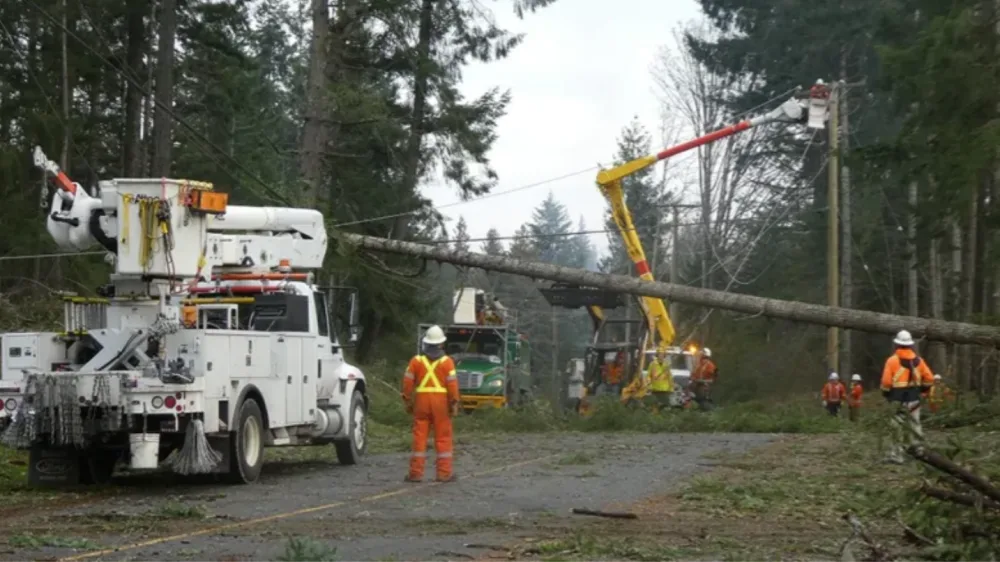
The south of the Canadian province continues to contend with a series of autumn storms. More rain and wind threaten flooding, landslides and power outages, while Vancouver, despite the bad weather, is shifting into holiday mode—with Christmas markets, the Eastside arts festival, concerts and charity events.
Southern British Columbia remains in the path of severe weather as rain and wind continue
The weather on British Columbia’s south coast continues to test residents’ resilience. After a powerful storm caused widespread flooding, the region is bracing for another bout of bad weather: a new storm system is expected on Saturday, bringing heavy rain and strong winds. Environment and Climate Change Canada has issued a series of yellow warnings covering a broad area, from the Sea-to-Sky corridor to Vancouver Island and coastal communities. Conditions are made worse by the fact that the ground is already saturated from previous storms and cannot absorb more precipitation, increasing the risk of further flooding and landslides.
According to forecasts cited by CBC News, 40 to 70 millimetres of rain could fall by Sunday in the Sea-to-Sky area, from Squamish to Whistler. Authorities are especially concerned that the ground is already waterlogged, leaving little capacity to absorb more rain and increasing its impact. The entire Sea-to-Sky area and the Pemberton Valley remain under high streamflow advisories, while the Village of Pemberton is still under an evacuation alert. Highway 99 east of Pemberton reopened Saturday evening after being closed due to flooding, but Squamish River Road remains closed between kilometre three and the Pichchuk Creek Bridge. Squamish Mayor Sean Easton urged residents to exercise caution: “Although the risk of flooding is going down, we’re expecting more rain over the weekend. Our rivers are dynamic and constantly changing, so we strongly urge people to stay safe, keep away from riverbanks, keep a close eye on children and pets, and whatever you do—don’t go into the water.” His words carry particular weight in light of Thursday’s tragedy: three people died in a boating accident on the Squamish River during heavy rain. The police investigation is ongoing.
The situation on Vancouver Island is no less tense. Rain warnings are in effect for the island’s north, interior and west. Up to 120 millimetres of rain could fall in Tofino and areas to the south, and up to 150 millimetres in the area between Zeballos, Gold River and Port Alice. Several properties in Zeballos remain under an evacuation order following a landslide triggered by last week’s rain. High streamflow advisories are also in effect across northern, western and central Vancouver Island. Coastal flood warnings remain in effect through Sunday for Metro Vancouver, Greater Victoria, Saanich Inlet and the Strait of Georgia. Storm surges and strong winds are expected to push tides above normal levels. Wind warnings have been issued for most of Vancouver Island, except for the east coast from Nanaimo to Shawnigan Lake, as well as the Southern Gulf Islands, the Sunshine Coast from Saltery Bay to Powell River, and Haida Gwaii.
A few terms help put the situation in perspective. In Canada’s warning system, a “yellow warning” means conditions may be hazardous and call for extra caution, but are not considered extreme. A “high streamflow advisory” signals that river levels are rising and could pose a risk to people and infrastructure, though they have not yet reached critical levels. An “evacuation alert” means residents should be ready to leave at any moment, while an “evacuation order” requires them to leave immediately. A “storm surge” is a rise in sea level caused by strong winds and low atmospheric pressure, which can lead to flooding in coastal areas.
The main takeaway is clear: southern British Columbia is facing a cascade of severe weather events. A succession of storms is leaving the ground no time to recover, and saturated soil means even moderate rainfall could be dangerous. The Squamish River tragedy, which claimed three lives, underscores just how serious the consequences of ignoring warnings can be. Authorities are urging vigilance, but the scale of the threat—from landslides in Zeballos to coastal flooding in Metro Vancouver—calls for coordinated action and readiness for the worst. One question remains: how many more such cycles can the region withstand before more radical measures to adapt to climate change become necessary?
British Columbia weathers another autumn storm: wind, rain and snow, but the worst is over
Another weekend on the coast of the Canadian province of British Columbia was marked by bad weather. A powerful storm system brought gusty winds, heavy rain and snow in the mountains, leaving thousands of residents without power. As The Weather Network notes, autumn storms are nothing unusual in the region, but this season has been especially severe, and this latest storm was another reminder of that.
The storm peaked on November 14–15. The strongest wind gust, reaching 156 kilometres per hour, was recorded on Solander Island. The powerful winds caused widespread power outages, leaving thousands of customers without electricity. Northern Vancouver Island and the Sunshine Coast were hit hardest, with outages scattered across a wide area. Such outages are a typical consequence of coastal windstorms: falling trees and downed power lines can knock out entire sections of the grid, and utility crews have to restore service in stages.
The good news is that the wind began to ease by Sunday, with gusts along the coast dropping to 30–60 kilometres per hour. But the rain was slower to let up. Heavy rainfall continued on western Vancouver Island, as well as in the Sea-to-Sky area and the North Shore mountains. An additional 30 to 50 millimetres of rain was forecast for higher elevations on the Sunshine Coast, western Vancouver Island and along the Sea-to-Sky corridor. Meanwhile, snow continued to fall in the Coast Mountains above 1,600 metres. This layered pattern—rain at sea level and snow in the mountains—is typical of Pacific storms, when warm, moist air meets colder air at higher elevations.
By Monday, the weather had improved noticeably: isolated heavy showers remained on Vancouver Island, while the Lower Mainland—the province’s most densely populated region—saw little precipitation. The long-range forecast was also encouraging: temperatures were expected to stay close to seasonal norms, and storm activity to ease significantly as the main storm track shifted south. In other words, the region was due for a welcome break after a run of severe weather.
A few points may need clarification. Solander Island is a small, uninhabited island off the northwest coast of Vancouver Island, where a weather station is located. Its exposed position in the ocean makes it one of the windiest places in the region, which is why record gusts are often recorded there. “Sea-to-Sky” refers to the Highway 99 corridor from Howe Sound to the resort town of Whistler—a popular route where rain and snowfall regularly make travel difficult. The “Lower Mainland” is the Vancouver metropolitan area and surrounding communities, home to much of the province’s population. Finally, an “active storm track” is the route followed by storm systems; when it shifts south, British Columbia lies outside the main path of the storms.
The main takeaway is clear: the storm caused significant, but not catastrophic, disruption. The main impacts were power outages and heavy precipitation rather than major damage. Still, context matters: as The Weather Network emphasizes, this has been a difficult autumn in British Columbia, and this storm is not the first—and probably won’t be the last. The article also mentions a related story about a tragic incident on the water amid severe flooding in the Squamish Valley, a reminder that storms pose a direct threat to people, in addition to causing problems for power and transport. For residents, the practical advice is simple: keep an eye on forecasts, be prepared for power outages and take extra care on roads and waterways until the weather system has fully moved away from the coast.
18 things to do in Vancouver from November 16 to 22: from Christmas markets to the Eastside arts festival
November in Vancouver is when the city quickly shifts into holiday mode. While some people have yet to put away their pumpkins, others are already switching on millions of lights, opening wooden booths at German-style markets and inviting artists to open their studio doors. The week of November 16 to 22 is especially busy: several major annual traditions get underway at once, from the 30th Eastside Culture Crawl to the opening of the city’s main Christmas market on the waterfront. Daily Hive has rounded up 18 reasons to leave the house—and this is far from a complete list.
The week’s main event for local art lovers is the 30th-anniversary Eastside Culture Crawl. From November 19 to 22, hundreds of artists—from painters to glassblowers and mixed-media artists—will open their studio doors in dozens of buildings in East Vancouver. Organizers expect tens of thousands of visitors. Studios are open from 5 to 10 p.m. on Thursday and Friday, and from 11 a.m. to 6 p.m. on the weekend. It’s a rare chance not only to see finished work, but also to get a glimpse of the creative process, talk to artists and, if you’re lucky, buy something directly from them. To clarify, the Culture Crawl is not an exhibition in the traditional sense: visitors use a map to make their own way between buildings and drop into whichever studios interest them.
Meanwhile, on Monday, November 16, the Vancouver Christmas Market opens at Jack Poole Plaza—one of the city’s most recognizable holiday traditions. Until December 24, the plaza will be transformed into a German-style market with more than 90 wooden huts featuring craftspeople, chefs and winemakers. It’s a tradition that sparks debate among locals every year: some see it as an essential ritual, while others grumble about the prices and crowds. But it’s hard to deny its appeal.
For those who want to combine shopping with charity, the free Make Change Market, organized by Employ to Empower, takes place at Heritage Hall on Main Street on Friday, November 20. Visitors can find handmade soap, jewelry, beauty services and even mental health support sessions, all offered by entrepreneurs supported by the organization. Registration is free but required.
Another highlight is Wednesday, November 18, when the Yes Shef food event takes place in the Star Sapphire Ballroom at the Fairmont Pacific Rim. Fifteen chefs, sommeliers, brewers and mixologists will offer unlimited tastings, along with carefully selected wine, beer and cocktail pairings. Tickets cost $220 plus tax. The evening also features live music, a People’s Choice vote and auctions, including a live auction hosted by Fred Lee. This event is clearly aimed at those willing to spend both time and money on a culinary experience.
Families should look out for two festivals of lights. On Saturday and Sunday, November 21 and 22, the 16th annual Surrey Tree Lighting Festival and Holiday Market takes place at Surrey Civic Plaza. Admission is free, and there will be a market, food trucks, rides and live music. The main attraction is the return of a 4,000-square-foot outdoor skating rink, where skating is free. The festival runs from noon to 8 p.m.
On the same day, November 21, Lights by the Lake begins in the town of Harrison Hot Springs. The daily light display along the waterfront will run from dusk until 11 p.m. through January 10. Opening night will feature fireworks, hot chocolate and live music, and visitors can skate at the Starlight Skating Rink—bring your own skates. Admission is free.
Another holiday favourite is Canyon Lights at Capilano Suspension Bridge Park, celebrating its 20th anniversary this year. From November 20 to January 10, the suspension bridge and entire park will glow with millions of lights, including new installations. Adult admission costs $76.95—not cheap, but many consider the visit an essential winter tradition.
Film buffs can catch the annual European Union Film Festival at the Cinematheque on Howe Street through November 26. It is organized in partnership with the Canadian Film Institute and the EU Delegation to Canada. The program features films from all 27 EU member states; screenings take place at various times, and tickets are available online.
Theatre fans can escape the pre-holiday rush at The Improv Centre on Granville Island. Starting November 19, the venue presents its new seasonal show, Heart Felt Holiday, in which the audience and improvisers create a romantic comedy about a doll searching for love amid work, family drama and holiday chaos. Shows are on Fridays and Saturdays, with tickets in several price categories.
The week’s music lineup is also packed. On Saturday, November 21, the 13th annual East Van Opry takes place at the Rio Theatre, featuring The Western Playboys, Stringband Sundae, Desirée Dawson, Ringo Supernova & the East Van Playpeople and others. Doors open at 7 p.m.; the show starts at 8 p.m. Early-bird tickets start at $37.
Outdoor enthusiasts have until November 22 to catch the fall edition of the Vancouver International Mountain Film Festival. Screenings of films about skiing, climbing and mountain biking are taking place in four cities and at one resort in the Sea-to-Sky region. Online screenings will continue until the end of the year. Group discounts are available: buy two or more tickets for 15 percent off, or buy three tickets to the same screening and get the fourth free.
The list also includes some unexpected events. In Langley, Merry & Bright opens on November 20 and runs through December 31 at Martini Town film studios. The outdoor movie set will be transformed for the holidays, with a giant 30-foot Christmas tree made of gift boxes, a local makers’ market, live performances and movie characters. Tickets must be purchased in advance for a specific time slot. Admission is $24 for adults; children under five get in free.
The Fort Langley Farmers Market runs every Saturday through December 5, from 9 a.m. to 3 p.m. beside the historic St. Andrews Church. Expect fresh produce from the Fraser and Okanagan valleys, as well as plants, flowers and handmade goods.
The Got Craft Holiday Market runs over two weekends—November 21–22 and 28–29—at the Croatian Cultural Centre on Commercial Drive. It features 100 makers and small businesses, food trucks, a Mini Makers area with young entrepreneurs, free workshops and limited-edition tote bags. Admission is $5 for one weekend or $8 for both; children under 12 get in free.
Finally, two events have a strong charitable focus. On Saturday and Sunday, November 21 and 22, the 21st annual Homes for the Holidays takes place at Cecil Green Park House at UBC. Well-known interior designers will decorate the historic mansion, with proceeds going to the YWCA Metro Vancouver Housing Fund, which aims to raise $5 million to speed up the construction of affordable housing for women and their children. And on November 18, Dueck Auto Group launches a 100-hour sale marking the company’s centenary. Founded in Vancouver in 1926, the company is offering 30 percent off all 2027 Bolt electric vehicles and $13,500 off the Equinox EV, along with prize draws and bonuses. The sale runs until 5 p.m. on Sunday.
And, of course, there’s sports: the Vancouver Canucks host the Minnesota Wild on Saturday and the Chicago Blackhawks on Sunday at Rogers Arena.
This week is revealing of Vancouver: the city is launching several seasonal fixtures—markets, light displays and festivals—almost simultaneously, with a strong focus on local talent and businesses. Nearly every event on the list highlights local makers, local artists or charitable causes. The range of options—from
```html