In the digest: a controversial program to buy out vacant condos in British Columbia, a football fan march in Vancouver ahead of Canada vs Switzerland, and an explanation of why the BC Place Vancouver stadium kept its name for the 2026 World Cup.
Canada’s federal government will buy 2,200 vacant condos: a market rescue or a developer subsidy?
Prime Minister of Canada Mark Carney and the Premier of British Columbia David Eby announced a joint program to buy thousands of vacant units from private developers in condominiums and convert them into affordable housing. The initiative, called the “Canada–British Columbia Partnership for Condominium Conversion,” has already become one of the most contentious examples of state intervention in the housing market in recent years. The authorities call it a fast way to obtain ready-to-move-in apartments, but critics — from opposition politicians to market analysts — warn that the program could turn into a “taxpayer-funded subsidy for developers.” As reported by Daily Hive, the first details of the program were unveiled as part of a signing event for a broader decade-long infrastructure and housing agreement.
Under the partnership, the federal agency Build Canada Homes and the provincial BC Housing, using “innovative financial tools,” are expected to acquire more than 2,200 vacant condos in priority growth areas and bring them into the affordable-housing category. At the same time, officials are not disclosing where exactly the apartments will be bought, at what price, how “affordability” will be determined, or what financing mechanism will be used. Alongside the conversion program, a wider package of measures was also announced: up to $3.2 billion over ten years to reduce municipal development charges for land servicing by 50% for new projects, as well as a one-time federal transfer of $284 million to remove barriers to construction.
The proposed scale of the buy-up drew particular attention. According to the Canada Mortgage and Housing Corporation (CMHC), in May 2026 there were 4,376 completed but unsold condo units in the Metro Vancouver region — 76% more than a year earlier. Mark Goodman, director of Vancouver firm Goodman Commercial, estimates that 2,200 units is roughly equivalent to half of this “overhang” (the excess of unsold units on the market). “Removing 2,200 units in one go would effectively wipe out more than half of the current overhang,” he says. “At today’s average price of about $1.1 million per condo, the purchase would require between $2.2 and $2.5 billion, not counting additional costs for conversion and ongoing maintenance.” Goodman notes that most of the unsold units are concentrated in Burnaby, Richmond, and the Coquitlam–Port Moody area, with almost 80% located in concrete high-rise buildings. In his view, the program could be fully filled using that segment alone.
Goodman agrees that such a buy-up could quickly absorb ready, vacant units, provide financial relief to developers, and reduce the risk of forced discounted sales. At the same time, he warns: “If the program pays a price close to market (or only slightly below), the question of value for taxpayers becomes very loud. It also dulls normal market signals — prices and the pace of absorption — which pressure developers to adjust the volume and types of new construction.” The analyst draws a parallel with the provincial Rental Protection Fund, which, he says, used taxes to “inflate the market” when buying older rental properties. Still, he notes that the new program looks pragmatic in today’s market conditions, but its success will depend on the details expected later this year.
Mike Drummond, CEO of the Urban Development Institute of British Columbia (UDI), says industry lobbyists proposed a different approach — expanding the GST rebate for all buyers, as Ontario did. “The government chose a different path, using funding to help first-time buyers purchase condos in a targeted way,” Drummond commented. “There are still few details, but we’ll be closely watching the program’s design to ensure it provides real support to buyers and helps build more housing.” Daily Hive also reached out to nine major developers for comment, but none would speak while the program remains unclear.
The political backlash has been no less sharp than the economic one. Pierre Poilievre, leader of the federal Conservative Party, called the initiative “a joke” and a “taxpayer buyout” during a press conference on Sunday. “If you want to make these condos affordable, developers have to cut the price to a level that people can afford,” he said. “Someone has to lose money. I don’t think it should be a single mother working for minimum wage… Let it be bankers and developers who originally made those decisions.” Poilievre mocked the “innovative financial tools”: “Usually the innovative financial tool for turning an overpriced vacant condo into affordable housing is when the price drops enough that someone can buy it or rent it. So why not let that happen?”
The Conservative Party of British Columbia issued a similar statement. Housing critic Linda Hepner, a former Surrey mayor, said: “The housing crisis can’t be solved by spending taxpayers’ money to artificially prop up developers. If prices are too high, market forces will drive them down until people can afford to buy. But if developers know the government will buy units if they sit vacant for a long time, they’ll never lower prices — and that will make the crisis even worse.” Former Conservative leader John Rustad called the program “subsidizing incompetence” and accused the authorities of preventing the market from adjusting.
For now, governments say they will publish further details in the coming months. Many observers agree that the final assessment will depend on answers to unanswered questions: which neighborhoods the condos will be bought in, how much will be paid for each, how “affordability” will be defined, and most importantly whether this program will be an effective way to create affordable housing or simply an expensive intervention that delays the inevitable market correction. One thing is clear for now: the debate around this “condo rescue…
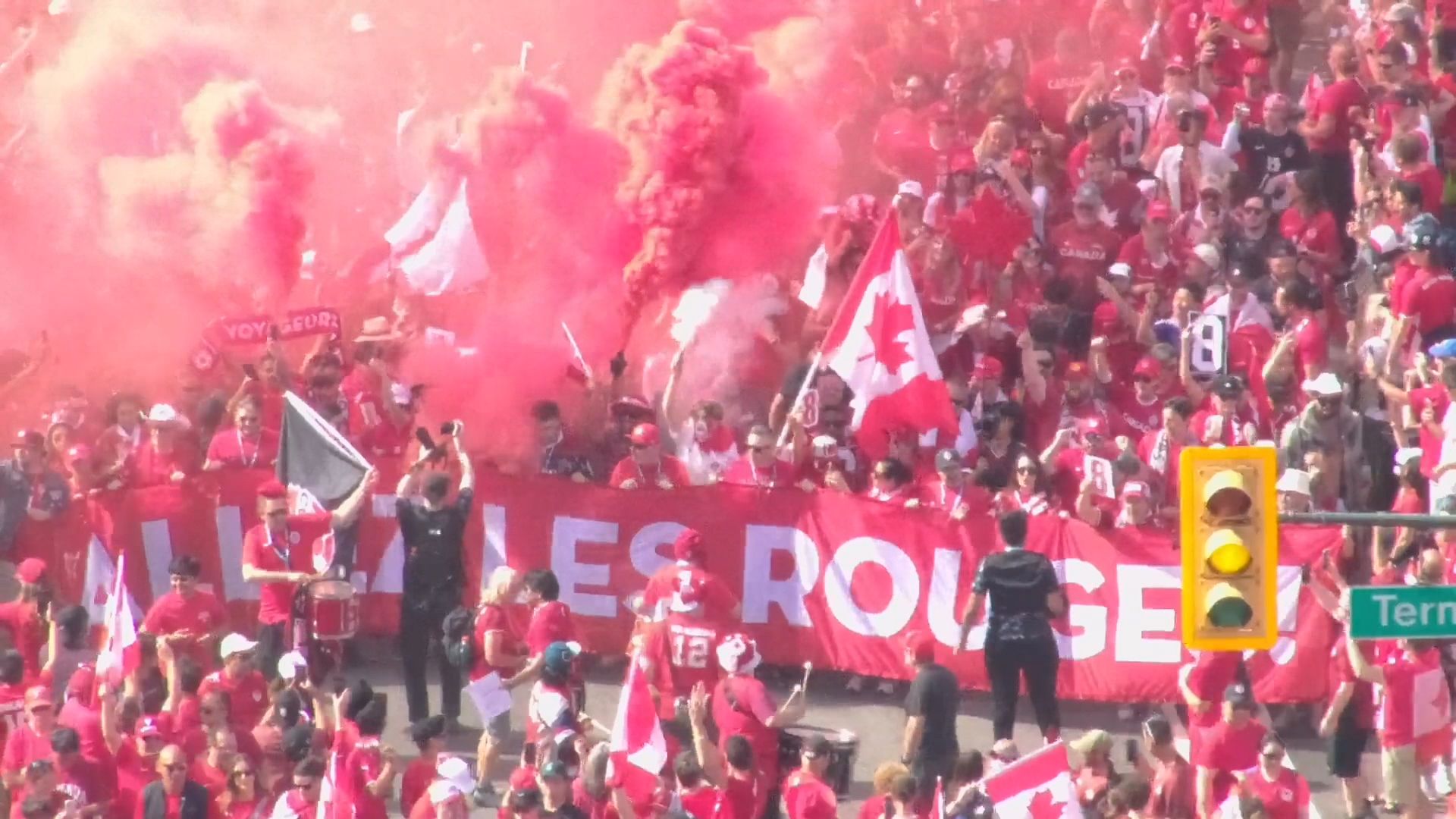
A sea of red and white: fans march to BC Place ahead of Canada–Switzerland
Vancouver turned red and white as thousands of soccer fans took to the “final mile” toward BC Place stadium, where on Wednesday afternoon the group-stage match of the World Cup between Canada and Switzerland was played. Fans from both teams, seemingly in sync, dressed in the national colors, creating a genuine festive stream through the streets. The mood was upbeat despite the rainy weather, as the hosts’ game became crucial in the group round.
Canada arrives at the match with high stakes. As reported by CityNews Vancouver, the team only needs not to lose — a draw or a win guarantees first place in the group. In that scenario, Canada would continue the fight on home turf, first in the Round of 32 and, if successful, also in the Round of 16, both in Vancouver. If Canada loses to Switzerland, it will have to travel to the United States for the knockout stage, where home-field advantage will be lost. For a team that has played the entire tournament on its home ground, losing that edge would be a major blow.
Recall that last week Canada thrashed Qatar 6–0, rallying around an injured Ismael Kone. The team’s main star is now back: Alphonso Davies, a former player of the Vancouver Whitecaps. He is expected to take the field, but to play a limited number of minutes to avoid risking his health. Davies has not appeared at this World Cup yet, and his return could be a key factor in the fight for first place.
For those who don’t follow the finer points of football, here’s the basics: the group stage is the tournament’s initial phase, when teams are divided into groups and play one match against each other. The group winners and the best second-place teams advance to the playoffs. In this case, the “Round of 32” (Round 32) is the first playoff stage where 32 teams compete. The “Round of 16” is the next stage. If Canada stays on the home stadium, it gets not only support from the stands, but also familiar playing conditions — and avoids the travel. A loss would mean losing all of that. The fans gathered outside BC Place clearly understand how big the moment is: their “red-and-white sea” has become a symbol of hope that the hosts can hold onto their advantage and continue their winning run in front of their home crowd.
BC Place Vancouver: why the stadium kept its name despite FIFA rules
When FIFA announced the temporary renaming of all 16 stadiums used at the 2026 World Cup, fans in Vancouver expected their arena to be called “Vancouver Stadium.” Instead, the stadium kept the name “BC Place Vancouver,” becoming the only exception to the general practice. As explained in a Daily Hive article, the reason lies in the absence of a sponsor name.
FIFA is very protective of its sponsorship contracts, so stadiums with commercial names — such as BMO Field in Toronto or Lumen Field in Seattle — were given neutral names: “Toronto Stadium” and “Seattle Stadium,” respectively. BC Place, named after the province of British Columbia, does not have a sponsor in its official name, so there is no conflict with FIFA’s partners, including Bank of America, which is the tournament’s official banking sponsor.
The full list of stadiums is as follows: “Atlanta Stadium” (Mercedes-Benz Stadium), “BC Place Vancouver” (BC Place), “Boston Stadium” (Gillette Stadium), “Dallas Stadium” (AT&T Stadium), “Guadalajara Stadium” (Estadio Akron), “Houston Stadium” (NRG Stadium), “Kansas City Stadium” (Arrowhead Stadium), “Los Angeles Stadium” (SoFi Stadium), “Mexico City Stadium” (Estadio Banorte), “Miami Stadium” (Hard Rock Stadium), “Monterrey Stadium” (Estadio BBVA), “New York New Jersey Stadium” (MetLife Stadium), “Philadelphia Stadium” (Lincoln Financial Field), “San Francisco Bay Area Stadium” (Levi’s Stadium), “Seattle Stadium” (Lumen Field), “Toronto Stadium” (BMO Field). As you can see, only the Vancouver arena kept an element of the original name.
It’s important to emphasize that, despite “Vancouver Stadium” not appearing on the official list, BC Place has already become a historic venue. Major sold-out matches have taken place there, and the Canada and Egypt national teams recorded their first-ever wins in men’s World Cups on that pitch. That gives the stadium a symbolic significance that goes beyond sponsor-name disputes.
FIFA’s decision shows just how deeply marketing agreements permeate modern football. Even temporary stadium names are subject to strict brand-protection rules. For Vancouver, this became a pleasant compromise: the local name remained — with the “Vancouver” clarification. As noted in Daily Hive, this is the only case where FIFA didn’t have to fully abandon the familiar name. For fans, there’s still reason to celebrate — without worrying about the contract details.